
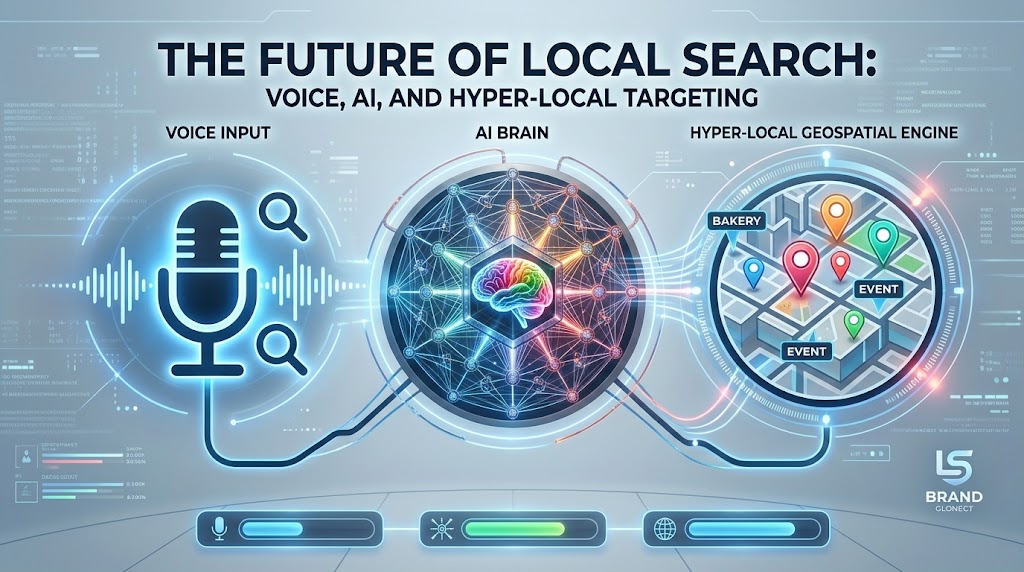
The local search landscape is undergoing its most radical transformation since Google replaced the yellow pages. For over fifteen years, local search engine optimization (SEO) followed a predictable playbook: claim your Google Business Profile (GBP), optimize for generic keywords like “plumber near me,” build local citations, and ask happy clients for 5-star reviews.
That playbook is rapidly losing its edge.
Today, three converging technologies are rewriting the rules of local discovery:
-
Generative AI is shifting search engines from link indexers to direct answer engines.
-
Conversational Voice Search is transforming short-tail keywords into multi-turn, long-tail dialogue.
-
Hyper-Local Targeting is shrinking geographic radii from entire cities down to neighborhood blocks, street intersections, and micro-geofences.
Consumers no longer want a list of ten websites to open, compare, and filter manually. They want precise, real-time, context-aware answers delivered instantly across smart displays, mobile assistants, and spatial audio devices.
If your business relies on local foot traffic, phone inquiries, or localized service delivery, adapting to this paradigm shift is no longer optional—it is a requisite for survival. In this guide, we break down the core mechanics driving the future of local search and outline the exact framework required to dominate your local market in the AI-first era.
1. The Death of “Near Me”: How Generative AI Is Redefining Discovery
Traditional local search operated on explicit query parameters. A user typed best coffee shop near me, and Google evaluated distance, prominence, and relevance to display a standard 3-Pack map result.
Generative Search Experience (SGE) and Large Language Model (LLM)-driven search engines (like Perplexity, ChatGPT Search, and Google Gemini) do not just match keywords—they synthesize multi-variable intent.
+-----------------------------------------------------------------------+
|                        THE PARADIGM SHIFT                             |
+-----------------------------------------------------------------------+
| TRADITIONAL LOCAL SEO                  AI-DRIVEN LOCAL DISCOVERY      |
|                                                                       |
| Simple Query:                         Conversational Query:           |
| "Italian restaurant downtown"          "Quiet Italian place downtown  |
|                                        with gluten-free pasta and     |
|                                        outdoor seating open past 9 PM" |
|        │                                        │                     |
|        ▼                                        ▼                     |
| Rank by: Distance + Star Count         Rank by: Entity Context +      |
|                                        Structured Data + Unstructured |
|                                        Sentiment & Menu Ingestion     |
+-----------------------------------------------------------------------+
The Transition from Keywords to Entities
AI engines do not view your business as a website with attached keywords; they view your business as a Knowledge Graph Entity. An entity is a distinct, well-defined real-world object or concept characterized by its attributes and relationships to other entities.
To evaluate whether your boutique gym fits an AI user’s request, the search engine synthesizes:
-
Structured data on your website (
Schema.org). -
Unstructured review text across third-party platforms (Yelp, Reddit, Tripadvisor, Google Reviews).
-
Real-time transactional feeds (inventory status, table reservation availability, booking schedules).
-
Visual recognition data from customer-uploaded photographs.
Key Takeaway: AI search engines do not just match words; they solve complex, constraint-heavy real-world problems. Your digital presence must convey deep contextual details, not just surface-level keywords.
Practical Implementation: Entity-First Optimization
To train AI models on what your business actually offers, move beyond static landing pages and enrich your structured data profile.
Pro Tip: Implement dynamic nested
Schema.orgmarkup on your website. Do not stop at basicLocalBusinessschema. Use specific subtypes such asMedicalBusiness,FinancialService, orFoodEstablishment, and explicitly define your offerings using thehasOfferCatalogproperty.
Example: Enhanced Entity Schema Breakdown
{
  "@context": "https://schema.org",
  "@type": "HVACBusiness",
  "name": "Apex Climate Solutions",
  "image": "https://example.com/assets/hero.jpg",
  "@id": "https://example.com/#organization",
  "url": "https://example.com",
  "telephone": "+15550192834",
  "priceRange": "$$",
  "address": {
    "@type": "PostalAddress",
    "streetAddress": "1044 Market Street",
    "addressLocality": "San Francisco",
    "addressRegion": "CA",
    "postalCode": "94102",
    "addressCountry": "US"
  },
  "geo": {
    "@type": "GeoCoordinates",
    "latitude": 37.7813,
    "longitude": -122.4093
  },
  "areaServed": [
    {
      "@type": "AdministrativeArea",
      "name": "SoMa, San Francisco"
    },
    {
      "@type": "AdministrativeArea",
      "name": "Union Square, San Francisco"
    }
  ],
  "knowsAbout": [
    "24/7 Emergency Heat Pump Repair",
    "Residential Ductless Mini-Split Installation",
    "Commercial HVAC Preventative Maintenance"
  ]
}
2. Conversational & Zero-Click Voice Search: Winning the “Single Answer” Game
Voice search has transitioned from a novel smartphone tool to an ubiquitous interface spanning ambient home speakers, connected vehicles, and wearable audio devices.
Unlike desktop or mobile search, where a user scans a visual SERP (Search Engine Results Page) containing multiple options, voice search is zero-sum. The voice assistant delivers a single definitive response. You are either the chosen answer, or you do not exist.
Desktop/Mobile SERP ──► Displays 10+ organic links & 3-Pack Map (Multiple Winners)
Voice Search SERP   ──► Delivers 1 Auditory Synthesis (Single Winner)
Conversational Query Syntax vs. Written Queries
Voice queries differ fundamentally from typed queries across three main vectors:
-
Length: Typed queries average 1.5 to 3 words (
mechanic Austin). Voice queries average 6 to 10+ words (Who is the best certified European auto mechanic near me open on Saturday morning?). -
Question Formats: Voice queries disproportionately use natural question triggers (Who, What, Where, When, How, Can I).
-
Implicit Context: Voice assistants rely heavily on device telemetry, such as exact GPS coordinates, user movement speed, and historical user preferences.
| Parameter | Typed Search | Voice Search |
| Average Query Length | 2.2 Words | 7.4 Words |
| Primary Format | Fragmanted Keywords | Complete Natural Sentences |
| Intent Profile | Research & Discovery | Immediate Action / Navigation |
| Output Type | Visual List (Multi-option) | Audio Answer (Single option) |
Optimizing for Conversational Zero-Click Results
To secure your position as the singular voice answer, structure your digital footprint to address long-tail conversational triggers directly.
Step 1: Target Long-Tail Conversational Questions
Transform standard web pages into conversational resource hubs. Use natural language headers ($H_2$ or $H_3$) structured precisely as users speak them.
Step 2: Implement the “BLUF” Writing Method
Apply the BLUF (Bottom Line Up Front) principle. Provide a direct, 25 to 40-word answer immediately following your question heading. Voice assistants parse this initial sentence block to read aloud. Follow the concise answer with expanded detail for human readers.
Step 3: Optimize for Schema Speakable Specification
Utilize SpeakableSpecification schema markup to inform search engines which precise sections of your web content are best suited for audio playback via smart devices.
Example:
Subheading ($H_3$): Can I get my commercial AC unit repaired on a Sunday in downtown Austin?
BLUF Answer (First 30 words): Yes. Apex Climate Solutions provides 24/7 emergency commercial AC repairs across downtown Austin every Sunday, featuring guaranteed 60-minute dispatch times for commercial properties.
3. Micro-Geofencing & Hyper-Local Targeting
In traditional SEO, targeting a city-level keyword (e.g., “Chicago Roofing Company”) was sufficient. In modern local search, algorithms evaluate location signals at the micro-level—down to specific neighborhoods, business districts, and ZIP codes.
Hyper-local targeting aligns your digital assets with the exact physical location of the user at the precise moment of intent.
       +-------------------------------------------------------+
       |             GEOGRAPHIC TARGETING GRANULARITY          |
       +-------------------------------------------------------+
       |                                                       |
       |  [ Regional / Metro Area ]  ──►  City-Wide Level      |
       |                                       │               |
       |                                       ▼               |
       |  [ Neighborhood / District ] ──► Sub-Locality Level   |
       |                                       │               |
       |                                       ▼               |
       |  [ Radius Geofence / Street ]──► Hyper-Local Micro    |
       |                                                       |
       +-------------------------------------------------------+
The Mechanism of Local Signal Triangulation
Search engines use a process called Signal Triangulation to determine whether your business is qualified to rank for a user standing on a specific street corner:
-
User Telemetry: GPS lat/long, Wi-Fi network connection data, cell tower triangulation.
-
Business Physical Proximity: Exact physical street address verified via GBP and municipal mapping databases.
-
Geographic Relevance Vectors: Geotagged imagery, localized landing pages, locally focused backlinks, and neighborhood-specific user sentiment.
Building Hyper-Local Content Architecture
Rather than creating generic city landing pages stuffed with repetitive text, build a location hub architecture that reflects genuine neighborhood-level authority.
                  ┌───────────────────────────────┐
                  │    /locations/chicago/        │
                  │   (City Master Hub Page)      │
                  └──────────────┬────────────────┘
                                 │
         ┌───────────────────────┼───────────────────────┐
         ▼                       ▼                       ▼
┌─────────────────┐     ┌─────────────────┐     ┌─────────────────┐
│ /chicago/loop/  │     │/chicago/lincoln-│     │/chicago/wicker- │
│ (Neighborhood)  │     │     park/       │     │     park/       │
└─────────────────┘     └─────────────────┘     └─────────────────┘
Blueprint for an Authoritative Neighborhood Landing Page:
-
Micro-Specific Title Tags: Target distinct district names, popular landmarks, and local transit stops rather than broad metro names.
-
Embedded Neighborhood Maps: Include dynamic maps centered on your service perimeter within that specific district.
-
Localized Case Studies: Feature real client projects, completed jobs, or deliveries tied explicitly to that neighborhood block (e.g., “Emergency Plumbing Service on Elm Street near Lincoln Park Zoo”).
-
Local Civic Connections: Highlight partnerships, sponsorships, or active involvement with neighborhood business associations and district chamber meetings.
Pro Tip: Avoid duplicating content across neighborhood landing pages. Every hyper-local page must contain 100% unique textual content, authentic project photographs, and distinct local client testimonials to avoid algorithmic duplicate content filters.
4. Building an AI-Proof Local Authority Stack
To maintain dominance as local search evolves, businesses must build an integrated digital framework. This framework relies on three distinct pillars: First-Party Data, Entity Association, and Unstructured Reputation Mining.
               ┌─────────────────────────────────────┐
               │    LOCAL AUTHORITY TRIAD STACK      │
               └──────────────────┬──────────────────┘
                                  │
         ┌────────────────────────┼────────────────────────┐
         ▼                        ▼                        ▼
┌─────────────────┐      ┌──────────────────┐     ┌─────────────────┐
│ 1. First-Party  │      │ 2. Unstructured  │     │ 3. Multi-Engine │
│ Data Engine     │      │ Sentiment Engine │     │ Entity Matrix   │
│ (Real-time CRM) │      │ (Review Ingest)  │     │ (Structured API)│
└─────────────────┘      └──────────────────┘     └─────────────────┘
Pillar 1: Build a First-Party Data Engine
Search platforms prioritize businesses that offer live operational clarity over static information. Connect your operational backend directly to public discovery points.
-
Real-Time Inventory Integration: Utilize feeds like Google’s Pointy or merchant product feeds so AI engines know your exact product availability on store shelves in real time.
-
Live Scheduling Hooks: Enable direct API integration between your booking software (e.g., Mindbody, OpenTable, ServiceTitan) and local search interfaces to facilitate zero-click bookings.
Pillar 2: Master Unstructured Sentiment Ingestion
AI discovery engines extract nuance from customer feedback rather than relying solely on raw star ratings.
Raw Review: "Great service, but parking was a nightmare near the back alley entrance."
                             │
                             ▼
              [ AI Entity Parsing Engine ]
                             │
       ┌─────────────────────┴─────────────────────┐
       ▼                                           ▼
Positive Sentiment Attribute:               Negative Sentiment Attribute:
[ + Efficient Service ]                     [ - Difficult Parking / Alley ]
To optimize for sentiment parsing:
-
Encourage Contextual Feedback: Prompt customers to mention specific services, staff names, product models, and physical surroundings in their reviews.
-
Respond with Semantic Richness: Craft responses that reinforce key services naturally.
-
Standard Response: “Thanks for the 5 stars, John!”
-
Optimized Response: “Thanks for the feedback, John! We’re thrilled our team could complete your ductless mini-split installation quickly in downtown Austin.“
-
Pillar 3: Multi-Engine Entity Synchronization
Google is no longer the sole discovery engine. AI models source business facts from an interconnected ecosystem.
-
Data Aggregator Consistency: Ensure your Name, Address, and Phone Number (NAP) details are identical across core ecosystem aggregators (Data Axle, Neustar Localeze, Foursquare).
-
Third-Party Platforms: Maintain updated entity details on Apple Maps (Apple Business Connect), Bing Places, Yelp, Tripadvisor, and niche directory platforms relevant to your sector.
5. Common Local Search Mistakes to Prevent
Transitioning to an AI and voice-first local strategy requires eliminating legacy SEO practices that undermine your search authority.
Mistake 1: Keyword Stuffing Business Names
Appending target keywords or location names onto your official business listing (e.g., Apex Plumbing – Best Emergency Plumber Downtown) violates platform guidelines and creates entity confusion for AI parsers. Keep your business name consistent with your official corporate registration across all touchpoints.
Mistake 2: Creating Low-Value “Doorway” Location Pages
Generating hundreds of programmatic landing pages targeting adjacent suburbs with identical, template-spun content dilutes website authority and risks penalties from search quality algorithms. Focus on building fewer, highly authoritative location pages packed with unique local evidence.
Mistake 3: Ignoring Negative Unstructured Review Sentiment
Ignoring recurring negative sentiment signals in customer reviews—such as long wait times, poor lighting, or missing parking guidance—damages your ranking for nuanced conversational queries. Address recurring customer feedback systematically to improve real-world operations and review sentiment.
Mistake 4: Treating Third-Party Profiles as “Set and Forget”
Leaving business profiles unmonitored leads to outdated operating hours, unanswered customer questions, and incorrect service menus. Treat your local business profiles as real-time customer communication hubs requiring regular updates.
Frequently Asked Questions
How will Generative AI impact traditional Google Maps 3-Pack rankings?
Generative AI will not replace local map interfaces overnight, but it sits directly on top of them. While traditional 3-Packs rely heavily on physical proximity, overall review count, and keyword relevance, AI search overlays filter these results based on intent parameters (e.g., “find a family-friendly restaurant with quiet booths”). Optimizing your entity for deep contextual attributes ensures your business remains visible in both traditional map results and AI-filtered answers.
What is the most effective way to optimize for voice search on Apple Siri and Amazon Alexa?
Apple Siri relies primarily on Apple Maps (Apple Business Connect) and Yelp data, whereas Amazon Alexa relies heavily on Bing Places, Yelp, and third-party data aggregators. To capture voice share across these devices:
-
Claim and fully optimize your business presence on Apple Business Connect and Bing Places.
-
Maintain active, well-reviewed profiles on Yelp.
-
Ensure structured
Schema.orgdata is properly formatted on your primary web assets.
Do I still need local citations and directory listings for AI-driven local search?
Yes, but their core purpose has evolved. Local citations are no longer just a ranking signal for link equity; they serve as validation points for AI entities. When an AI model processes information about your business, it cross-references data across independent directories to verify your business operational status, address accuracy, and category classifications.
How do search engines handle hyper-local searches for service-area businesses (SABs) without a physical storefront?
For service-area businesses without a public storefront (e.g., mobile locksmiths, electricians, plumbers), search engines evaluate your verified service area boundaries alongside localized signals. These signals include local customer reviews, geotagged project logs, neighborhood-specific landing pages, and locally relevant backlinks.
Conclusion: Preparing Your Local Strategy for What’s Next
The future of local search belongs to businesses that prioritize operational clarity, rich context, and seamless technical structure. As consumers shift from typed key phrases to natural conversational queries across smart devices and AI assistants, the competitive advantage shifts away from simple keyword placement toward authentic entity authority.
+-----------------------------------------------------------------------+
|                      ACTIONABLE LOCAL SEO ROADMAP                     |
+-----------------------------------------------------------------------+
|                                                                       |
|  [Step 1] AUDIT ENTITY DATA  ──► Standardize NAP across primary       |
|                                  aggregators and platforms.           |
|                                                                       |
|  [Step 2] IMPLEMENT SCHEMA   ──► Deploy nested LocalBusiness schema   |
|                                  with detailed service offerings.     |
|                                                                       |
|  [Step 3] STRUCTURE FOR VOICE──► Create FAQ hubs using BLUF answers   |
|                                  for long-tail questions.             |
|                                                                       |
|  [Step 4] EXPAND HYPER-LOCAL ──► Build distinct location pages with   |
|                                  authentic neighborhood evidence.     |
|                                                                       |
+-----------------------------------------------------------------------+
Take Action Today
Begin by conducting an entity-first audit of your business. Standardize your core business information across digital touchpoints, update your website with comprehensive structured schema, and refine your content to answer natural, conversational questions directly.
By laying this groundwork today, you ensure your business remains visible, authoritative, and easily accessible to local customers—no matter how they choose to search.

I’m Md Nasir Uddin, a digital marketing consultant with over 9 years of experience helping businesses grow through strategic and data-driven marketing. As the founder of Macroter, my goal is to provide businesses with innovative solutions that lead to measurable results. Therefore, I’m passionate about staying ahead of industry trends and helping businesses thrive in the digital landscape. Let’s work together to take your marketing efforts to the next level.