
Every media buyer, business founder, and growth marketer eventually reaches the same high-stakes crossroad: You have a fixed advertising budget, but where should you deploy it for maximum return on investment?
Should you allocate your capital to Google Ads, where active searchers are actively hunting for immediate solutions? Or should you pour it into Meta Ads (Facebook & Instagram), where visually magnetic ad creative can disrupt passive scrollers and manufacture desire out of thin air?
Making the wrong choice isn’t just a minor operational hiccup—it burns capital, skews customer acquisition costs (CAC), and stagnates growth. In an ad ecosystem defined by machine-learning models, automated campaign types (like Performance Max and Advantage+ Shopping), and shifting privacy paradigms, relying on outdated advice is an expensive mistake.
This master guide dismantles the “Google vs. Meta” debate with concrete performance benchmarks, clear structural comparisons, real-world scenarios, and practical budget allocation frameworks.
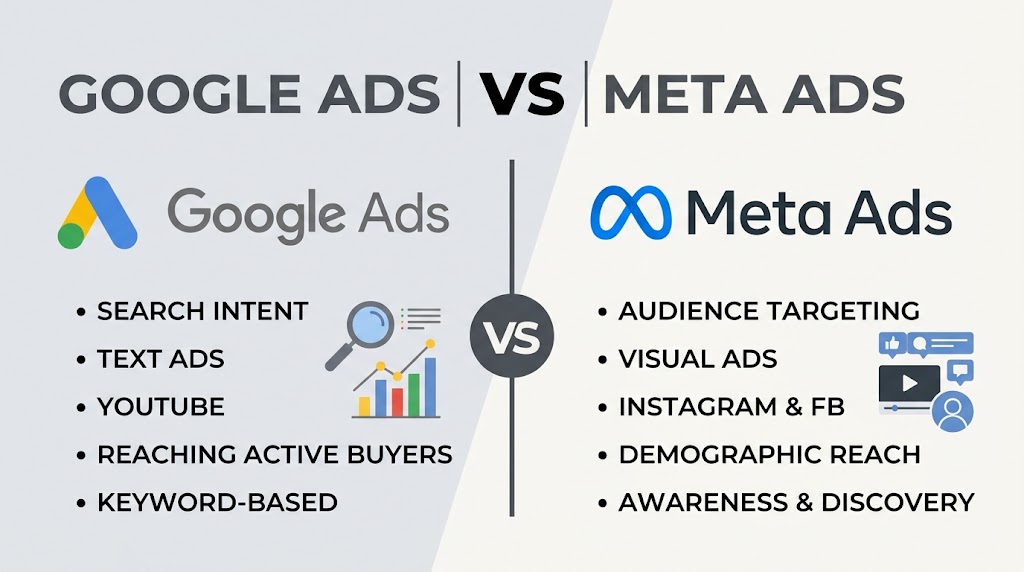
1. The Core Architecture: Active Demand vs. Passive Discovery
To build an efficient media-buying strategy, you must understand the fundamental difference in buyer behavior on each platform.
  GOOGLE ADS: DEMAND CAPTURE (Pull Strategy)
  [User Intent: "I need a solution right now"]
           └─► Search Query ──► High Intent Click ──► Conversion

  META ADS: DEMAND CREATION (Push Strategy)
  [User State: "I am scrolling my feed"]
           └─► Visual Creative ──► Manufactured Desire ──► Conversion
Google Ads: Capturing Active Intent
Google Ads operates primarily as a demand-capture engine. When a user opens Google and types "emergency plumber near me" or "best enterprise SEO software," they possess high commercial intent. They are actively searching for an immediate answer, product, or service.
You are paying for the privilege of placing your solution directly at the exact moment of commercial consideration.
Meta Ads: Manufacturing New Demand
Meta Ads (Facebook, Instagram, Messenger, and Audience Network) operates as a demand-generation engine. People do not log into Instagram to purchase software or book a plumber; they log in for entertainment, social validation, and content discovery.
Your ads interrupt their feed. To convert a passive scroller into a paying customer, your visual creative, hook, and offer must instantly capture attention and spark desire for a solution they weren’t actively seeking.
Key Takeaway: Google captures existing demand at the bottom of the sales funnel, while Meta builds and nurtures demand at the top and middle of the funnel.
2. Benchmark Comparison: Metrics, Costs, and Efficiency
When deciding where to spend your budget, raw metrics like Cost Per Click (CPC), Click-Through Rate (CTR), and Conversion Rate (CVR) tell a compelling story about platform economics.
Metric Breakdown Across Platforms
| Benchmark Metric | Google Search Ads (Median) | Meta Ads (Median) |
| Primary Mechanism | Keyword Search & Intent Capture | Visual Feeds & Interest/Lookalikes |
| Average Cost Per Click (CPC) | $1.50 – $5.50+ (Industry Varies) | $0.50 – $2.50 (Traffic/Feed) |
| Average Conversion Rate (CVR) | 3.5% – 8.5% (High Intent) | 1.0% – 3.0% (Cold Audience) |
| Primary Conversion Driver | Text Copy, Keyword Match, Landing Page | Creative Refresh, Video Hooks, Visuals |
| Algorithmic Focus | Performance Max & AI Max for Search | Advantage+ Shopping & Broad Targeting |
Example: A corporate law firm bidding on
"commercial litigation attorney"on Google Search might pay $45.00 per click, but that single click has a high probability of converting into a high-value retainer client. Conversely, an e-commerce brand selling $60 ergonomic desk chairs on Meta might pay $0.80 per click, requiring a higher volume of traffic to yield conversions given the lower intent.
3. Deep Dive: Google Ads Strengths, Weaknesses, and Best Use Cases
Strengths
-
Unrivaled Commercial Intent: You reach buyers who have their credit cards in hand, drastically shortening sales cycles.
-
Multi-Channel Ecosystem: Through Performance Max and Search, your budget touches Google Search, YouTube, Gmail, Maps, and Display networks simultaneously.
-
High Conversion Rates: Because you are fulfilling active intent, conversion rates on Google Search typically outpace social channels.
Weaknesses
-
Higher CPCs: Competitive keywords carry substantial costs, which can rapidly drain modest testing budgets.
-
Search Volume Constraints: You cannot force people to search for your product. If you offer an entirely new invention, search volume will be minimal.
PRO TIP: GOOGLE BIDDING ARCHITECTURE
When running Google Search campaigns for established service categories, avoid
starting directly with "Maximize Conversions" without historical account data.
Begin with "Enhanced CPC" or "Manual CPC" to establish clean baseline data,
then transition to Smart Bidding (Target CPA / Target ROAS) once you reach
at least 30–50 verified conversions per month.
4. Deep Dive: Meta Ads Strengths, Weaknesses, and Best Use Cases
Strengths
-
Unmatched Visual Storytelling: Ideal for products that rely on aesthetics, demonstration videos, or emotional transformation (fashion, beauty, fitness, D2C).
-
Creative as Targeting: Advanced AI modeling scans ad creative elements (hook, messaging, visual cues) to find ideal buyers automatically without needing complex audience slicing.
-
Cost-Effective Top-of-Funnel Reach: Low CPMs allow you to introduce new concepts to tens of thousands of potential buyers at a fraction of Google’s cost.
Weaknesses
-
Creative Fatigue: Meta campaigns require continuous creative iteration. Static images and videos can lose effectiveness within 2–4 weeks.
-
Attribution Friction: Multi-touch journeys and privacy updates make in-platform reporting on Meta prone to view-through inflation.
PRO TIP: CREATIVE TESTING FRAMEWORK FOR META
Structure your creative strategy using the 3x3 Dynamic Creative Rule:
• 3 Distinct Video Hooks (0–3 seconds) addressing different pain points
• 3 Primary Body Creatives (Product Demo, UGC testimonial, Unboxing)
• 3 Distinct Offers / CTAs ("Get 15% Off", "Try Risk-Free", "Claim Free Gift")
Combine these into dynamic creative sets to let Meta's algorithm find the winning mix.
5. Budget Allocation Frameworks: How to Divide Your Capital
Instead of treating this as an “either/or” decision, successful growth strategies rely on allocating capital based on business maturity, category awareness, and available budget.
STAGE 1: EARLY GROWTH (< $3,000 / month)
┌───────────────────────────────────────────────────────────┐
│ Focus on ONE core platform based on category intent:      │
│ • Established intent? ──► 100% Google Search              │
│ • Visual/New concept? ──► 100% Meta Advantage+            │
└───────────────────────────────────────────────────────────┘

STAGE 2: SCALING PHASE ($5,000 – $20,000 / month)
┌───────────────────────────────────────────────────────────┐
│ 60% Core Demand Driver   ──► (Meta or Google)             │
│ 30% Intent Capture / Retargeting                          │
│ 10% Experimental Media   ──► (YouTube / Demand Gen)       │
└───────────────────────────────────────────────────────────┘
Scenario A: Local Services & B2B Solutions
-
Recommended Split: 70% Google Ads | 30% Meta Ads
-
Strategy: Allocate the bulk of the budget to Google Search keywords for high-intent search terms. Use Meta primarily for video retargeting and customer list re-engagement to stay top-of-mind.
Scenario B: D2C E-Commerce & Consumer Brands
-
Recommended Split: 60% Meta Ads | 40% Google Ads
-
Strategy: Drive product discovery, social proof, and impulses via Meta Advantage+ Shopping Campaigns. Capture high-intent shoppers searching for your brand name or category keywords via Google Shopping and Performance Max.
6. Common Pitfalls to Avoid
1. Evaluating Platforms in Silos
Looking at in-platform ROAS reported by Google and Meta independently often leads to double-counting. A customer often sees a Meta ad, searches for the brand on Google, and converts. Track your overall Marketing Efficiency Ratio (MER)—Total Revenue divided by Total Ad Spend across all channels.
2. Spreading Small Budgets Too Thin
Splitting a modest $1,000/month budget evenly between both platforms prevents either algorithmic learning engine from exiting the learning phase. Focus on one primary channel until you reach predictable CPA and profitability before diversifying.
3. Ignoring Ad Creative Fatigue on Meta
Running a single image or video ad on Meta for months will cause CPMs to spike and performance to degrade. Refresh your creative assets regularly to maintain efficiency.
Frequently Asked Questions (FAQ)
Is Meta Ads or Google Ads cheaper for lead generation?
Meta Ads generally yields a lower Cost Per Lead (CPL) due to native lead forms and lower CPMs. However, Google Ads often produces higher-quality, higher-intent leads that close at a higher rate. Calculate your final Cost Per Acquired Customer (CAC) rather than relying solely on CPL.
Should I trust in-platform reported ROAS?
No. Both Google and Meta claim credit for conversions where they played a role in the buyer’s touchpoint journey, leading to overlapped performance figures. Rely on blended metrics like MER (Total Revenue / Total Ad Spend) alongside UTM tracking to measure holistic impact.
Can a small budget ($500–$1,000/mo) work on both platforms simultaneously?
It is generally better to pick one primary platform initially. If your product requires visual discovery or impulse purchases, spend the full budget on Meta. If you offer a service or established product category that people actively search for, dedicate the budget entirely to Google Search.

I’m Md Nasir Uddin, a digital marketing consultant with over 9 years of experience helping businesses grow through strategic and data-driven marketing. As the founder of Macroter, my goal is to provide businesses with innovative solutions that lead to measurable results. Therefore, I’m passionate about staying ahead of industry trends and helping businesses thrive in the digital landscape. Let’s work together to take your marketing efforts to the next level.