
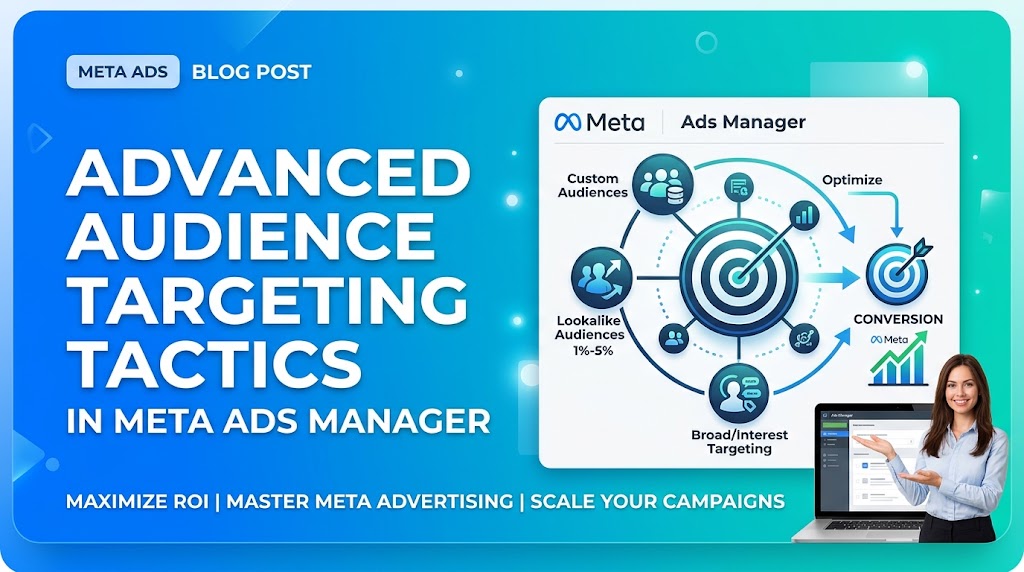
The landscape of paid social advertising has shifted dramatically. The era of selecting a handful of basic demographic parameters, layering five interest tags, and watching high-yield conversions roll in is officially over. Today, ad costs are rising, user privacy frameworks (from Apple’s ATT to global cookie deprecation) have altered tracking capabilities, and Meta’s machine learning algorithms have become vastly more intelligent—and hungry for the right data signals.
Media buyers who rely on basic broad targeting or outdated interest stacks often watch their Cost Per Acquisition (CPA) skyrocket while Return on Ad Spend (ROAS) plummets.
To achieve predictable, high-ROI performance in modern media buying, you must move beyond standard audience setups. You need advanced audience targeting tactics that leverage first-party data, custom event signals, strategic segmentation, and algorithmic nudging.
This comprehensive guide breaks down step-by-step strategies to refine your audience architecture in Meta Ads Manager, lower your acquisition costs, and scale your campaigns profitably.
1. Moving Beyond Basic Interest Targeting
Traditional interest targeting relies on third-party data inferences—predicting what a user might like based on pages clicked or content viewed. In modern media buying, relying exclusively on interest groups like “Shopping” or “Fitness” often places your ads in overcrowded, expensive bidding pools.
+-----------------------------------------------------------------------+
|                       THE AUDIENCE TIER MATRIX                        |
|                                                                       |
|   [Tier 1: High Intent]  ==> First-Party Custom Audiences (LTV, Recency)|
|   [Tier 2: Algorithmic]  ==> Value-Based Lookalikes & Advantage+ Signals |
|   [Tier 3: Discovery]    ==> Layered Broad + Creative-Led Segmentation   |
+-----------------------------------------------------------------------+
The Downside of Interest Stacking
When you stack multiple interests in a single ad set using OR logic (e.g., targeting people interested in Nike OR Adidas OR Puma), you create a massive, diluted audience pool where Meta’s algorithm struggles to isolate winning sub-segments efficiently. Conversely, using overly restrictive AND logic can shrink your audience too much, causing your CPMs (Cost Per Thousand Impressions) to surge due to low auction liquidity.
High-ROI Alternative: Strategic Interest Layering & Exclusions
Instead of stacking broad terms, structure your interest targeting around high-affinity indicators and strict exclusions.
-
Target Niche Brands over Generic Keywords: Rather than targeting “Coffee,” target specific specialty coffee grinder manufacturers or niche roast brands.
-
Layer with Purchasing Intent: Combine niche interests with behavioral indicators such as Engaged Shoppers.
-
Apply Systematic Exclusions: Always exclude recent purchasers (e.g., last 30 to 90 days) and active customer lists to prevent wasting budget on users who have already converted.
Key Takeaway: Stop competing in broad, crowded interest pools. Target high-affinity, brand-specific indicators and strictly exclude existing customers to preserve margin and maximize spend efficiency.
2. Advanced First-Party Data & Custom Audience Strategies
Your first-party data is your most defensible asset in Meta Ads Manager. Because native tracking pixels face signal loss from browser restrictions and opt-outs, feeding high-quality server-side data through Meta’s Conversions API (CAPI) is critical for effective audience creation.
                     +---------------------------+
                     | High-Value First-Party    |
                     | Customer Data (CAPI/CRM)  |
                     +-------------+-------------+
                                   |
            +----------------------+----------------------+
            |                                             |
            v                                             v
+-----------------------+                     +-----------------------+
|  RFM Segmentation     |                     | Engagement Thresholds |
| (Recency, Frequency,  |                     | (Top 25% Time Spent,  |
|  Monetary Value)      |                     |  Multi-Video Views)   |
+-----------+-----------+                     +-----------+-----------+
            |                                             |
            +----------------------+----------------------+
                                   |
                                   v
                     +---------------------------+
                     | High-Intent Seed Pool for |
                     | Value-Based Lookalikes    |
                     +---------------------------+
1. RFM-Segmented Customer Match Lists
Uploading a generic, unsorted list of all past email subscribers treats a one-time buyer of a $10 item the same as a VIP who spends $1,000 annually. Instead, segment your customer list using an RFM (Recency, Frequency, Monetary) framework before uploading it to Meta.
-
Top 10% Lifetime Value (LTV) Buyers: Export a list of your top spenders over the past 365 days.
-
High-Frequency Repeat Buyers: Export users with 3+ purchases in the past 180 days.
-
Recent Churn Candidates: Export users who haven’t purchased in 120 days but historically had high engagement.
2. High-Intent Engagement & Time-Spent Audiences
Instead of targeting everyone who visited your website in the last 30 days, filter for quality signals:
-
Top 25% Time Spent on Site: Create Custom Audiences based on user engagement depth rather than single-page bounces.
-
Specific High-Intent URLs: Target users who visited high-value pages (e.g., pricing tables, checkout steps, or specific category landing pages) but did not complete the purchase event within the last 7 to 14 days.
-
Multi-Video View Engagement: Target users who watched at least 50% or 75% of your product demonstration videos across Instagram and Facebook in the last 30 days.
   [ All Website Visitors (Low Signal) ]
                    │
                    ▼
     [ Top 25% Time Spent (Mid Signal) ]
                    │
                    ▼
[ Visited Checkout + 50%+ Video View (High Signal) ]
Pro Tip: Ensure your Event Match Quality (EMQ) score in Meta Events Manager is rated “Good” or “Great” (typically 7.0+ out of 10). Always include hashed identifiers like email, phone number, city, zip code, and external ID when sending custom audience payloads via CAPI to maximize match rates.
3. High-Value Lookalike Audience (LAL) Engineering
Lookalike Audiences remain a core lever for cold prospecting when engineered with precise seed data. The primary reason Lookalikes fail for media buyers is poor seed list selection. If you feed the algorithm average inputs, it will deliver average results.
+---------------------------------------------------------------------------+
|                          LOOKALIKE PIPELINE                               |
|                                                                           |
|   [ CRM Raw Data ] ──► [ Filter: Top 10% LTV ] ──► [ Value Custom Audience ]|
|                                                                 │         |
|                                                                 ▼         |
|   [ Scaled Prospecting ] ◄── [ Test 1%-3% LAL ] ◄── [ Meta Algorithm Seed ]|
+---------------------------------------------------------------------------+
Building Value-Based Lookalikes
Instead of creating a Lookalike from a standard “Purchase” pixel event, build a Value-Based Custom Audience using exact monetary values assigned to individual customers.
-
Navigate to Audiences in Meta Ads Manager.
-
Select Create Audience $\rightarrow$ Custom Audience $\rightarrow$ Customer List.
-
Include a column for Customer Value (LTV) in your CSV upload.
-
Once created, select this value list as the seed source for your Lookalike Audience.
Meta’s algorithm will analyze the shared traits of your highest-value customers rather than just finding users who resemble any low-ticket buyer.
Dynamic Lookalike Stacking (1% to 10%)
Rather than running individual 1%, 2%, or 5% lookalike ad sets that compete against each other in auctions, test Lookalike Stacking for dynamic scaling:
| Audience Type | Tier / Range | Best Used For | Strategic Approach |
| Value-Based LAL | 1% – 2% | Precision Prospecting | Pair with core offer creative for fast validation |
| Stacked LAL | 1% – 5% Consolidated | Scale & Efficiency | Reduces auction overlap while maintaining target quality |
| Broad LAL | 5% – 10% | Mass Reach + Advantage+ | Gives machine learning flexibility while maintaining a baseline persona signal |
Example: A direct-to-consumer skincare brand segmenting its past purchasers found that a 1% Lookalike built from all buyers yielded a 1.8x ROAS. When they switched the seed list to only customers with a Repeat Purchase Count $\ge 3$ and spending $>\$200$, the resulting 1% Value-Based Lookalike achieved a 3.1x ROAS at the same spend volume.
4. Advantage+ Audience & Algorithmic Targeting Control
Meta’s Advantage+ Audience technology completely changed audience targeting logic. Instead of hard-locking your ad sets to static parameters, Advantage+ treats your specified inputs (demographics, interests, lookalikes) merely as Targeting Suggestions.
+---------------------------------------------------------------------------+
|                        ADVANTAGE+ AUDIENCE FLOW                           |
|                                                                           |
|  [ Your Suggested Signals ]                                                |
|  (Interests / Lookalikes) ────┐                                           |
|                               │                                           |
|  [ Creative Hooks / Messaging ] ───► [ Meta AI Engine ] ──► [ Dynamic Out- |
|                               │                             of-Bound Scale]|
|  [ First-Party Pixel Data ] ──┘                                           |
+---------------------------------------------------------------------------+
How Advantage+ Audience Works
When you provide suggestions, Meta starts by serving ads to people matching those parameters. However, if the algorithm detects cheaper, higher-converting opportunities outside those suggestions, it will dynamically expand targeting to find conversions beyond your specified parameters.
                    ┌─────────────────────────┐
                    │ Meta AI Optimization    │
                    └────────────┬────────────┘
                                 │
                 ┌───────────────┴───────────────┐
                 ▼                               ▼
   ┌───────────────────────────┐   ┌───────────────────────────┐
   │ Core Suggestion Boundary  │   │ Expanded Audience Pool    │
   │ (Interests / Lookalikes)  │   │ (Dynamic Conversion Search│
   └───────────────────────────┘   └───────────────────────────┘
Controlling Advantage+ Without Over-Restricting
While machine learning performs well with broad parameters, media buyers still need guardrails to protect brand alignment and budget efficiency:
-
Use Advantage+ Controls for Hard Constraints: If your product is legally restricted by age or only available in specific regions, define those in Advantage+ Controls (not just suggestions). Controls act as strict, unbroken boundaries.
-
Targeting Suggestions for Nuanced Signals: Feed high-performing Lookalikes (e.g., Top 5% LTV) or tight interest pairs into the Suggestion field. This gives Meta a qualified starting direction while keeping customer acquisition costs low as budget scales.
-
Creative-Led Audience Segmentation: When using Advantage+ with minimal targeting constraints, your creative assets act as your primary targeting filter. The messaging, hooks, and visual context of your ad will naturally self-select the right target audience.
5. Creative-Led Audience Segmentation
As Meta’s platform trends toward broad audience structures, modern audience targeting relies as much on ad creative strategy as it does on explicit demographic or interest toggles.
+-----------------------------------------------------------------------+
|                    CREATIVE-LED TARGETING ENGINE                      |
|                                                                       |
|   Ad Angle A (Enterprise B2B Hook)   ──► Pulls Decision Makers        |
|   Ad Angle B (Budget/SMB Hook)        ──► Pulls Freelancers / Startups|
|   Ad Angle C (Technical Spec Hook)   ──► Pulls Engineers / Developers |
+-----------------------------------------------------------------------+
Using Creative Hooks as Audience Filters
The system reads the visual elements, text overlays, transcription audio, and post text of your ads. It then serves those ads to users whose behavior indicates an interest in those specific elements.
-
Visual Hooks: A video starting with an office setup instantly filters for corporate professionals.
-
Copywriting Angles: Lead copy stating, “Designed specifically for agency owners managing over $50k/mo in ad spend” instantly deters unqualified users while capturing high-value prospects.
-
Pain-Point Specific Messaging: Varying ad angles allows you to speak to distinct buyer personas within a single broad audience ad set.
Campaign Architecture: Structuring Broad vs. Segmented Ad Sets
+---------------------------------------------------------------------------+
|                        SCALED CAMPAIGN STRUCTURE                          |
|                                                                           |
|  [ CBO Campaign: Scaling Engine ]                                         |
|    ├── Ad Set 1: Broad Targeting (Creative-Led Segmentation via Angles A/B/C)|
|    ├── Ad Set 2: High-Value Stack (Top 10% LTV Lookalikes + Suggestions)  |
|    └── Ad Set 3: Retargeting Engine (Engaged Users + Exclusion Filters)   |
+---------------------------------------------------------------------------+
To prevent internal auction competition, structure your Meta campaign using a clear, non-overlapping hierarchy:
-
Prospecting Layer (Broad/Advantage+): Target wide demographics without restrictive interests. Rely on distinct ad creative angles to segment buyers dynamically.
-
High-Intent Testing Layer (Custom Signals): Target Value-Based Lookalikes and stacked high-affinity interests using Advantage+ Suggestions to validate new offers.
-
Retargeting Layer (First-Party Retention): Target 7-day to 30-day website engagers and video viewers with specific bottom-of-funnel offers, testimonial ads, or objection-handling content.
6. Common Pitfalls to Avoid
Even seasoned media buyers fall into costly structural traps when configuring Meta Ads Manager. Avoid these common mistakes:
1. High Auction Overlap
Running multiple ad sets in the same account targeting similar interests or Lookalike percentages causes your ad sets to compete against each other in Meta’s internal auction. This artificial competition drives up your CPMs and burns budget needlessly.
Fix: Use the Inspect Tool in Meta Ads Manager to monitor Auction Overlap. If overlap exceeds 20%, combine those ad sets into a single consolidated audience or implement strict negative exclusions.
2. Audience Saturation & Frequency Creep
When targeting smaller Custom Audiences or hyper-niche interest lists, monitor your ad set Frequency closely. If your ad frequency climbs above 3.5–4.0 within a 7-day window without a proportional rise in conversions, your audience is experiencing ad fatigue.
Fix: Expand your lookalike percentages, broaden your demographic parameters, or refresh your visual creative to reset the audience decay curve.
3. Neglecting Retargeting Exclusions
Failing to exclude recent purchasers or active leads from your prospecting campaigns leads to negative customer experiences, inflated metrics, and wasted ad spend.
Fix: Maintain standard exclusion lists across all prospecting ad sets:
Exclude: All Purchasers (Last 180 Days)
Exclude: Active Leads / Customer List CSV
Exclude: Pixel Event - Purchase (Last 30-90 Days)
7. Frequently Asked Questions (FAQs)
What is the ideal audience size for Meta Ads targeting in 2026?
For cold prospecting ad sets, an ideal broad audience size typically ranges between 2 million and 10 million+ users (depending on your geographic constraints). Broad or Advantage+ audiences work best when given large pools of data to find conversion signals efficiently.
Should I still use manual interest targeting or switch fully to Advantage+ Audience?
Manual interest targeting is still useful for testing new niche products, validating immediate market hooks, or working with smaller initial budgets. However, for scaling accounts, testing Advantage+ Audience with Targeting Suggestions generally delivers lower long-term CPAs by allowing Meta’s algorithm to hunt for conversions outside strict interest borders.
How big should my customer seed list be to create a Value-Based Lookalike Audience?
Meta requires a minimum of 100 high-quality records from the same country for seed lists, but for optimal machine-learning accuracy, aim for a clean seed list containing 1,000 to 5,000+ unique customer entries with complete identifier details (email, phone number, address, and purchase value).
Conclusion: Elevating Your Media Buying Strategy
Achieving high ROI on Meta Ads Manager is no longer about finding a single “hidden” interest setting. True performance relies on building a robust data pipeline, creating clean audience structures, and letting advanced algorithms execute within clear strategic guardrails.

I’m Md Nasir Uddin, a digital marketing consultant with over 9 years of experience helping businesses grow through strategic and data-driven marketing. As the founder of Macroter, my goal is to provide businesses with innovative solutions that lead to measurable results. Therefore, I’m passionate about staying ahead of industry trends and helping businesses thrive in the digital landscape. Let’s work together to take your marketing efforts to the next level.