
Digital advertising is undergoing its most radical transformation in over two decades. The gradual decay of third-party tracking cookies, heightened user privacy regulations (GDPR, CCPA, CPRA), and Apple’s App Tracking Transparency (ATT) framework have effectively shattered traditional retargeting and attribution models.
For years, media buyers and performance marketers relied heavily on third-party pixel tracking to track user behavior across the web, build granular lookalike audiences, and optimize bidding algorithms. Today, those third-party signals are degraded, incomplete, or outright blocked. The result? Skyrocketing Customer Acquisition Costs (CAC), shrinking retargeting pools, and imprecise multi-touch attribution.
However, top-performing advertisers aren’t burning their budgets—they are pivoting to first-party data.
First-party data is information collected directly from your audience through interactions across your owned digital properties. Because it is explicit, consent-based, and immune to third-party cookie blocking, it represents the single most valuable asset in modern media buying.
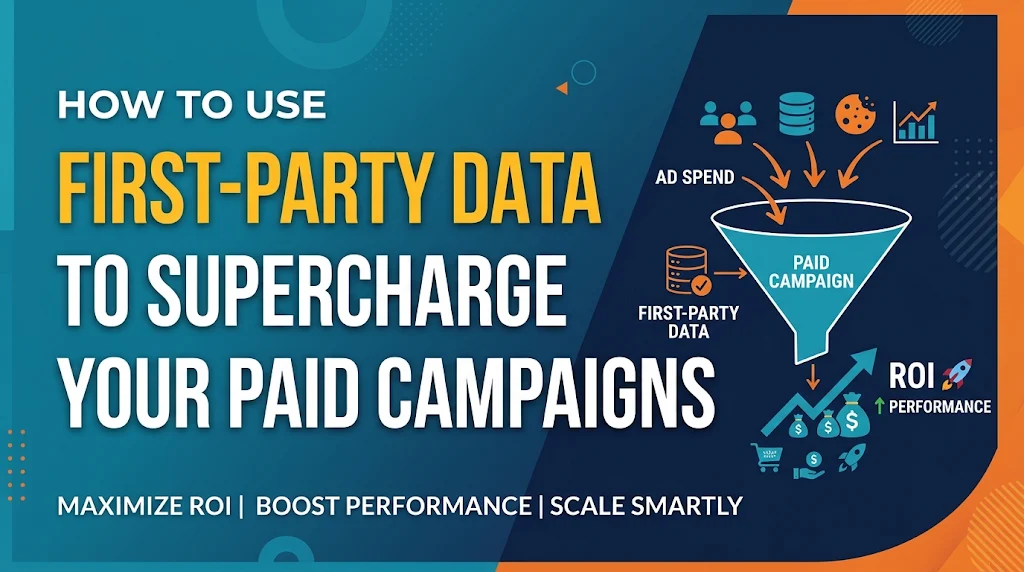
This comprehensive guide breaks down how to transform your raw customer data into actionable paid media strategies that lower CAC, boost Customer Lifetime Value (LTV), and scale your ROAS (Return on Ad Spend).
What Is First-Party Data (And Why Is It the Ultimate Growth Lever)?
Before implementing advanced targeting tactics, it is crucial to understand where first-party data fits into the modern data taxonomy.
       +-------------------------------------------------------------+
       |                     DATA TAXONOMY MAP                       |
       +-------------------------------------------------------------+
       | TYPE             | SOURCE                 | ACCURACY & VALUE|
       +------------------+------------------------+-----------------+
       | First-Party Data | Direct Customer        | Highest         |
       |                  | Interactions           | (Consensual)    |
       +------------------+------------------------+-----------------+
       | Second-Party Data| Partner's First-Party  | Moderate-High   |
       |                  | Data Shared Directly   | (Vetted)        |
       +------------------+------------------------+-----------------+
       | Third-Party Data | Aggregated & Sold by   | Lowest          |
       |                  | Data Brokers           | (Degraded)      |
       +------------------+------------------------+-----------------+
The Data Spectrum Defined
-
First-Party Data: Information gathered directly from your audience via website interactions, CRM software, mobile app activity, email subscriptions, transaction histories, and customer feedback.
-
Second-Party Data: Another company’s first-party data shared directly with you through a strategic partnership or co-marketing agreement.
-
Third-Party Data: Information aggregated from external data brokers who have no direct relationship with the user. This data is rapidly losing accuracy and coverage.
Why First-Party Data Outperforms All Other Signal Sources
Key Takeaway: First-party data delivers superior performance because it reflects actual brand affinity, verified purchase intent, and real transactional history—not inferred third-party assumptions.
-
Data Integrity and Accuracy: Collected directly at the source, eliminating proxy errors and stale profile data.
-
Privacy Compliance by Design: Built on explicit consent (opt-ins, form submissions, purchases), reducing compliance liability under evolving global privacy laws.
-
Cost Efficiency: You already own this data. Leveraging your existing customer intelligence costs a fraction of buying third-party segments.
-
Algorithmic Advantage: Modern ad platforms (Google Ads, Meta Ads, TikTok Ads) rely on Machine Learning algorithms. Feeding ad engines high-quality first-party signals trains their models to find your ideal customers faster.
4 Strategic Pillars for Collecting High-Quality First-Party Data
You cannot activate what you haven’t collected. To build a robust data ecosystem for media buying, you must systematically capture value-driven inputs at every customer touchpoint.
  [ Website & App Analytics ] ───┐
  [ CRM & ERP Systems       ] ───┼──> [ Customer Data Platform ] ──> [ Paid Media Engines ]
  [ Lead Captures & Quizzes ] ───┤          (CDP / CAPI)                (Meta, Google, TikTok)
  [ Offline Conversions     ] ───┘
Pillar 1: High-Value Value Exchanges (Lead Generation)
Users do not share their contact details without a compelling reason. Offer tangible value in exchange for lead submission:
-
Interactive Tools: Calculators, assessment quizzes, configurators, or free audits.
-
Gated Premium Assets: Original benchmark reports, templates, whitepapers, or exclusive webinars.
-
Incentivized Commerce Touchpoints: First-order discounts, early access to sales, or loyalty program enrollment.
Pillar 2: Server-Side Tracking & Conversions API (CAPI)
Client-side browser tracking (JavaScript tags) fails to record up to 30% of user conversions due to ad blockers, network dropouts, and browser restrictions (such as Safari ITP).
-
Implement Meta Conversions API (CAPI), Google Ads Server-Side Tracking, and TikTok API for Ads.
-
Server-side integrations transmit conversion events directly from your server to the ad platform’s server, bypassing browser restrictions entirely.
Pro Tip: Match quality scores matter. When sending server-side events, pass multiple hashed user parameters—such as hashed email (
em), phone number (ph), first/last name, city, state, zip code, and external ID—to maximize match rates on ad networks.
Pillar 3: Zero-Party Data Capture via Quizzes and Surveys
Zero-party data is information a customer intentionally and proactively shares with a brand (e.g., product preferences, budget, timeline, style choices).
-
Integrate progressive profiling forms into lead nurturing workflows.
-
Deploy post-purchase surveys asking “What main challenge led you to shop with us today?” or “What is your target budget?”
-
Pass these survey responses into your CRM to create granular targeting tiers for future paid campaigns.
Pillar 4: Offline Conversion Tracking (OCT)
For businesses with extended sales cycles (B2B SaaS, Real Estate, Automotive, Professional Services), online lead capture is only the beginning.
-
Connect your CRM (HubSpot, Salesforce) directly to Google Ads and Meta Ads.
-
Automatically pass pipeline milestone events back to ad networks—such as
Lead Qualified,Demo Completed,Proposal Sent, andClosed Won. -
Configure ad network bidding engines to optimize for closed deal value rather than top-of-funnel lead volume.
5 Tactical Playbooks to Supercharge Paid Campaigns Using First-Party Data
Once your data capture infrastructure is operational, implement these five high-ROI execution playbooks to lower CAC and scale ad spend profitability.
       +-------------------------------------------------------------+
       |           FIRST-PARTY DATA MEDIA BUYING PLAYBOOKS            |
       +-------------------------------------------------------------+
       | Playbook 1 | LTV-Based Lookalike & Value-Based Bidding      |
       +------------+------------------------------------------------+
       | Playbook 2 | Advanced Customer Churn Prevention & Reactivation|
       +------------+------------------------------------------------+
       | Playbook 3 | Precision Suppression Lists to Eliminate Ad Waste|
       +------------+------------------------------------------------+
       | Playbook 4 | Dynamic Cross-Sell & Upsell Funnels            |
       +------------+------------------------------------------------+
       | Playbook 5 | Privacy-Safe Retargeting via Customer Lists    |
       +-------------------------------------------------------------+
Playbook 1: Build LTV-Based Lookalike/Similar Audiences (Value-Based Bidding)
Most advertisers upload an unsegmented list of all contacts to create lookalike audiences. This treats a one-time low-value buyer identical to a high-frequency whale.
Execution Steps:
-
Extract your top 10%–20% customers based on Historical Lifetime Value (LTV), Repeat Purchase Frequency, or Highest Net Margin.
-
Format your list with fully normalized data fields (Email, Phone, First Name, Last Name, Country, Postal Code).
-
Upload this segmented seed list into Meta Ads as a Value-Based Custom Audience or into Google Ads as a Customer Match List.
-
Generate 1%, 2%, and 3% Lookalike Audiences derived exclusively from your highest-value customers.
-
In Google Smart Bidding (Performance Max or Search), enable Target ROAS (tROAS) with Value Rules, adjusting bids upward for lead profiles matching your ideal customer attributes.
Example: An e-commerce apparel brand uploaded a seed list composed strictly of customers who spent over $500 across 3+ orders in the past 12 months. Constructing a 1% Meta Lookalike Audience from this high-LTV seed list resulted in a 42% reduction in CAC and a 68% increase in average order value (AOV) compared to a general customer lookalike.
Playbook 2: Deploy Precision Suppression Lists to Eliminate Ad Waste
One of the fastest ways to improve ROAS is to stop paying for impressions served to people who shouldn’t see your ads.
Execution Steps:
-
Build dynamic smart segments in your CRM or CDP for:
-
Recent Buyers: Purchased within the last 7 to 30 days (depending on your product buying cycle).
-
Active Pipeline Prospects: Leads currently in active sales conversations (to avoid disturbing sales touchpoints with aggressive acquisition messaging).
-
Unqualified Leads / Unsubscribed Users: Disqualified contacts or spam form submissions.
-
-
Connect your CRM to Google Ads, Meta Ads, LinkedIn Ads, and TikTok Ads using real-time API integrations (e.g., Zapier, Hightouch, Census, or native platform connectors).
-
Exclude these custom audiences from all cold acquisition campaigns at the campaign or ad set level.
Pro Tip: Set up auto-syncing customer list exclusions. If a user buys a product via your checkout today, they should automatically drop into your exclusion list within 15 minutes, preserving your retargeting budget for non-converters.
Playbook 3: Execute High-Intent Cross-Sell and Upsell Funnels
Instead of relying on broad retargeting pixels, use explicit order history data to run tailored post-purchase cross-sell ad campaigns.
  [ Customer Buys Product A ] ──> [ Auto-Sync to Segment: "Owners of Product A" ]
                                                 │
                                                 ▼
                                  [ Targeted Paid Ad Campaign ]
                                  (Feature Product B Complement)
Execution Steps:
-
Identify natural product pairings in your catalogue (e.g., Customer bought a DSLR Camera $\rightarrow$ Needs a 50mm Lens; Customer bought B2B CRM software $\rightarrow$ Needs Implementation Add-on).
-
Segment users who purchased Product A, but have not yet purchased Product B.
-
Create dedicated ad campaigns featuring creative assets demonstrating how Product B enhances the utility of Product A.
-
Target this dynamic list 7 to 45 days after their initial transaction.
Example: A subscription SaaS company targeted existing self-serve users who reached 80% of their usage tiers with LinkedIn and Google Search ads showcasing enterprise feature add-ons. This campaign generated a 5.4x ROAS on expansion revenue, outperforming cold acquisition initiatives by more than 300%.
Playbook 4: Automated Win-Back & Churn Prevention Campaigns
Re-engaging dormant customers using first-party transactional data generates significantly higher conversions than acquiring net-new leads.
Execution Steps:
-
Determine your brand’s average repurchase interval (e.g., 60 days for supplements, 365 days for annual software renewals).
-
Build a CRM segment of customers entering their “at-risk” window (e.g., Day 45 to Day 75 with no secondary purchase).
-
Push these contacts to Meta, Google, and LinkedIn as a targeted re-engagement audience.
-
Run ad creative featuring new product line updates, limited-time replenishment discounts, or customer success stories reminding them of your value proposition.
Playbook 5: Power Google Performance Max & Meta Advantage+ with Custom Signals
Modern ad network algorithms perform best when trained with precise conversion signals. Relying solely on default platform algorithms without custom data inputs leads to broad, inefficient spend.
       +-------------------------------------------------------------+
       |             ALGORITHM OPTIMIZATION WORKFLOW                 |
       +-------------------------------------------------------------+
       | 1. Collect First-Party Conversion Data (CAPI / CRM)         |
       | 2. Assign Weighted Values to Events (e.g., Lead=$10, MQL=$50)|
       | 3. Feed Signals into Google PMax / Meta Advantage+          |
       | 4. Bidding Engine Automatically Shifts Budget to High-Value |
       |    Audience Segments                                        |
       +-------------------------------------------------------------+
Execution Steps:
-
In Google Ads, navigate to Audience Manager and upload your high-value first-party customer segments.
-
Attach these lists as Audience Signals inside your Performance Max (PMax) asset groups. This instructs Google’s Machine Learning engine to prioritize users whose search behavior, online signals, and intent map closely to your known customer database.
-
In Meta Ads, implement Advantage+ Shopping Campaigns (ASC) or standard conversion campaigns utilizing Value Bidding.
-
Pass enhanced parameters—including margin data and predicted LTV—via Meta CAPI so Meta’s algorithm bids aggressively for users showing signs of higher long-term profitability.
4 Critical Pitfalls to Avoid in First-Party Data Activation
Even mature media buying teams make costly operational mistakes when integrating first-party data into ad engines. Protect your budget by avoiding these frequent errors:
  ❌ IMPERFECT DATA MATCH RATES
     Failing to hash or provide rich parameters (names, phones, zips) drops match rates below 50%.

  ❌ STALE, MANUAL CSV UPLOADS
     Manual monthly uploads cause out-of-date audience targeting and waste budget.

  ❌ DATA SILOS BETWEEN SALES AND MEDIA BUYERS
     Ad spend optimizes for top-of-funnel lead forms rather than downstream revenue.

  ❌ NON-COMPLIANT DATA CAPTURE
     Capturing data without clear consent disclosures creates major legal liabilities.
1. Low Customer Match Rates Due to Insufficient User Data
-
The Mistake: Uploading audience lists containing only email addresses. Match rates often drop below 40-50% because users frequently use personal email accounts on ad platforms and business emails for work.
-
The Fix: Pass all available identifiers—first name, last name, phone number, physical address, city, state, zip code, and mobile advertiser ID (MAID)—formatted according to platform specifications (SHA-256 hashing for raw inputs).
2. Relying on Static, Manual CSV Uploads
-
The Mistake: Exporting a CSV file from your database once every quarter and manually uploading it to ad networks. Within days, the list becomes outdated, causing customer exclusions to fail and new leads to miss campaign nurturing steps.
-
The Fix: Implement automated real-time data syncs using a Customer Data Platform (CDP), Reverse ETL tool (e.g., Census, Hightouch), or automated pipeline integrations (Zapier, Make, or native API connections).
3. Siloing Paid Media Optimization from Downstream Revenue
-
The Mistake: Optimizing campaigns for the lowest Cost Per Lead (CPL) or Cost Per Click (CPC) rather than Cost Per Acquired Customer (CAC) or Return on Ad Spend (ROAS).
-
The Fix: Feed offline CRM conversion milestones back into ad channels. Teach your advertising algorithms to find contacts who become Sales Qualified Leads (SQLs) and Paying Customers, rather than driving high volumes of low-quality lead submissions.
4. Non-Compliant Data Collection Practices
-
The Mistake: Harvesting user data without explicit consent disclaimers or violating regional privacy frameworks (GDPR, CCPA/CPRA, Virginia VCDPA).
-
The Fix: Maintain transparent Privacy Policies, clear opt-in checkboxes on form submissions, and robust Consent Management Platforms (CMP) to log consent state before activating data for ad targeting.
Frequently Asked Questions (FAQ)
What is the difference between first-party data and zero-party data?
First-party data is information collected via user behavior and transactional touchpoints (e.g., website page views, purchase history, app usage). Zero-party data is information explicitly and intentionally shared by the user (e.g., survey responses, preference center choices, product quiz answers). Both are highly accurate, privacy-safe inputs for optimizing paid campaigns.
How do I increase customer match rates on Google Ads and Meta Ads?
To maximize customer match rates:
-
Provide as many data parameters as possible (email addresses, phone numbers, full names, street addresses, zip codes, and country codes).
-
Ensure data is normalized (standardize text spacing, use lower-case formatting, format phone numbers with international country codes).
-
Implement real-time server-side tracking (CAPI) alongside client-side pixels to continuously build and verify user profiles.
Is first-party data targeting compliant with privacy laws like GDPR and CCPA?
Yes, provided you obtain clear, explicit consent at the point of collection and give users a straightforward method to manage their data preferences or opt out. Ensure your privacy policy clearly discloses that user data may be hashed and shared with third-party advertising partners for targeted advertising and audience modeling.
How large does a first-party data list need to be to create effective lookalike audiences?
While most ad platforms permit seed lists with as few as 100 contacts, optimal performance requires a clean, high-intent seed list of 1,000 to 5,000 active users. Quality always trumps quantity: a tightly segmented list of 1,000 high-LTV buyers consistently outperforms a generic list of 50,000 unsegmented contacts.
How often should first-party data audiences be updated in ad platforms?
First-party data audiences should update in real-time or near-real-time via API integrations. If real-time streaming isn’t feasible, configure automated daily syncs. Manual monthly updates introduce targeting delays, waste ad spend on recent converters, and reduce campaign efficiency.
Conclusion & Next Steps
The era of easy, cheap customer acquisition built on third-party tracking cookies is over. However, advertisers who build a strong first-party data foundation gain a durable competitive advantage.
By capturing high-intent signals across your owned properties, implementing server-side tracking via CAPI, and automating real-time audience feeds to your ad platforms, you transform your media buying strategy. You move away from unsegmented, broad-audience spending toward precise, value-driven campaigns that yield lower Customer Acquisition Costs and higher Lifetime Value.

I’m Md Nasir Uddin, a digital marketing consultant with over 9 years of experience helping businesses grow through strategic and data-driven marketing. As the founder of Macroter, my goal is to provide businesses with innovative solutions that lead to measurable results. Therefore, I’m passionate about staying ahead of industry trends and helping businesses thrive in the digital landscape. Let’s work together to take your marketing efforts to the next level.