
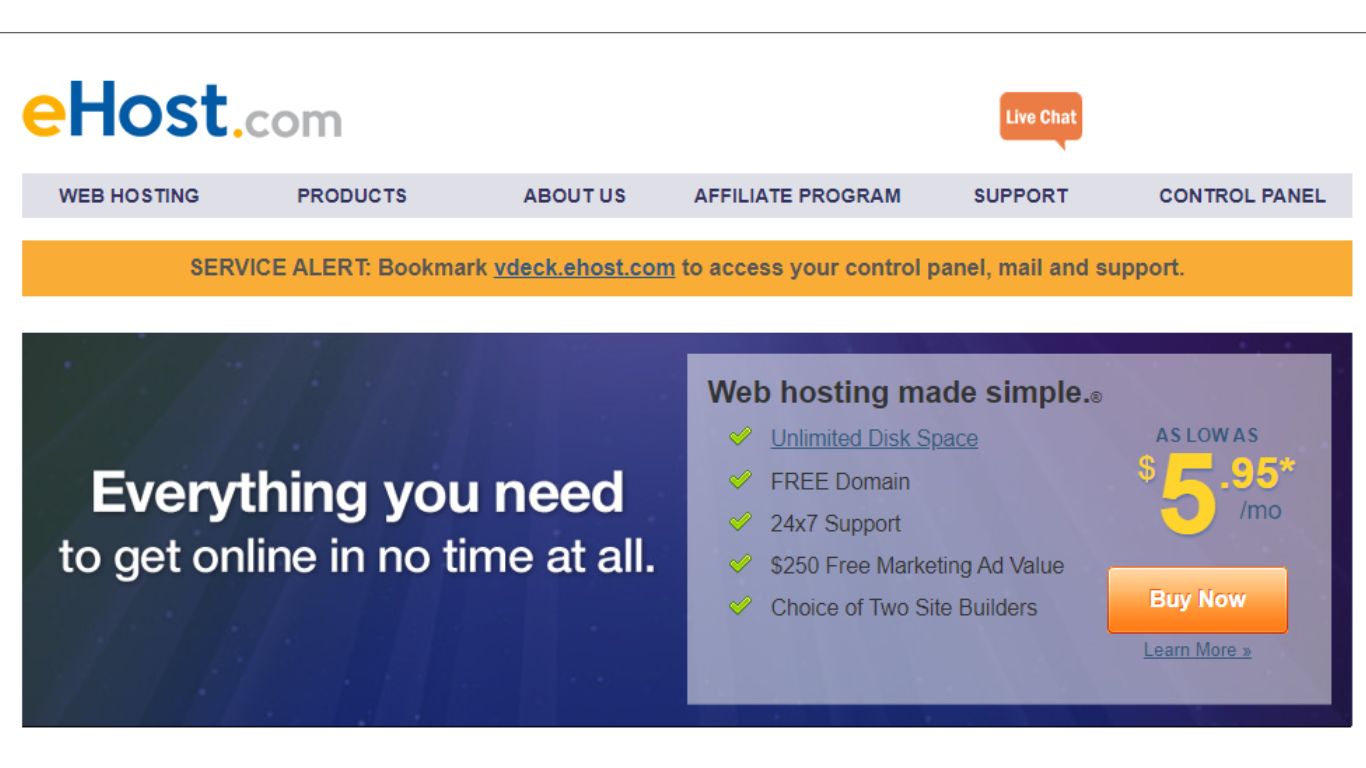
eHost was one of the most recognizable budget shared hosting providers in the US market for over two decades. Founded in 1996 and operating under Endurance International Group (EIG) — the same parent company behind Bluehost, iPage, and HostGator — eHost built its reputation on ultra-affordable pricing, a surprisingly generous feature set, and a beginner-friendly experience.
However, if you’ve recently searched for eHost or tried to visit eHost.com, you may have noticed something: the company has ceased independent operations and is now redirecting users to iPage, another EIG-owned hosting brand. This is an important piece of context that most reviews gloss over, and it significantly shapes the recommendation at the end of this article.
This review covers everything you need to know: what eHost offered, how it performed, what real users said, its pricing structure, and — most importantly — what your options are now.
⚠️ 2026 Status Update: eHost.com is no longer operating as an independent hosting provider. Existing customers have been migrated or redirected to iPage. If you’re looking for a new hosting provider, skip to the Alternatives section for our current recommendations.
What Was eHost?
eHost is a US-based web hosting company that was founded in 1996. With a platform that hosts over one million websites, eHost is one of the most popular hosting service providers online. After a site-wide redesign in 2015, the company integrated a website builder into their platform in order to compete with companies like Wix and Weebly.
eHost operated exclusively as a shared hosting provider — it never offered VPS, dedicated, or cloud hosting under its own brand. That kept the product lineup simple and the prices low, which appealed strongly to first-time website owners, bloggers, and small businesses with modest budgets and limited technical experience.
eHost is a large shared hosting provider that has been a leader in the market for quite some time. They have been in business since 1999, but in 2015 they did a complete refresh of their website, logo, branding and just about everything else. They even updated all their hosting services and features to be more in line with the latest industry standards.
As part of EIG (later rebranded as Newfold Digital), eHost shared backend infrastructure with several other budget hosting brands. This meant customers benefited from a well-established server network, but also inherited some of the criticisms that followed EIG brands — including reports of declining support quality and aggressive upselling at checkout.
eHost Hosting Plans & Pricing
One of eHost’s most distinctive characteristics was its single-plan pricing model. Rather than offering multiple tiers that force users to compare dozens of features, eHost presented one comprehensive shared hosting package with everything included.
| Feature | eHost Single Plan |
|---|---|
| Intro Price | ~$3.99–$5.95/month (36-month term) |
| Renewal Price | ~$9.99–$11.99/month |
| Websites | Unlimited |
| Storage | Unlimited (fair use policy applies) |
| Bandwidth | Unlimited (fair use policy applies) |
| Domains | Unlimited |
| MySQL Databases | Unlimited |
| Email Accounts | Unlimited |
| Free Domain | Included for life (while customer) |
| Money-Back Guarantee | 30 days |
It often becomes difficult for users to choose between so many hosting plans and are left wondering which one to choose. eHost addresses the issue by offering a single pricing plan that includes all the features. However, the insanely affordable prices eHost advertises are actually based on a 3-year subscription, while the promotional price is mostly for the first term only.
The Free Domain for Life Deal
When you opt to create your eHost account, you get a free domain name for life. This means that you can choose a compelling web address that suits the purposes of your site, and it will be renewed automatically and free of charge as long as you remain a customer in good standing. This is a better deal than many other competitors who offer a free domain but charge you for it after the first year. Only if you opt to cancel your eHost service yet still keep your domain name will you incur a one-time fee of $15.
Advertising Credits
Every customer at eHost gets $100 in Google Adwords credits and another $100 to use with Bing and Yahoo. While these credits have limited long-term value (they expire and typically only benefit brand-new ad accounts), they were a meaningful sweetener for new website owners exploring paid traffic for the first time. For businesses looking to build sustainable paid traffic strategies, partnering these credits with a proper pay-per-click marketing service delivers far better ROI than spending promotional credits without a clear campaign strategy.
Key Features
eHost is incredibly feature-rich, wooing customers with a laundry list of standard and premium features as a standard part of their hosting packages. Here’s a breakdown of what the plan included:
Website Builder
The drag-and-drop site builder works great for users not familiar with WordPress and programming languages and comes with thousands of eye-catching templates. Installing WordPress and other apps is just a click away. However, the site builder won’t work in conjunction with cPanel, while experts also recommend not using the site builders as they are often not as flexible as other options such as WordPress.
The website builder was genuinely useful for complete beginners, but experienced users consistently found it limiting compared to a self-hosted WordPress site. If you’re serious about building a professional online presence, a properly developed WordPress site — or a custom-built solution — will always outperform a drag-and-drop builder in terms of flexibility, SEO performance, and long-term scalability. Our website development services are built around exactly this philosophy.
Unlimited Resources (With Caveats)
Unlike many web hosting providers, which cap bandwidth and storage space, eHost doesn’t set any hard limits on your usage of either of these resources. In order to prevent anyone from abusing this rule, the company reserves the right to restrict those who are consuming too much. According to information on eHost’s website, 199 out of 200 customers are unaffected by this policy because their website activities fall under the rubric of normal usage patterns.
Email Hosting
You’ll get unlimited free email addresses at your domain: both webmail and POP3/IMAP accounts. This is a solid inclusion for small businesses that need professional email (yourname@yourdomain.com) without paying for a separate email hosting service.
E-Commerce Tools
Do you want to sell products on your website? eHost.com has you covered with their simple to use eCommerce functionality. eHost allows you to link directly to PayPal to process payments and sell products with ease. If you need a full blown eCommerce system you will have to pay more, however, this seems standard among web hosting companies. They offer a basic, free eCommerce system but more advanced functionality will require an upgrade.
For serious e-commerce operations, the basic tools eHost included were a starting point at best. Running a store that converts visitors requires much more than a PayPal link — it requires strong SEO, targeted content, and a well-structured content marketing strategy to bring qualified buyers to the site in the first place.
cPanel Access
eHost provided full cPanel access on all accounts, giving experienced users the control panel they were already familiar with. This was a significant advantage over some competitors that had moved to proprietary dashboards.
One-Click App Installs
WordPress, Joomla, Drupal, and dozens of other CMS platforms could be installed in a single click through eHost’s Softaculous integration — a standard but essential feature for any shared hosting provider.
Performance & Uptime
Uptime Guarantee
As a customer of eHost, you’ll be covered by a 99.9% uptime guarantee. For any month wherein your site was down for more than 0.1% of the time, you’ll be entitled to a free month of web hosting. Scheduled maintenance isn’t counted as downtime for the purposes of this guarantee. Most third-party tracking sites state that eHost’s uptime percentages routinely beat its 99.9% claims.
Speed & Load Times
eHost’s speed performance was adequate for a budget shared hosting provider but not exceptional. Independent tests placed average load times in the 2.5–3.5 second range — sufficient for simple blogs and brochure sites, but below the sub-2-second benchmark that Google increasingly factors into search rankings.
For context, the hosting industry’s performance leaders in 2026 — Hostinger, GreenGeeks, HostArmada — consistently deliver average load times under 700ms with global TTFB scores under 250ms. eHost was never in that league, which is a meaningful consideration for anyone focused on SEO performance.
💡 Why Page Speed Matters for SEO: Google uses Core Web Vitals — including Largest Contentful Paint (LCP) and Time to First Byte (TTFB) — as ranking signals. A slow host directly hurts your search visibility, regardless of how good your content is. This is why pairing your hosting choice with a proper search engine optimization strategy requires considering technical performance, not just keywords.
Ease of Use
This was one of eHost’s genuine strengths. The platform was consistently praised by beginners for:
- A clean, intuitive onboarding process — from domain selection to cPanel access in minutes
- One-click WordPress installation via Softaculous
- A drag-and-drop website builder with responsive templates for those who didn’t want to use WordPress
- Clear billing and account management through a straightforward dashboard
Signing up for eHost is a simple process that acts as an indicator of the overall experience of creating a website on the platform. After choosing a domain, you will be directed to your cPanel where you have the choice of installing one of a number of website platforms, including a website builder. We recommend the website builder to new users looking to create a great and modern looking home page without the need for coding. The builder relies on a drag-and-drop system where you can add new elements and content by placing them anywhere on your site.
Customer Support
eHost offered 24/7 support via phone, live chat, and email — the full stack of support channels. Response quality was a recurring point of debate in user reviews.
eHost has a world-class support team which goes above and beyond to help their customers. Not only do they have a fully comprehensive training library to help you get your website up and running as quickly as possible they also provide 24/7 phone, email, and live chat support.
However, real-world user experiences told a more mixed story. Many users reported satisfactory interactions with support staff on routine questions. Others reported long resolution times for more complex issues, and some raised concerns about being transferred between agents without resolution. This inconsistency is a common trait across EIG-owned hosting brands.
Security Features
EHost has good security features with their services. The security facilities that EHost provides are marvellous and are generally looked upon by the users while choosing between hosting providers.
Standard security inclusions on eHost plans included:
- Free SSL certificate (Let’s Encrypt) — HTTPS encryption for all hosted domains
- SiteLock malware scanning (basic tier included, advanced tiers as paid add-on)
- Spam filtering for email accounts
- DDoS protection at the network level
- Automated backups (availability varied by plan and period)
One notable gap: eHost did not include a robust Web Application Firewall (WAF) on standard plans — something that more security-conscious hosts now include as standard. For websites handling customer data or running e-commerce, this was a meaningful limitation.
eHost Pros & Cons
✅ Pros
- Simple, all-in-one pricing — one plan with everything included, no tier confusion
- Free domain for life — genuinely better than competitors who charge after year one
- Unlimited storage, bandwidth, and email — practical for most small sites
- Free advertising credits — $200 across Google and Bing/Yahoo for new accounts
- Full cPanel access — familiar control panel for experienced users
- 30-day money-back guarantee — risk-free trial period
- One-click WordPress installation — fast setup for the world’s most popular CMS
- Beginner-friendly onboarding — minimal friction from signup to live site
❌ Cons
- Shared hosting only — no VPS, cloud, or dedicated options for growing sites
- Steep renewal pricing — introductory rates up to 150% lower than renewal rates
- Speed performance below modern benchmarks — not suitable for performance-critical sites
- Aggressive upselling at checkout — add-ons pre-selected, require active opt-out
- Support inconsistency — quality varied significantly across channels and agents
- Website builder limitations — not compatible with cPanel; less flexible than WordPress
- EIG ownership concerns — shared infrastructure with multiple brands raised questions about resource dilution
- Operations have ceased — eHost.com is no longer active as an independent brand
Real User Reviews
User sentiment toward eHost was genuinely mixed — positive reviews typically came from beginners who appreciated the simplicity and value, while negative reviews clustered around billing practices and support failures.
Positive themes from real users:
- “Great value for money — everything you need to get started in one package”
- “Setup was incredibly easy, had my site live within an hour”
- “The drag-and-drop builder was perfect for my small business site”
- “cPanel access made it feel like a real hosting account, not a toy”
Negative themes from real users:
One user reported: “I have taken service for 3 years but after 1 year they migrated my services to another host who is asking me to buy dedicated IP, SSL certificates. I was cheated by their service and now as I can see they are redirecting their users to iPage website.”
Other users reported being charged without explicit confirmation, difficulty cancelling accounts, and websites going down without resolution after extended support interactions. These patterns are consistent with complaints documented across multiple EIG-owned brands over the years.
Who Was eHost Best For?
At its peak, eHost was a reasonable choice for:
- Complete beginners launching their first personal website or blog
- Small local businesses needing a simple brochure site with a professional email address
- Students and hobbyists who wanted a low-cost hosting environment to experiment with
- Budget-conscious individuals who needed unlimited email and domain hosting without complexity
eHost was not a good fit for:
- Growing businesses needing scalable resources (VPS, cloud, dedicated)
- E-commerce stores requiring reliable payment processing infrastructure
- Performance-focused websites where page speed directly impacts conversions
- Developers requiring advanced server configuration or staging environments
- Agencies managing multiple client accounts with professional-grade reliability requirements
Best Alternatives to eHost
Since eHost is no longer operating independently, here are the strongest alternatives in 2026 — each offering comparable or superior value depending on your needs:
1. Hostinger — Best Overall Value
Hostinger is the closest comparable to what eHost offered at its best — ultra-affordable pricing, beginner-friendly setup, and a generous feature set. Plans start at around $1.99–$2.99/month on a 48-month term. Unlike eHost, Hostinger delivers genuinely fast load times (under 700ms in independent testing), a custom hPanel dashboard that’s more modern than cPanel, and an AI-powered site builder.
Best for: Beginners, bloggers, small businesses, budget-conscious site owners.
2. Bluehost — Best for WordPress
Officially recommended by WordPress.org, Bluehost offers a very similar price point to what eHost charged. Shared plans start around $3.99/month introductory. The WordPress-optimized environment, automatic updates, and strong customer support make it a reliable upgrade from eHost for anyone running a WordPress site.
Best for: WordPress sites, small business websites, WooCommerce beginners.
3. SiteGround — Best for Performance
SiteGround costs more than eHost (starting around $3.99/month introductory, renewing at a higher rate), but delivers significantly better speed and support quality. It’s particularly well-regarded for its staging tools, daily automated backups, and proactive security features.
Best for: Performance-conscious users, agencies, growing businesses.
4. iPage — The Direct Migration Path
Since eHost is redirecting customers to iPage (both are EIG/Newfold Digital brands), iPage is the path of least resistance for existing eHost customers. Pricing is similar, features are nearly identical, and the transition requires minimal setup. That said, iPage carries some of the same criticisms as eHost — renewal pricing spikes, aggressive upselling, and variable support quality.
Best for: Existing eHost customers who want minimal disruption.
5. DreamHost — Best for Transparency
DreamHost stands out for honest pricing — renewal rates are more predictable than EIG brands, and the company has a strong track record of reliability. It’s one of only three hosting providers officially recommended by WordPress.org. Plans start around $2.95/month.
Best for: Users who value pricing transparency and long-term value.
| Provider | Starting Price | Best For | Uptime |
|---|---|---|---|
| Hostinger | ~$1.99/mo | Overall value | 99.99% |
| Bluehost | ~$3.99/mo | WordPress | 99.98% |
| SiteGround | ~$3.99/mo | Performance | 99.99% |
| iPage | ~$1.99/mo | eHost migration | 99.9% |
| DreamHost | ~$2.95/mo | Transparency | 99.98% |
🌐 Beyond Hosting: Switching to a better host is step one. But the websites that actually grow their traffic, generate leads, and build lasting brands are the ones backed by a real digital strategy — from SEO-optimized content and search engine optimization to social media management that keeps your audience engaged. The hosting decision matters — but it’s the content and marketing layer on top of it that drives real business results.
Final Verdict
eHost Rating: 3.2 / 5 (Historical — no longer active)
eHost was a serviceable budget hosting provider for its era. The all-in-one pricing model, free lifetime domain, and unlimited resources made it an attractive entry point for beginners who didn’t want to navigate complex plan tiers. The beginner-friendly setup and full cPanel access offered enough flexibility for most small websites to function comfortably.
But the limitations were real: shared hosting only, speed performance below modern expectations, inconsistent customer support, steep renewal pricing, and — most critically — the brand has now ceased independent operations.
The bottom line: If you were an eHost customer, migrating to a more established provider — Hostinger, Bluehost, or SiteGround — will give you a meaningfully better experience at a comparable price point. If you’re researching eHost as a new customer, redirect that research energy: the brand no longer exists as a viable hosting option.
Whatever host you choose, remember that hosting is just the foundation. The sites that actually grow are the ones backed by strong content marketing, a well-executed SEO strategy, and — where it makes sense — paid advertising to accelerate early traffic. A great hosting plan with no marketing strategy is a parked car with a full tank of fuel — it goes nowhere until you start driving.
Need help building and growing your online presence from the ground up? The Macroter team specializes in website development, SEO, content marketing, and social media management — everything you need to turn a new website into a real business asset.

I’m Md Nasir Uddin, a digital marketing consultant with over 9 years of experience helping businesses grow through strategic and data-driven marketing. As the founder of Macroter, my goal is to provide businesses with innovative solutions that lead to measurable results. Therefore, I’m passionate about staying ahead of industry trends and helping businesses thrive in the digital landscape. Let’s work together to take your marketing efforts to the next level.