
The modern marketing landscape is locked in a high-stakes debate. On one side, teams marvel at the lightning-fast output of large language models like ChatGPT, capable of drafting an entire blog post in under thirty seconds. On the other side, seasoned content directors and brand strategists watch conversion rates plummet when generic, robotic text floods their digital channels, realizing that true connection cannot be synthesized by an algorithm alone.
The question is no longer whether you should use artificial intelligence in your content operations. The true question—and the one that separates high-performing growth teams from stagnant ones—is knowing precisely when to leverage AI and when to invest in a professional human writer.
In this comprehensive guide, we will break down the strengths, weaknesses, and optimal use cases for both AI and human content creation. By the end, you will have a clear, strategic framework to optimize your content budget, protect your brand authority, and scale your organic growth without sacrificing quality.
1. Understanding Search Intent and the Content Spectrum
Before choosing between an automated prompt and a human freelancer, you must analyze your target audience’s search intent. Not all content serves the same purpose, and treating every piece of copy with the same production pipeline is a recipe for wasted resources.
The content spectrum generally falls into three distinct categories:
-
Informational & Foundational: High-volume, structured queries answering straightforward questions (e.g., “How to format a CSV file”).
-
Commercial & Comparative: Mid-funnel evaluations where users weigh options (e.g., “Top 5 CRM software for SaaS startups”).
-
Transactional & Emotional: Bottom-funnel or brand-building content designed to build deep trust, drive conversions, or evoke emotional resonance (e.g., “Our founder’s story on redefining remote work”).
The AI Advantage in Volume and Speed
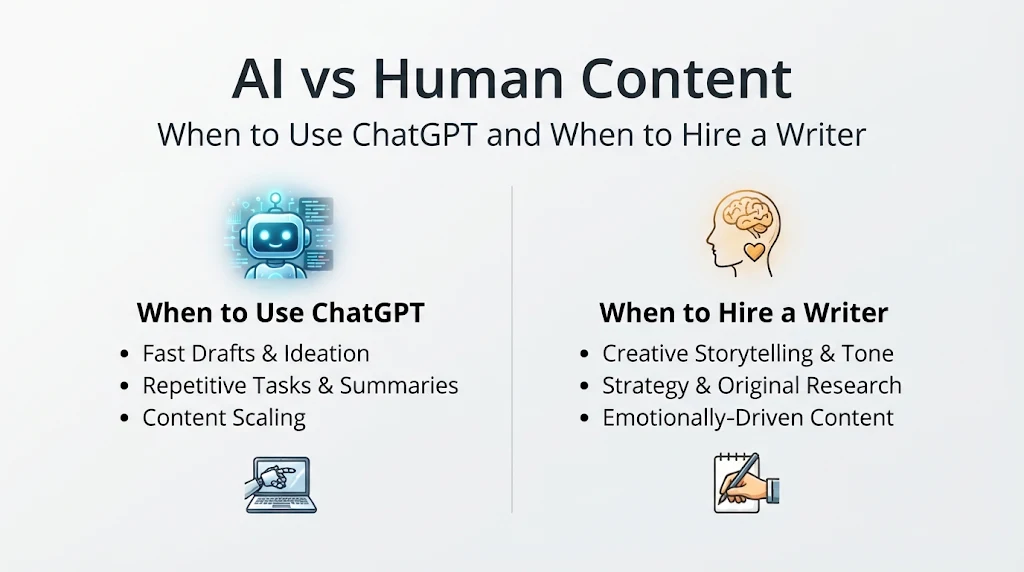
ChatGPT and similar LLMs excel at processing massive datasets, synthesizing existing knowledge, and structuring repetitive frameworks. If your goal is to map out content outlines, generate schema markup descriptions, write meta tags at scale, or draft first-pass summaries of well-documented topics, AI is an unmatched productivity multiplier.
The Human Advantage in Nuance and Authority
Human writers bring lived experience, original research, emotional intelligence, and idiosyncratic brand voice. Google’s Search Quality Rater Guidelines heavily emphasize E-E-A-T (Experience, Expertise, Authoritativeness, and Trustworthiness). True first-hand experience—such as testing a piece of software yourself, interviewing industry leaders, or sharing proprietary case studies—cannot be faked or accurately hallucinated by an AI model.
Pro Tip: Use AI to build the scaffolding and accelerate your research phase, but reserve your human capital for building original thought leadership, emotional connection, and brand differentiation.
2. When to Use ChatGPT: Automating for Scale and Efficiency
Artificial intelligence shines brightest in operational scenarios where speed, scale, and data organization outweigh the need for deep emotional storytelling. Here are the core scenarios where you should lean heavily on ChatGPT:
A. Scaling Outlines and Keyword Grouping
Building a comprehensive content calendar requires structuring dozens of subtopics. ChatGPT can analyze keyword clusters and generate granular, hierarchical H2 and H3 outlines in seconds, saving content managers hours of structural brainstorming.
B. Repurposing Existing Assets
If you have a high-performing webinar transcript, a long-form whitepaper, or a detailed case study, ChatGPT is exceptional at transforming that asset into secondary formats. You can prompt the model to:
-
Extract 5 key takeaways for a LinkedIn carousel post.
-
Condense the core argument into a punchy, 3-part email newsletter sequence.
-
Generate concise social media snippets tailored for Twitter/X.
C. First-Draft Acceleration for Standard Formats
For routine informational articles, basic product descriptions, or localized FAQ pages, human writers often suffer from “blank page syndrome.” Feeding ChatGPT a detailed prompt with specific brand guidelines allows you to bypass the blank page, generating a structured 70% draft that a human editor can refine in a fraction of the time.
+-------------------------------------------------------+
|              THE AI CONTENT PIPELINE                  |
+-------------------------------------------------------+
| 1. Keyword Research & Clustering (Human Strategy)     |
| 2. Prompt Engineering & Outline Generation (AI)       |
| 3. First-Pass Draft Creation (AI)                     |
| 4. Fact-Checking, Polishing & Voice Tuning (Human)    |
+-------------------------------------------------------+
3. When to Hire a Writer: Protecting Brand Equity and Conversions
While AI can mimic the style of writing, it lacks intent, moral judgment, and genuine expertise. Certain types of content demand a human touch to achieve high return on investment (ROI). You must hire a skilled human writer for the following scenarios:
A. Thought Leadership and Original Opinions
True industry authority comes from taking a definitive stance, challenging conventional wisdom, and sharing proprietary insights. If your content strategy relies on thought leadership essays, executive ghostwriting, or visionary industry commentary, AI will only produce safe, homogenized platitudes. Readers reward originality; algorithms reward repetition.
B. High-Stakes Conversion Copy (Landing Pages & Sales Letters)
When a user lands on your high-intent pricing or product page, every word must build trust and dismantle objections. Human copywriters understand behavioral psychology, pacing, micro-copy nuances, and emotional triggers. Relying on generic AI templates for sales copy often results in stiff phrasing that alienates sophisticated buyers.
C. Investigative Journalism and Primary Research
AI models are trained on past data; they cannot discover new information. If your content strategy involves conducting original customer interviews, running surveys, analyzing proprietary data sets, or testing physical products, you need a human journalist or researcher who can investigate, verify, and synthesize raw human truth.
4. The Hybrid Workflow: Maximizing ROI Through Collaboration
The most successful marketing teams in competitive industries do not choose between AI or humans—they build a symbiotic hybrid workflow. By combining the computational speed of ChatGPT with the editorial brilliance of human writers, you can scale output without degrading quality.
Step-by-Step Blueprint for the Hybrid Pipeline:
-
Strategic Briefing (Human): Define the target audience, primary keyword, search intent, unique angle, and specific internal data points or case studies to include.
-
AI-Assisted Research & Structuring (AI): Prompt ChatGPT to analyze competitor outlines, suggest relevant subtopics, and organize the structural flow.
-
The AI Draft (AI): Generate the initial draft using precise system prompts that enforce your brand tone, formatting rules, and vocabulary constraints.
-
The Human Polish & Fact Check (Human): A professional writer or editor reviews the draft to eliminate robotic phrasing, inject original anecdotes, verify all statistics, and ensure authentic voice resonance.
Example: A SaaS company needs 20 comparison articles. Instead of paying a freelance writer full rate to write every word from scratch, they use ChatGPT to generate structured feature comparison tables and section drafts based on product specs. A staff writer then reviews each article, adds real user quotes gathered from customer success calls, injects personal testing notes, and refines the tone. Output speed increases by 300%, while human editorial quality ensures zero loss in authority.
5. Common Pitfalls and Mistakes to Avoid
As organizations rush to integrate AI into their marketing workflows, several costly traps frequently derail their SEO and conversion goals.
-
Publishing Raw, Unedited AI Output: Search engines actively scan for low-effort, mass-produced programmatic content. Unedited AI copy often contains factual inaccuracies (“hallucinations”), repetitive transitional phrases (“In conclusion,” “Delve into,” “Testament to”), and lack of depth.
-
Ignoring Brand Voice Consistency: If your tone shifts dramatically from article to article because different prompts were used without strict guardrails, your brand feels disjointed and untrustworthy.
-
Treating AI as a Strategy Replacement: ChatGPT is an execution tool, not a strategist. Relying on AI to determine your core positioning or customer acquisition framework will lead to generic positioning that fails to differentiate you from competitors.
-
Failing to Verify Facts and Statistics: AI models frequently invent citations, case studies, or data points to support a claim. Publishing unverified claims destroys your E-E-A-T credibility instantly.
6. Frequently Asked Questions (FAQ)
Can Google penalize my website for using AI-generated content?
No. Google’s official search guidance clarifies that they reward high-quality content, regardless of how it is produced. However, if AI is used to automatically generate low-quality, unhelpful, or spammy content designed purely to manipulate search rankings, it violates Google’s spam policies and will be penalized.
How do I train ChatGPT to write in my specific brand voice?
To maintain voice consistency, create a comprehensive brand style guide prompt. Feed ChatGPT examples of your best-performing human-written copy, explicitly list words and phrases to avoid (e.g., common AI buzzwords like “tapestry,” “beacon,” or “realm”), and define your precise sentence length, humor level, and point of view.
When is it strictly necessary to hire a human freelance writer?
You should hire a human writer when creating executive ghostwriting, original research reports, high-conversion landing pages, brand storytelling, or deep-dive product reviews where first-hand experience is mandatory for E-E-A-T compliance.
How does the hybrid AI-human model impact content budgets?
Adopting a hybrid model typically reduces content production costs by 40% to 60% while increasing publishing velocity. Instead of paying writers for baseline research and drafting, you pay them a higher rate for high-value editing, fact-checking, and strategic angle injection.
Conclusion
The debate between AI and human content is built on a false dichotomy. ChatGPT is not a replacement for human creativity, empathy, and strategic thinking; rather, it is the most powerful force multiplier ever handed to content marketers.
By strategically deploying AI for data structuring, outlining, and first-pass drafting—while reserving human writers for original insights, rigorous fact-checking, and emotional resonance—you can build an agile, high-ROI content engine that dominates search rankings and converts readers into loyal customers.
Call to Action: Audit your current content calendar today. Identify repetitive, informational tasks to delegate to AI, and reallocate your budget toward hiring elite human talent for your core thought-leadership and conversion assets.

I’m Md Nasir Uddin, a digital marketing consultant with over 9 years of experience helping businesses grow through strategic and data-driven marketing. As the founder of Macroter, my goal is to provide businesses with innovative solutions that lead to measurable results. Therefore, I’m passionate about staying ahead of industry trends and helping businesses thrive in the digital landscape. Let’s work together to take your marketing efforts to the next level.