
You have a massive problem. Your traffic numbers look incredible, your ad spend is optimized down to the penny, and your click-through rates (CTR) are outperforming industry benchmarks. Yet, when visitors land on your page, they vanish. They bounce. They slip through your digital fingers without converting.
Why? Because traffic doesn’t buy your product—words do.
In the high-stakes world of pay-per-click (PPC) advertising and media buying, your landing page is the ultimate battlefield. You have roughly three seconds to capture a user’s attention, prove your value, and convince them to stay. If your copy is generic, confusing, or self-centered, no amount of design wizardry or budget scaling will save your campaign.
This comprehensive guide breaks down a battle-tested framework for writing high-converting landing page copy that turns cold traffic into loyal customers.
1. Deconstructing Search Intent and the Psychology of the Landing Page Click
Before you write a single word, you must understand why the user is on your page. In performance marketing, alignment is everything. If the promise made in your ad doesn’t match the reality of your landing page copy within the first 500 milliseconds, your bounce rate will skyrocket.
The Three Pillars of Landing Page Psychology
-
Cognitive Friction: The human brain hates friction. If a visitor has to read a sentence three times to understand what you do, they are gone. Clear copy always beats clever copy.
-
Pain-First Motivation: People are fundamentally motivated more by the desire to avoid pain and frustration than by the desire to gain pleasure. Your copy must acknowledge their current struggle before offering your solution.
-
Immediate Value Exchange: Your visitor is subconsciously asking, “What’s in it for me?” Every single element on your page must answer that question immediately.
Pro Tip: Never mix intents on a single landing page. If your ad targets a bottom-of-funnel transactional query (e.g., “Buy enterprise CRM software”), do not send them to a top-of-funnel educational blog post. The copy must speak directly to their current stage in the buyer’s journey.
2. The Hero Section: Crafting the Ultimate Hook and Subheadline
The hero section is prime digital real estate. It’s what visitors see above the fold without scrolling. If your hero copy fails, the rest of the page doesn’t matter.
Anatomy of a High-Converting Hero Section
-
The H1 Headline: Your primary hook. It must communicate your core value proposition instantly.
-
The Subheadline: Your expansion bridge. It clarifies how you deliver the promise and for whom it is built.
-
The Primary Call-to-Action (CTA): A high-contrast button featuring action-oriented, low-friction copy.
The 4-Part Headline Framework
To write an irresistible H1, use the formula: [Desired Outcome] + [Without Pain/Objection] + [In Timeframe].
-
Example (B2B SaaS): “Scale Your Outbound Sales Pipeline by 300% Without Adding Headcount in 30 Days.”
-
Example (E-Commerce/DTC): “Medical-Grade Posture Correction That Eliminates Lower Back Pain While You Sit.”
| Weak Headline | High-Converting Headline | Why It Works |
| “Welcome to our software platform.” | “Automate your payroll in under 3 minutes.” | Instantly states the exact benefit and speed. |
| “Get fit with our coaching program.” | “Lose 15 pounds of stubborn fat without starving.” | Addresses a specific outcome and removes a major pain point. |
| “Best digital marketing tools online.” | “Generate qualified leads on autopilot with AI.” | Focuses on the mechanism and hands-off convenience. |
3. The Anatomy of Persuasion: Structuring Your Page Body
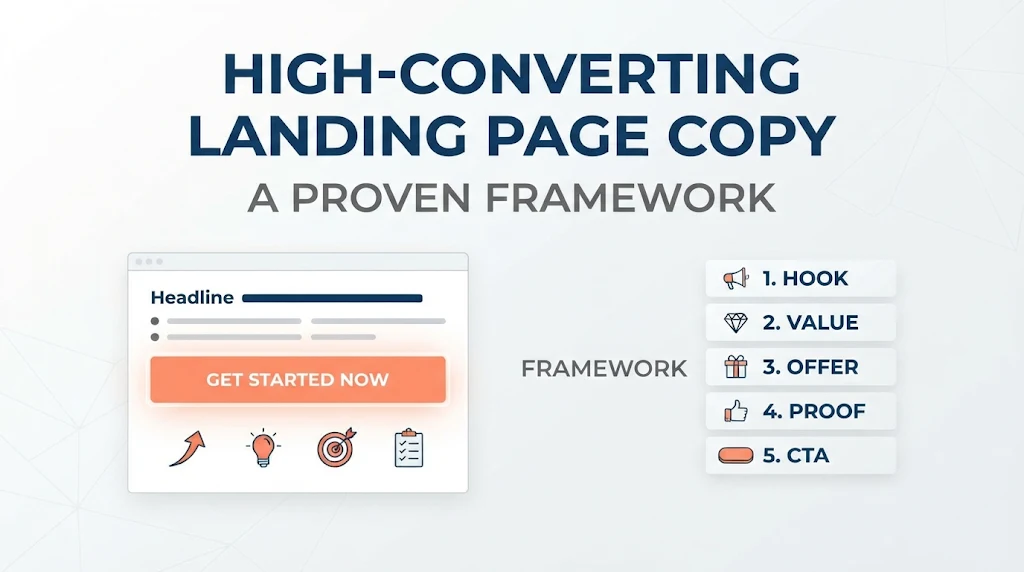
Once you’ve hooked the user in the hero section, your body copy must systematically build trust, dismantle objections, and guide them toward the conversion button. Here is the chronological flow of a high-converting landing page body:
Step 1: Agitate the Problem
Your audience is living with a specific frustration. Describe their pain point better than they can articulate it themselves. When a prospect reads your copy and thinks, “Finally, someone understands my exact struggle,” you instantly establish authority and empathy.
Step 2: Introduce the Solution and Mechanism
Now that the wound is open, introduce your product or service as the ultimate remedy. Explain how it works in simple terms. Avoid dense jargon; instead, use analogies that bridge complex concepts with everyday understanding.
Step 3: Feature-to-Benefit Translation
A common trap for marketers is listing features instead of benefits.
-
Feature: “Our software has a 256-bit encryption database.”
-
Benefit: “Your customer data is completely secure, protecting your brand from costly breaches and building instant consumer trust.”
4. Building Unshakable Trust and Overcoming Objections
Cold traffic is inherently skeptical. They don’t know you, and they don’t trust you yet. Your copy must proactively dissolve doubt using social proof and risk-reversal strategies.
Types of Proof to Integrate into Your Copy
-
Data-Driven Social Proof: Instead of saying “Our clients love us,” say “Trusted by over 4,500 fast-growing marketing teams.”
-
Specific Testimonials: Use testimonials that call out specific objections. If people worry your product is too hard to set up, feature a review that says: “I had it up and running in less than 10 minutes.”
-
Risk Reversal: Strong guarantees (e.g., “30-day money-back guarantee, no questions asked”) reduce the perceived financial or psychological risk of taking action.
Example Scenario: If you are selling a high-ticket online course, your copy shouldn’t just talk about the modules. It must feature a prominent FAQ section and trust badges right above the final checkout button to neutralize fears regarding refunds, support access, and time commitments.
5. Common Pitfalls and Mistakes to Avoid
Even experienced marketers occasionally fall into traps that tank conversion rates. Watch out for these four deadly sins of landing page copywriting:
-
The “We, We, We” Trap: Making the copy entirely about your company, your history, and your awards instead of focusing exclusively on the customer’s desires and transformations. Shift every sentence from “We provide…” to “You will achieve…”
-
Vague CTAs: Using generic button text like “Submit,” “Click Here,” or “Learn More.” Your CTA should complete the sentence: “I want to…” (e.g., “Get My Free Audit,” “Claim My Discount”).
-
Wall of Text Syndrome: Writing long, unformatted paragraphs. Users don’t read landing pages; they scan them. Break up text with bolding, bullet points, and visual callouts.
-
Weak Alignment with Ad Creative: Promising a 50% discount in a Facebook ad, only to send users to a landing page where the discount is buried or non-existent. Message match is sacred.
6. Frequently Asked Questions (FAQ)
How long should landing page copy be?
There is no magic word count. A landing page should be as long as it takes to answer every question and overcome every objection in your prospect’s mind. Simple lead magnets might only need 300 words, while high-ticket B2B software or complex services require 1,500+ words of deep persuasion.
How do I balance SEO optimization with conversion rate optimization (CRO)?
Focus your primary SEO keywords (like product categories, solution names, and industry terms) in your H1, H2 tags, and natural body paragraphs. However, never sacrifice clarity or conversion psychology for keyword density. Human readability and conversion velocity always trump algorithmic keyword stuffing.
What is the single most important part of a landing page?
The headline (H1) and the primary call-to-action (CTA). If your headline fails to hook the user, they will never read the rest of your copy. If your CTA is weak or confusing, they will never convert.
How can I test my landing page copy effectively?
Run A/B split tests focusing on one high-impact element at a time—such as testing two completely different value propositions in your H1 headline or varying the framing of your CTA button copy. Let tests run until you reach statistical significance before declaring a winner.
Conclusion
Writing high-converting landing page copy is not an act of creative writing; it is an exercise in applied human psychology, rigorous empathy, and strategic clarity. By leading with your customer’s pain points, structuring your narrative logically from problem to solution, backing up your claims with undeniable proof, and ending with a frictionless call-to-action, you transform standard traffic into a predictable revenue engine.
Stop guessing what your audience wants to hear. Audit your current landing page against this framework today, cut the fluff, sharpen your hook, and watch your conversion rates climb.
Ready to skyrocket your conversion rates? Take your media buying to the next level by auditing your top-performing landing page using our step-by-step conversion framework today.

I’m Md Nasir Uddin, a digital marketing consultant with over 9 years of experience helping businesses grow through strategic and data-driven marketing. As the founder of Macroter, my goal is to provide businesses with innovative solutions that lead to measurable results. Therefore, I’m passionate about staying ahead of industry trends and helping businesses thrive in the digital landscape. Let’s work together to take your marketing efforts to the next level.