
Every day, the average digital consumer is exposed to anywhere from 4,000 to 10,000 brand messages. On platforms like Google Search, Meta, LinkedIn, and TikTok, you have less than 1.7 seconds to stop a user’s thumb, capture their cognitive bandwidth, and convince them to click.
Yet, most performance marketers and media buyers still treat ad copy as an afterthought. They obsess over bidding strategies, audience segmentation, lookalike modeling, and pixel attribution—only to pour thousands of dollars into ads written like dry product spec sheets. When click-through rates (CTR) stagnate and customer acquisition costs (CAC) skyrocket, the algorithm is rarely to blame. The bottleneck is human psychology.
High-ROI PPC and media buying rely on a fundamental truth: people do not buy products; they buy better versions of themselves, relief from pain, or protection from loss. While machine learning handles ad delivery, persuasive copywriting remains the single highest-leverage variable in paid media performance.
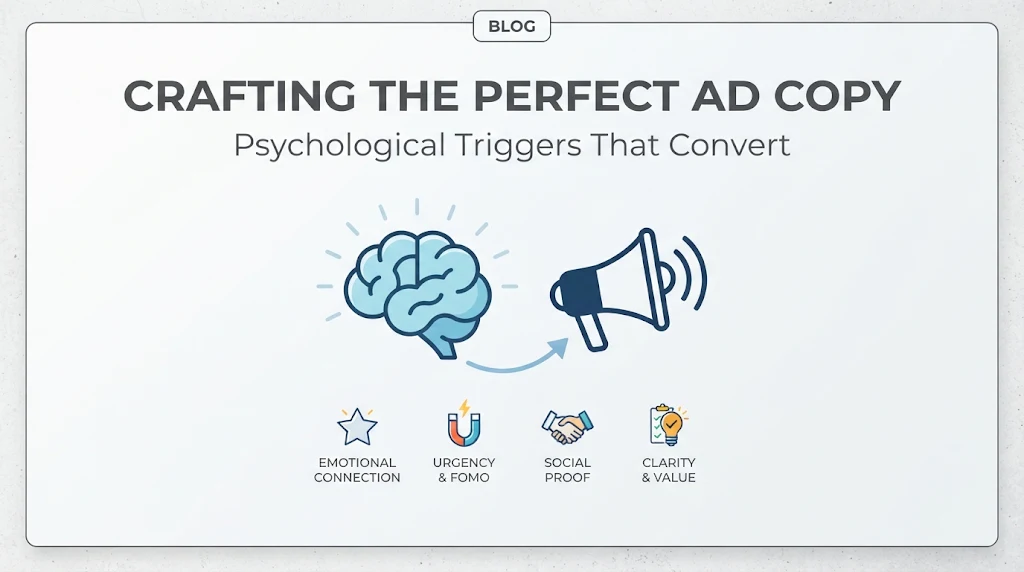
In this comprehensive guide, you will learn how to bridge the gap between behavioral psychology and direct-response copywriting. We will break down the cognitive mechanics behind high-converting ads, explore nine battle-tested psychological triggers with real-world before-and-after examples, provide structural copywriting frameworks, and outline the critical compliance and conversion pitfalls to avoid.
The Science Behind the Click: Why Psychology Beats Features
To write ads that consistently convert, you must first understand how the human brain processes commercial information. Nobel laureate Daniel Kahneman famously divided human thought into two distinct modes: System 1 and System 2.
-
System 1 Thinking: Fast, automatic, emotional, subconscious, and instinctive. This is the mode users are in when scrolling through an Instagram feed or scanning search results.
-
System 2 Thinking: Slow, effortful, logical, calculating, and conscious. Users only activate System 2 when they are comparing pricing tiers on a landing page or evaluating technical specifications.
The fatal mistake most advertisers make is writing System 2 copy for a System 1 environment. If your ad leads with technical jargon, corporate buzzwords, or a laundry list of software features, System 1 ignores it to conserve mental energy.
Key Takeaway: Your ad copy is not meant to close the entire sale on the spot. Its primary job is to trigger an emotional or instinctive response in System 1 that earns the click, handing the prospect off to your landing page where System 2 can justify the decision logically.
The Core Value Equation in Paid Media
Before deploying any psychological trigger, your underlying offer must align with how buyers perceive value. In direct-response marketing, perceived value is governed by four levers:
-
Dream Outcome: What is the ultimate transformation the user desires?
-
Perceived Likelihood of Achievement: How certain is the user that your solution will actually work for them?
-
Time Delay: How fast will they experience the initial result?
-
Effort and Sacrifice: How much friction, pain, or lifestyle disruption is required to get the result?
Great ad copy maximizes the first two variables while ruthlessly minimizing the last two. Psychological triggers act as the accelerants that make those four levers feel urgent, believable, and irresistible.
9 Proven Psychological Triggers for High-ROI Ad Copy
Below are nine foundational psychological principles rooted in behavioral economics and evolutionary psychology, complete with tactical applications for Google Search, Meta, and LinkedIn ads.
1. Loss Aversion (The Fear of Missing Out on Value)
Psychologically, the pain of losing something is roughly twice as powerful as the pleasure of gaining something equivalent. When users feel they are actively losing money, time, status, or opportunities by maintaining their current behavior, they are compelled to act.
-
How it works: Instead of framing your headline around what the user will gain by using your product, frame it around what they are currently bleeding without it.
-
Example (B2B SaaS – Expense Management):
-
Feature-Driven (Weak): “Automate Your Company Expense Reports with CloudSync.”
-
Loss Aversion (Strong): “Your Finance Team Wastes 14 Hours a Week on Manual Receipts. Stop the Bleed.”
-
-
Pro Tip: Use verbs associated with leakage, waste, and hidden costs—such as leaking, overpaying, missing, draining, and leaving on the table.
2. Social Proof and the Bandwagon Effect
Humans are hardwired to look to the behavior of others to determine correct action, especially under conditions of uncertainty. In paid media, unsubstantiated claims (“We are the #1 rated agency”) trigger immediate skepticism. Specific, verifiable social proof bypasses that skepticism.
-
How it works: Leverage crowd wisdom, authority endorsements, user-generated metrics, and micro-niche peer validation.
-
Example (E-Commerce – Ergonomic Office Chairs):
-
Generic Claim (Weak): “The Most Comfortable Ergonomic Chair for Remote Workers.”
-
Specific Social Proof (Strong): “Join 84,000+ Remote Developers Who Eliminated Lower Back Pain in 14 Days.”
-
-
Pro Tip: Match the social proof to the exact audience segment. If targeting dentists on LinkedIn, say “Trusted by 1,200+ private dental practices,” rather than “Trusted by thousands of businesses.”
3. The Curiosity Gap (Information Gap Theory)
Coined by behavioral economist George Loewenstein, the Information Gap Theory states that curiosity arises when we notice a gap between what we know and what we want to know. That gap creates a mild cognitive itch that can only be scratched by clicking.
-
How it works: Tease a counterintuitive insight, a proprietary mechanism, or an unexpected outcome without giving away the punchline in the ad text.
-
Example (Paid Social – Personal Finance App):
-
Predictable (Weak): “Save More Money Every Month with Our Automated Budgeting Tool.”
-
Curiosity Gap (Strong): “The ‘Silent Subscription’ Trap Costing Average Households $2,140/Year (And How to Cancel All of Them in 60 Seconds).”
-
-
Pro Tip: Never cross the line into deceptive clickbait. The landing page must immediately fulfill the curiosity gap opened by the ad, or your bounce rate will skyrocket and ad platform quality scores will plummet.
4. Scarcity and Urgency (Reactance Theory)
When freedom of choice is threatened or supply becomes limited, humans experience psychological reactance—an intense desire to obtain the restricted item before access disappears. Scarcity deals with quantity (only 4 spots left), while urgency deals with time (offer expires at midnight).
-
How it works: Introduce genuine constraints around inventory, enrollment windows, promotional pricing, or seasonal deadlines.
-
Example (Google Search – Emergency HVAC Repair):
-
Static (Weak): “24/7 Heating and Air Conditioning Repair Services. Call Us Today.”
-
Urgency + Scarcity (Strong): “AC Broken? Only 3 Same-Day Technician Slots Left in [City] Today. Book Now.”
-
-
Pro Tip: Fake scarcity (such as evergreen countdown timers that reset on page refresh) destroys brand trust with sophisticated buyers. Tie urgency to real operational triggers: cohort start dates, quarterly price increases, or batch manufacturing limits.
5. Anchoring and Price Framing
The human brain cannot evaluate value in a vacuum; it relies heavily on the first piece of information it receives—the anchor. By establishing a high reference point before introducing your actual price, you make your offer seem remarkably affordable by comparison.
-
How it works: Compare your product’s cost against a painful alternative, a daily micro-expense, or the financial cost of inaction.
-
Example (Direct-to-Consumer – Specialty Coffee Subscription):
-
Unanchored (Weak): “Fresh Roasted Single-Origin Coffee Delivered for $24/Bag.”
-
Anchored (Strong): “Stop Paying $6.50 for Lukewarm Cafe Lattes. Barista-Grade Single-Origin Beans Delivered for $0.80/Cup.”
-
-
Pro Tip: Always pair a high anchor (e.g., hiring a full-time employee at $85,000/year) with a low-friction alternative (e.g., an AI workflow tool at $99/month) in B2B lead generation ads.
6. Specificity and Precision Bias
Round numbers feel like estimates or marketing exaggerations. Odd, hyper-specific numbers feel like empirical facts derived from real data. Precision signals competence, honesty, and rigorous testing.
-
How it works: Replace vague adjectives (“fast,” “affordable,” “high-converting”) with exact metrics, timelines, and measurements.
-
Example (B2B Agency – CRO Services):
-
Vague (Weak): “We Help E-Commerce Brands Increase Their Conversion Rates Fast.”
-
Hyper-Specific (Strong): “How We Lifted Checkout Conversions by 31.4% in 28 Days for 19 Shopify Plus Brands.”
-
-
Pro Tip: Audit your ad headlines for adjectives ending in “-ly” or vague superlatives (“best,” “leading,” “top”). Replace every single one with a hard number, dollar figure, or timeframe.
7. The Framing Effect and Cognitive Ease
How information is presented drastically alters how it is perceived, even when the underlying facts remain identical. Furthermore, statements that are easy to read, rhythmic, and visually simple are subconsciously judged as more truthful—a phenomenon known as cognitive fluency.
-
How it works: Frame outcomes positively or negatively depending on user awareness, and structure sentences using simple, punchy vocabulary (aim for a 5th-to-7th-grade reading level).
-
Example (Health & Wellness – Sleep Supplement):
-
Complex Framing (Weak): “Formulated with Bioavailable Magnesium Bisglycinate to Optimize Circadian Architecture.”
-
Cognitive Ease + Outcome Framing (Strong): “Fall Asleep in 18 Minutes. Wake Up Without Brain Fog. Zero Melatonin.”
-
8. Authority and Credibility Transfer
When an industry authority, recognized institution, or subject-matter expert validates a product, their credibility transfers directly to the brand. This lowers perceived risk for cold traffic who have never heard of your company.
-
How it works: Lead with press mentions, clinical studies, industry certifications, or founder credentials in the first two lines of primary text.
-
Example (Skincare – Dermatological Serum):
-
Standard (Weak): “Clear Stubborn Dark Spots with Our Vitamin C Formula.”
-
Authority Transfer (Strong): “Formulated by Board-Certified Dermatologists. Featured in Allure & Vogue. See Visible Dark Spot Reduction in 21 Days.”
-
9. Identity Labeling (Self-Signaling)
People act in ways that reinforce how they see themselves—or how they aspire to be seen. When ad copy calls out a specific identity or professional tribe, members of that group experience an immediate spike in relevance.
-
How it works: Call out your ideal customer explicitly in the opening hook so they feel the ad was written exclusively for them.
-
Example (LinkedIn Ads – Cybersecurity Compliance):
-
Broad (Weak): “Get SOC 2 Compliant Faster with Automated Monitoring.”
-
Identity Labeling (Strong): “Calling Series A CTOs: Stop Letting SOC 2 Audits Stall Your Enterprise Deals.“
-
High-Converting Copywriting Frameworks That Structure Psychology
Psychological triggers are the ingredients, but copywriting frameworks are the recipes that hold them together. Depending on your ad placement and funnel stage, use these three proven structures to organize your triggers logically.
1. PAS (Problem – Agitate – Solution)
Best for cold social traffic (Meta, TikTok, LinkedIn) where users are not actively searching for a solution and need to feel the weight of a problem first.
-
Problem: Call out a relatable frustration clearly.
-
Agitate: Pour salt in the wound using Loss Aversion—describe what happens if the problem goes unsolved.
-
Solution: Introduce your offer as the fast, low-friction relief.
PAS Ad Example (Project Management Tool):
Problem: Drowning in Slack threads, scattered Google Docs, and missed deadlines?
Agitate: Every context switch costs your team 23 minutes of deep focus—silently killing product velocity while competitors ship faster.
Solution: Bring tasks, docs, and timelines into one clean workspace. Start your free 14-day trial in 30 seconds.
2. AIDA (Attention – Interest – Desire – Action)
Best for longer-form paid social ads and video ad scripts where you have room to build narrative momentum.
-
Attention: Pattern-interrupt hook (Curiosity Gap or Identity Label).
-
Interest: Compelling facts, stats, or a unique mechanism (Specificity).
-
Desire: Emotional transformation and validation (Social Proof + Outcome Framing).
-
Action: Low-friction, urgent command (Scarcity/Urgency).
3. FAB (Features – Advantages – Benefits) for Search Ads
Best for high-intent Google Search (RSA) ads where users already know what they want and are comparing options rapidly.
| Component | Focus | Search Ad Headline / Description Example |
| Feature | What it is | 256-Bit Encrypted Cloud Backup |
| Advantage | What it does | Automatic Real-Time File Syncing |
| Benefit | Why it matters | Never Lose Client Work to a Crash Again |
Tailoring Psychological Triggers by Funnel Stage and Platform
A trigger that converts bottom-of-funnel search traffic can easily alienate cold social audiences. Align your psychological strategy with user intent:
Top of Funnel (Cold Awareness — Meta, TikTok, YouTube)
-
User Mindset: Distracted, entertained, problem-unaware or solution-unaware.
-
Primary Triggers: Curiosity Gap, Identity Labeling, Loss Aversion, Pattern Interrupts.
-
Goal: Disrupt the scroll and earn cheap, qualified attention. Avoid aggressive hard-selling or heavy discounting at this stage.
Middle of Funnel (Consideration — Retargeting & LinkedIn)
-
User Mindset: Problem-aware, comparing vendors, skeptical of bold claims.
-
Primary Triggers: Social Proof, Authority Transfer, Specificity, Anchoring.
-
Goal: Eliminate perceived risk and prove why your mechanism is superior to competitors.
Bottom of Funnel (High Intent — Google Search & Cart Abandonment)
-
User Mindset: Ready to buy, looking for speed, trust, and reassurance.
-
Primary Triggers: Urgency, Scarcity, Cognitive Ease, Risk Reversal (guarantees).
-
Goal: Remove final friction and give them a compelling reason to convert right now rather than bookmarking the tab.
Common Ad Copywriting Pitfalls That Destroy ROAS
Even experienced media buyers fall into psychological traps that quietly tank conversion rates and trigger ad platform penalties. Avoid these five common mistakes:
1. Violating Ad Platform “Personal Attributes” Policies
Platforms like Meta and Google strictly prohibit copy that implies you know sensitive personal details about the viewer.
-
Mistake: “Are you struggling with crippling debt or depression?” (Triggers instant ad rejection or account restriction).
-
Fix: Shift from second-person accusation (“You”) to third-person storytelling or broad framing: “How 12,000+ families paid off high-interest debt without extreme budgeting.”
2. Message Mismatch Between Ad and Landing Page
If your ad hooks users with a specific psychological angle—such as a 20% discount or a case study on reducing churn—and your landing page opens with a generic corporate homepage, cognitive dissonance occurs. The user feels tricked and bounces immediately, burning your ad spend. Ensure your landing page H1 mirrors the exact promise and framing of your ad headline.
3. Burying the Hook Below the “See More” Fold
On mobile feeds, Facebook and Instagram truncate primary text after roughly 125 characters (about 2–3 lines). If you waste your opening lines on pleasantries, company history, or background context, 80% of users will never expand the post. Put your strongest psychological trigger in the very first sentence.
4. Overloading a Single Ad with Too Many Triggers
Trying to cram urgency, three different case studies, a price anchor, and five product features into one short ad creates cognitive overload. When System 1 encounters clutter, it defaults to inaction. Stick to one dominant hook and one supporting proof point per ad variation.
5. Weak, Generic Calls to Action (CTAs)
Buttons and closing lines like “Learn More” or “Submit” ask the user to do mental work without promising a payoff. Upgrade your CTA copy to reflect the immediate value of the click:
-
Weak: “Click here to sign up.”
-
Strong: “Get My Custom SEO Audit Free →”
Frequently Asked Questions (FAQ)
What is the most powerful psychological trigger in ad copywriting?
Loss aversion is widely considered the strongest single psychological trigger in direct-response advertising. Behavioral research shows that humans are roughly twice as motivated to avoid a painful loss (wasted money, lost time, missed opportunities) as they are to achieve an equivalent gain. Pairing loss aversion with hyper-specific social proof creates a powerful combination for cold traffic.
How long should high-converting PPC ad copy be?
Ad copy length should match user intent and offer complexity, not an arbitrary word count. For high-intent Google Search ads, concise, punchy headlines under 30 characters perform best. For cold paid social ads selling high-ticket B2B software or complex services, longer narrative copy (150–300 words) often outperforms short copy because it provides enough space to build curiosity, overcome objections, and establish authority.
How do I A/B test psychological triggers effectively in paid media?
To isolate what actually drives conversions, test one psychological angle at a time while keeping your creative visual, targeting, and landing page identical. For example, run Ad A using a Social Proof headline against Ad B using a Loss Aversion headline. Run the test until each variation reaches statistical significance (typically at least 1,000–2,000 impressions and 30–50 conversions per variant) before scaling the winner.
Why does my ad have a high Click-Through Rate (CTR) but a low Conversion Rate?
A high CTR paired with a low conversion rate almost always indicates either curiosity clickbait (your ad promised something overly sensational that the landing page failed to deliver) or message mismatch (the headline, offer, or psychological framing on your landing page differs from the ad). Aligning your landing page hero section with your ad’s core hook immediately resolves this drop-off.
Conclusion: Turning Psychology into Predictable Revenue
Winning in modern PPC and media buying requires more than mastering ad platform dashboards. Algorithms will continue to automate bidding and targeting, turning media buying mechanics into a commodity. Your unfair competitive advantage lies in understanding human behavior—and translating that understanding into words that resonate deeply with your ideal buyer.
To recap the core principles of high-converting ad copy:
-
Write for System 1 first: Lead with emotion, instinct, and immediate relevance to earn the click before presenting logical specs.
-
Deploy targeted triggers: Use Loss Aversion, Social Proof, Specificity, and the Curiosity Gap strategically based on where the user sits in your funnel.
-
Structure for clarity: Organize your hooks using proven frameworks like PAS and AIDA, keeping sentences crisp and scannable.
-
Maintain scent: Ensure seamless psychological continuity from your ad headline straight through to your landing page CTA.
Ready to Upgrade Your Paid Media Performance?
Audit your top three active ad campaigns right now. Identify which ones rely solely on dry product features, rewrite their primary hooks using two of the psychological triggers from this guide, and launch a controlled A/B test this week. Track your CTR, cost per acquisition (CPA), and conversion rate over the next 14 days—and watch how small shifts in buyer psychology unlock exponential returns on your ad spend.

I’m Md Nasir Uddin, a digital marketing consultant with over 9 years of experience helping businesses grow through strategic and data-driven marketing. As the founder of Macroter, my goal is to provide businesses with innovative solutions that lead to measurable results. Therefore, I’m passionate about staying ahead of industry trends and helping businesses thrive in the digital landscape. Let’s work together to take your marketing efforts to the next level.