
Few industries on earth command the economic scale, geopolitical weight, and technological complexity of commercial aircraft manufacturing. A single narrowbody jet costs upward of $50 million. A widebody can exceed $400 million. And yet, airlines across the world are placing orders faster than manufacturers can build — with backlogs stretching more than a decade into the future.
This global analysis examines the current state of commercial aircraft manufacturing market share: who leads, who is recovering, who is rising, and what the competitive landscape will look like through the end of this decade. It draws on the latest delivery data, order backlogs, regional demand trends, and the emergence of China’s COMAC as a credible third force in what has long been a two-player game.
The Global Market at a Glance
The commercial aircraft manufacturing industry generated approximately $233–238 billion in revenue in 2025, with projections to exceed $280 billion by 2026 and reach $356 billion by 2031 at a compound annual growth rate of around 4.76–5.4%.
This growth is not speculative — it is already locked into manufacturer order books. Combined backlogs for Airbus and Boeing alone exceed 18,000 aircraft, representing more than a decade of production at current output rates. Airlines are ordering aggressively to replace aging fleets with fuel-efficient next-generation aircraft, expand capacity into underserved markets, and secure delivery positions before lead times stretch even further.
The industry’s demand fundamentals are strong:
- Global air travel demand has rebounded decisively past pre-pandemic levels, led by Asia-Pacific, the Middle East, and Latin America
- Low-cost carriers continue to fuel orders for single-aisle narrowbodies, opening secondary airports and new routes
- Regulatory pressure to reduce carbon emissions is accelerating fleet renewal as airlines retire 20-year-old aircraft in favor of models offering 20% lower fuel burn
- Supply chain constraints — not demand — are now the binding constraint on industry growth
Key market figure: Narrowbody aircraft accounted for approximately 78.69% of all 2025 deliveries, a dominance that is expected to continue through the decade, driven by the Airbus A320neo family and the Boeing 737 MAX.
The Duopoly: Airbus and Boeing
For more than three decades, the commercial aircraft market above 100 seats has been defined by a duopoly. Airbus and Boeing together supply the world’s widebody aircraft and have historically provided more than 93% of single-aisle aircraft globally. Understanding market share in this industry begins — and largely ends — with these two manufacturers.
Airbus: The Consistent Leader
Airbus SE, headquartered in Toulouse, France, has delivered more commercial aircraft than Boeing in every year since 2019. By 2023, the number of Airbus aircraft in service worldwide surpassed Boeing for the first time in history. And in October 2025, the Airbus A320 family achieved a historic milestone: surpassing the Boeing 737 as the best-selling jetliner family of all time, with over 12,250 A320-family deliveries since the program launched.
2024 Deliveries: 766 aircraft (to 86 customers worldwide), up 4.2% from 2023 — the best year since Airbus’s all-time record of 863 in 2019.
- A320 family: 602 deliveries
- A220: 75 deliveries
- A330: 32 deliveries
- A350: 57 deliveries
2025 Performance: Airbus targeted 820 deliveries for 2025. Through November, the company had delivered 657 aircraft, with the A320neo family accounting for 510 of those handovers — roughly 78% of the total. Meeting the full-year target required a record-breaking final quarter push of approximately 104 deliveries per month in Q4, a significant ramp up from its pace through the year. Most analysts expected Airbus to narrowly miss the 820 goal, similar to 2024 when it delivered 766 against a 770 target.
Orders and Backlog: Airbus logged 826 net orders in 2024. Over the decade from 2015 to 2024, Airbus received orders for 8,950 aircraft and delivered 7,043 — a commanding lead over Boeing. The company’s backlog represents approximately 10.6 years of production at current rates.
Key programmes:
- A320neo family — the backbone of commercial aviation. The A321XLR, a long-range variant capable of transatlantic thin routes, began deliveries in 2024 and has generated significant demand from carriers opening new point-to-point routes.
- A220 — a 100–150 seat aircraft (formerly the Bombardier C Series) targeting the upper regional jet market. Production increased to roughly 8 per month in early 2025, with a target of 14 per month by 2026.
- A330neo — refreshed long-haul widebody competing with the Boeing 787.
- A350 — long-haul flagship; deliveries have been constrained at an average of only 3.5 per month through September 2025, below target.
Market share outlook: Roland Berger consulting projects Airbus’s share of the medium and long-range commercial aircraft market will expand from approximately 50% to 58% by the end of the decade, as Boeing continues its recovery from a prolonged quality and safety crisis.
Boeing: Recovery in Progress
Boeing’s story over the past several years has been defined by crisis, contraction, and painstaking recovery. A January 2024 door panel blowout on an Alaska Airlines 737 MAX 9 triggered a renewed wave of regulatory scrutiny. A subsequent eight-week machinist strike in autumn 2024 halted production and pushed full-year deliveries to just 348 aircraft — roughly a third fewer than 2023 — while Airbus delivered more than twice as many.
Yet 2025 has brought meaningful signs of recovery.
2024 Deliveries: 348 aircraft (versus 528 in 2023) — Boeing’s worst full-year delivery performance in decades.
2025 Recovery: Boeing delivered 440 aircraft through the first nine months of 2025, already surpassing its entire 2024 total and putting the company on track for its best annual performance in seven years. September 2025 was Boeing’s best September since 2018, with 55 deliveries. For the full year 2025, Forecast International projected approximately 569 deliveries — a 63% improvement over 2024 but still well below Airbus’s output.
In a notable reversal, January 2025 marked the first month since January 2022 in which Boeing delivered more aircraft than Airbus in a given month (45 vs. 25), driven by a strong restart of 737 MAX production after the strike ended.
Orders: Boeing’s gross orders stood at 569 in 2024. Net orders were 377 (or 317 after accounting adjustments). In 2025, Boeing recorded 1,000 gross orders through November — a strong signal that customer confidence is returning. The backlog stood at approximately 5,987 aircraft at the end of September 2025, representing roughly 11.1 years of production at current output rates.
Key programmes:
- 737 MAX — remains Boeing’s primary commercial workhorse. The company was targeting production of 38 MAX aircraft per month by late 2026, once fuselage-related delays are resolved. The 737 MAX accounted for the lion’s share of Boeing’s 2025 deliveries.
- 787 Dreamliner — a consistent contributor to Boeing’s widebody deliveries, with orders from Turkish Airlines, Uzbekistan Airways, flydubai, and others confirming continued demand.
- 777X — Boeing’s next-generation widebody has faced repeated certification delays; entry into service remains pending as of early 2026.
Market share outlook: Roland Berger projects Boeing’s market share declining from roughly 50% to approximately 39% by the end of the decade — a reflection of the structural damage done to its reputation and delivery track record over the past several years. However, Boeing’s recovery trajectory, strong backlog, and the 737 MAX’s enduring popularity among low-cost carriers suggest the company will remain a central player in commercial aviation for the foreseeable future.
The Duopoly by Numbers
| Metric | Airbus | Boeing |
|---|---|---|
| 2024 Deliveries | 766 | 348 |
| 2025 Deliveries (est.) | ~800–820 | ~569–600 |
| 2024 Net Orders | 826 | 377 |
| 10-Year Orders (2015–2024) | 8,950 | 5,012 |
| Current Backlog | ~8,600+ aircraft | ~5,987 aircraft |
| Backlog (years of production) | 10.6 years | 11.1 years |
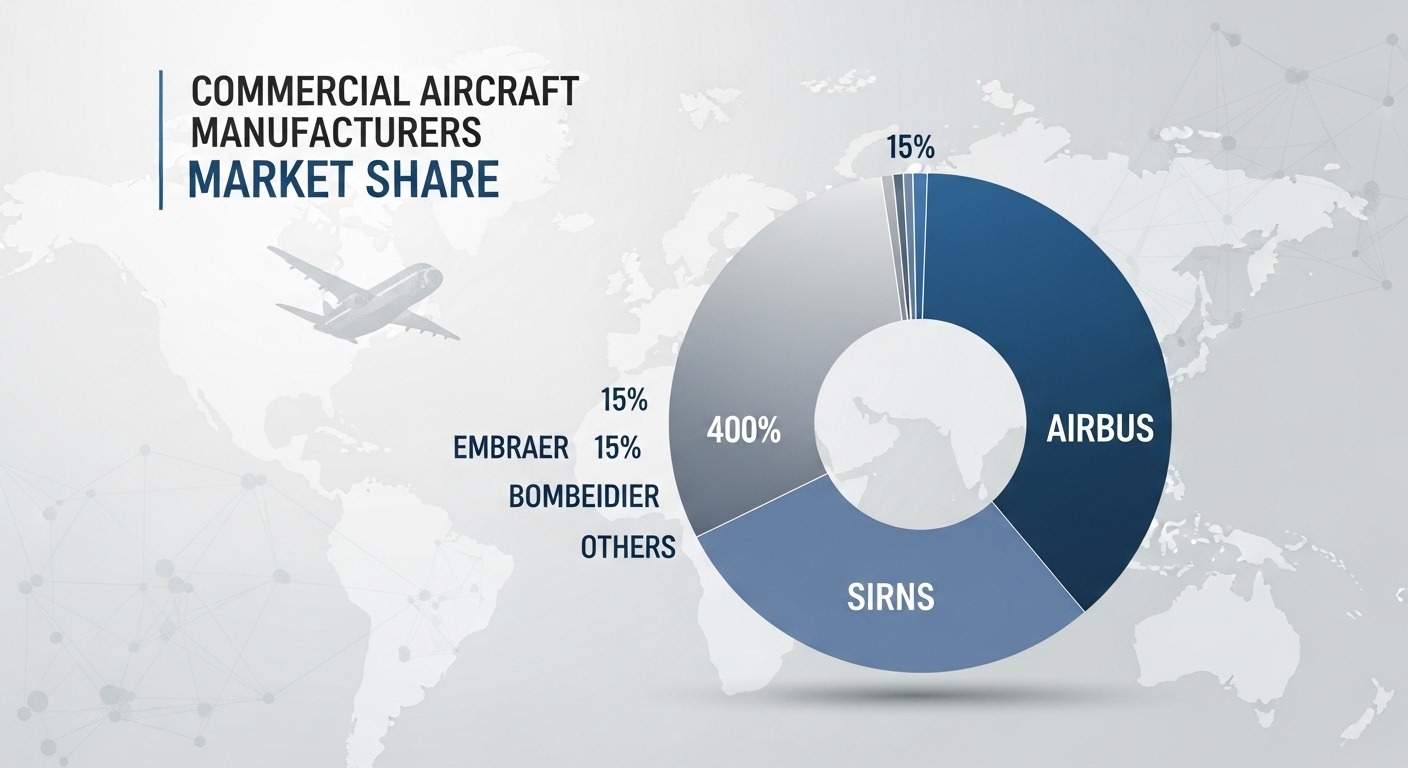
| Projected 2030 Market Share | ~58% | ~39% |
The Challenger: COMAC (China)
The most consequential development in global commercial aviation over the next decade will not be a new Airbus model or a Boeing recovery — it will be the extent to which China’s Commercial Aircraft Corporation of China (COMAC) succeeds in challenging the Western duopoly.
The Aircraft
COMAC operates two commercial programmes of relevance:
C919 (Narrowbody, 158–192 seats): China’s answer to the Airbus A320neo and Boeing 737 MAX. The C919 completed its first commercial flight in May 2023 with China Eastern Airlines after 15 years of development and achieved Chinese type certification in September 2022. It directly competes in the highest-demand segment of global aviation.
C909 (Regional Jet, formerly ARJ21): A 90-seat regional jet that entered service domestically in 2015 and has achieved its first international operations — serving routes in Indonesia (via TransNusa) and Laos (via Lao Airlines) in 2023–2025.
C929 (Widebody, in development): A twin-aisle aircraft targeting approximately 280 passengers and a 12,000 km range, currently in detailed design with entry into service targeted for the early 2030s.
Current Scale and Production
COMAC’s current production volumes are modest by Western standards. In 2024, the company delivered approximately 10–12 C919s and 37 C909s (ARJ21s) — totaling roughly 50 aircraft versus Airbus’s 766 and Boeing’s 348.
For 2025, COMAC initially set ambitious C919 production targets of 50–75 aircraft, but supply chain constraints forced a significant revision. By September 2025, only 5 C919s had been delivered to customers, far below the 32 that China’s three major airlines had anticipated. Confidential sources cited by Bloomberg reported COMAC slashed its 2025 C919 production target to as few as 25 aircraft — a significant setback from earlier ambitions.
IBA Group forecasts a more measured but still meaningful ramp-up:
- 2025: ~18 C919 deliveries
- 2026: ~25 C919 deliveries
- 2027: ~45 C919 deliveries
- 2030: ~90 C919 deliveries annually
By 2030, IBA projects total COMAC deliveries (across all programs) approaching 145 aircraft annually — still well below Airbus and Boeing but representing a credible third-tier presence in the global market.
Order Book
COMAC has announced over 1,200 orders for the C919, though all confirmed orders come from Chinese airlines, leasing companies, or government-related entities. The three major Chinese carriers — Air China, China Eastern, and China Southern — together have placed orders for over 300 C919s. A September 2023 agreement with Brunei’s GallopAir for 15 C919s would make it the first genuine international operator, though deliveries have yet to materialize.
The Certification Challenge
The C919’s international ambitions are constrained by a critical barrier: it is not certified by either the FAA (US) or EASA (Europe). Non-Chinese leasing companies and airlines have made clear they will not consider the aircraft without one of these certifications.
EASA certification, originally hoped for by end-2025, is now expected no earlier than 2028–2031. The agency’s executive director noted in 2025 that only two of the four years of working with COMAC had been “productive,” and that standard bilateral aviation agreement validation timelines — which typically take six months for manufacturers with established relationships — do not apply to COMAC given its shorter history with international regulators.
The FAA certification path has been effectively closed off entirely as of April 2025, given U.S.-China trade tensions.
Geopolitical Vulnerability
A fundamental structural challenge facing COMAC is its dependence on Western-supplied components. The C919’s CFM International LEAP-1C engines are jointly produced by GE Aerospace (US) and Safran (France). Critical avionics come from Honeywell and Collins Aerospace, both American companies. As a result, the C919’s supply chain is acutely vulnerable to geopolitical disruption.
This was demonstrated starkly in mid-2025 when the United States suspended the export of LEAP-1C engines to China in June 2025, before lifting the ban in July. The temporary suspension alone was enough to constrain C919 production materially for the year. COMAC is actively developing indigenous Chinese substitutes — including the CJ-1000A engine from the Aero Engine Corporation of China — but these are not expected to be ready before 2030.
China’s Market Impact
Despite its modest international footprint, COMAC is already reshaping aviation dynamics within China — the world’s second-largest aviation market. Aviation analytics firm Cirium projects that Chinese airlines will induct approximately 6,000 new single-aisle aircraft by 2042, and COMAC is expected to capture roughly 25% of these new additions — versus Boeing’s 30% and Airbus’s 45%.
The April 2025 trade tariffs, which imposed a 125% duty on American imports to China in retaliation for U.S. tariff hikes, significantly raised the effective cost of Boeing aircraft for Chinese carriers. This has materially accelerated the shift of Chinese airline orders toward Airbus and COMAC alternatives and may structurally reduce Boeing’s presence in the Chinese market for years to come.
Regional Manufacturers: Embraer, ATR, and Others
Embraer (Brazil)
Embraer is the world’s leading manufacturer of commercial jets between 70 and 150 seats, holding approximately 70–75% of the regional jet market with its E-Jet and E2 families. The São Paulo-based company delivered 73 commercial aircraft in 2024 — nine more than in 2023 and 16 more than 2022, though still below its pre-pandemic peak of over 100 annual deliveries.
Embraer’s E175 remains especially dominant in the U.S. regional market, where scope clauses in pilot contracts limit regional jets to 76 seats, creating a protected niche that neither Airbus nor Boeing competes in directly.
Looking ahead, Embraer has been studying a potential next-generation narrowbody (turbofan-powered, 100–150 seats) to address the gap between its current portfolio and the A320/737 segment. A January 2025 survey by Aviation Week and Bank of America found high interest among airlines, lessors, and industry participants in such a programme — though no formal launch has been announced as of early 2026.
Embraer’s near-term target is to exceed 80 commercial aircraft deliveries in 2025, supported by a strong backlog for both the E175 in the U.S. and the E2 internationally. AirAsia has been in active talks with Embraer (alongside Airbus and COMAC) for up to 100 regional aircraft.
ATR (France/Italy — Airbus/Leonardo JV)
ATR, a joint venture between Airbus (50%) and Leonardo S.p.A. (50%), is the world’s dominant producer of turboprop regional aircraft with 40–78 seats. Its ATR 42 and ATR 72 families operate across short-haul regional routes where jet economics are unfavorable — particularly in Africa, Southeast Asia, the Caribbean, and Pacific island networks.
ATR controls roughly 80% of the turboprop airliner market by deliveries. The regional turboprop segment is modest in total unit volumes compared to the narrowbody market, but ATR’s near-monopoly in its segment makes it highly profitable per aircraft.
Bombardier (Canada)
Bombardier exited commercial aviation entirely in 2020–2021 by selling its CRJ regional jet programme to Mitsubishi Aircraft and its C Series (now A220) programme to Airbus. The company now focuses exclusively on business jets. While Bombardier CRJs remain in service across North American regional networks, no new commercial aircraft are being produced under the Bombardier name.
Others of Note
Mitsubishi Aircraft (Japan): Mitsubishi acquired the Bombardier CRJ programme maintenance and support operations in 2020. It has struggled to bring its own SpaceJet (formerly MRJ) to certification and indefinitely suspended the program’s development in 2023 — a setback for Japan’s commercial aviation ambitions.
PJSC Yakovlev/UAC (Russia): Russia’s Irkut MC-21 narrowbody — a would-be competitor to the A320 and 737 — has faced severe delays following Western sanctions and the withdrawal of Western-sourced components post-2022. The programme has been reengineered with Russian-made substitutes, but deliveries have been negligible and the aircraft remains confined to the Russian domestic market with no international prospects.
Leonardo S.p.A. (Italy): Co-owner of ATR and producer of turboprop commuter aircraft. Involved in defence and helicopter manufacturing but not a standalone force in the commercial narrowbody or widebody market.
Market Share by Aircraft Segment
Narrowbody Aircraft (Single-Aisle)
Narrowbodies account for the dominant share of both orders and deliveries in commercial aviation. They power the global low-cost carrier revolution, drive domestic aviation in high-growth markets, and are the primary vehicle through which airlines are retiring fuel-inefficient older jets.
| Manufacturer | Key Programmes | Approx. Share of Deliveries |
|---|---|---|
| Airbus | A320neo family, A220 | ~60–62% |
| Boeing | 737 MAX family | ~30–32% |
| COMAC | C919, C909 | ~3–4% (growing) |
| Embraer | E175, E2 family | ~5–6% |
Trend: The A320neo family has now surpassed the Boeing 737 as the best-selling jetliner family in history. Airbus is targeting A320neo production of 75 aircraft per month by 2027 — up from roughly 50–55 today. Boeing is targeting 38 737 MAX per month by late 2026.
Widebody Aircraft (Twin-Aisle)
The widebody market is a true Airbus-Boeing duopoly. No other manufacturer currently produces a competitive commercial twin-aisle jet, and COMAC’s C929 — targeting the early 2030s — remains years from service entry.
| Manufacturer | Key Programmes | Approx. Share |
|---|---|---|
| Airbus | A330neo, A350 | ~52–55% |
| Boeing | 787 Dreamliner, 777X (pending) | ~45–48% |
Trend: Widebody replacement cycles are longer than narrowbody — airlines can extend the life of a 787 or A350 through D-checks, slowing the turnover rate. Boeing’s 777X certification delays continue to be a drag on its widebody competitiveness.
Regional Jets and Turboprops
| Manufacturer | Key Programmes | Approx. Share |
|---|---|---|
| Embraer | E175, E2 family | ~70–75% of regional jets |
| ATR | ATR 42/72 | ~80% of turboprops |
| COMAC | C909 (ARJ21) | Growing domestically |
Regional Market Dynamics
North America
North America accounts for approximately 47.8% of the commercial aircraft market by OEM presence, driven by Boeing’s home base and a dense domestic aviation network. The U.S. market alone is estimated at around $25.76 billion in 2026. American, Southwest, United, and Delta are all major buyers of narrowbody aircraft, and Boeing has historically dominated this market.
However, Boeing’s recent production challenges have led many U.S. carriers to diversify toward Airbus orders. The A321XLR has attracted particularly strong interest from carriers looking to open thin transatlantic routes directly from smaller U.S. cities.
The U.S. regional market is structurally protected by scope clauses that cap regional jets at 76 seats — ensuring continued strong demand for Embraer’s E175.
Asia-Pacific
Asia-Pacific has become the most dynamic region in global commercial aviation. The region accounted for 32.75–45.49% of the commercial aircraft market value in 2025, depending on the methodology applied, and is expected to post the fastest growth through the decade.
Key demand drivers include:
- India’s IndiGo airline, which flew 113 million passengers in 2024 and is targeting a 600-aircraft fleet by 2030, including long-range A321XLRs for nonstop Delhi-to-Europe routes
- China’s aviation market, which is simultaneously a major buyer of Airbus and Boeing jets and the primary market for COMAC’s domestically manufactured aircraft
- Southeast Asian low-cost carriers such as AirAsia and Lion Air, which have placed massive orders for A320neo and 737 MAX aircraft
- India’s infrastructure investment — $1.83 billion planned on airport infrastructure and navigation services by 2026, with the number of operational airports expanding from 136 to 220
The U.S.-China trade war of 2025 has significantly altered the aircraft trade landscape in Asia’s largest market. The 125% Chinese tariff on U.S. imports has effectively priced Boeing out of many new Chinese airline orders, redirecting demand toward Airbus and, incrementally, COMAC.
Europe
Europe holds a significant share of global commercial aircraft demand, driven by intra-European travel, a strong low-cost carrier sector (Ryanair, easyJet, Wizz Air), and expanding international routes. Ryanair, which boarded 21 million passengers in August 2025 alone, is one of Boeing’s largest customers for the 737 MAX.
Europe is also at the forefront of sustainability regulation, with the EU’s emissions trading system and SAF (sustainable aviation fuel) mandates accelerating fleet renewal toward newer, lower-emission aircraft.
Middle East
Middle Eastern hubs — Dubai (Emirates, flydubai), Abu Dhabi (Etihad), Doha (Qatar Airways), and Riyadh (Saudia/Riyadh Air) — have regained sixth-freedom traffic and represent some of the world’s most aggressive aircraft buyers. The region posted a 5.4% CAGR in passenger growth through 2028.
Emirates and Qatar Airways operate some of the most widebody-heavy fleets in the world, making the Middle East a critical battleground for Boeing’s 777X and Airbus’s A350.
Latin America
Latin America’s aviation market has recovered strongly, with Azul, GOL, LATAM, and Avianca all placing orders for new aircraft. Embraer’s home region remains an important market for the E2 family, and Brazil’s government has pushed (so far unsuccessfully) for Azul competitors GOL and LATAM to place E2 orders to support the domestic aerospace industry.
Key Market Trends Shaping the Next Decade
1. Supply Chain Constraints as the Binding Limit
Demand is not the challenge for commercial aircraft manufacturers — capacity is. With backlogs exceeding 12,000 units across Airbus and Boeing, the bottleneck lies in supply chains: castings, composites, engine components, and skilled labor. Both manufacturers have fallen short of their own delivery targets in recent years. Resolving these constraints will determine who captures revenue first.
2. The Rise of AI-Enabled Manufacturing
GE Aerospace deployed an AI-enabled inspection tool at more than a dozen MRO facilities in February 2025, targeting CFM LEAP engine maintenance. Across the supply chain, AI is being applied to quality control, predictive maintenance, and production scheduling — with the goal of closing the gap between order backlogs and actual deliveries.
3. Sustainability and Next-Generation Propulsion
Airlines and regulators are under increasing pressure to reduce commercial aviation’s carbon footprint. This is accelerating demand for:
- Next-generation narrowbodies with 20%+ fuel efficiency improvements (the A320neo and 737 MAX are already in market)
- Sustainable Aviation Fuel (SAF) mandates requiring fuel blending across European routes
- Electric and hybrid propulsion for short-haul regional routes — though infrastructure and range challenges mean this remains a 2030+ market at scale
- Hydrogen propulsion — Airbus has committed to bringing a hydrogen-powered aircraft to market by 2035, though significant technical and infrastructure hurdles remain
In March 2025, Airbus announced a new narrowbody design featuring advanced wings and engines targeting 20% lower fuel consumption than current models — an indication that a next-generation A320 replacement program is being actively explored.
4. COMAC’s Long-Term Disruption Potential
While COMAC’s near-term international impact is negligible (constrained by EASA certification timelines and supply chain dependencies), its long-term trajectory matters enormously. China’s aviation market is expected to absorb approximately 6,000 new single-aisle aircraft by 2042 — and every aircraft captured by COMAC is one not purchased from Airbus or Boeing.
The path to COMAC’s international credibility runs through EASA certification. If the C919 achieves European regulatory approval between 2028 and 2031 as EASA currently projects, the door opens — in theory — to exports in markets that are politically aligned with China or insufficiently served by Western OEMs.
5. Geopolitical Fragmentation of Supply Chains
The 2025 U.S.-China tariff war has exposed the degree to which commercial aviation supply chains are intertwined with geopolitical relationships. Boeing’s loss of the Chinese market — potentially structural given 125% import tariffs — is a significant market share risk. COMAC’s vulnerability to U.S. export controls on engines and avionics is equally acute.
The emerging pattern is a gradual bifurcation: a Western-led aviation ecosystem centered on Airbus and Boeing, and a Chinese-domestic ecosystem centered on COMAC, with competition intensifying in the markets in between — Southeast Asia, South Asia, the Middle East, and Africa.
Competitive Landscape Summary
| Manufacturer | Headquarters | 2025 Est. Deliveries | Primary Segments | Market Position |
|---|---|---|---|---|
| Airbus SE | Toulouse, France | ~800–820 | Narrowbody, Widebody | Global leader |
| Boeing | Chicago, USA | ~569–600 | Narrowbody, Widebody | Recovering #2 |
| Embraer | São José dos Campos, Brazil | ~80+ | Regional jets (70–150 seats) | Regional leader |
| ATR (Airbus/Leonardo JV) | Toulouse, France | ~50–60 | Turboprops (40–78 seats) | Turboprop leader |
| COMAC | Shanghai, China | ~50 (all programs) | Narrowbody (domestic), Regional | Emerging challenger |
Outlook to 2030
The structural dynamics of the commercial aircraft manufacturing market over the next five years can be summarized in four themes:
Airbus consolidates leadership. With a decade-long backlog, a best-selling narrowbody family, the A321XLR opening new markets, and Boeing still recovering, Airbus is positioned to extend its delivery and order lead further through 2030. Its projected 58% market share by decade’s end reflects structural advantage, not just cyclical luck.
Boeing recovers, but structurally diminished. Boeing’s 2025 recovery is real and meaningful. The 737 MAX remains an excellent product with strong demand from low-cost carriers. But the loss of Chinese market access, the 777X’s delayed entry into service, and a backlog significantly smaller than Airbus’s mean Boeing will likely stabilize in the 38–42% global share range rather than return to the near-50% levels it once held.
COMAC becomes significant in China, marginal globally. By 2030, COMAC may deliver 90–145 aircraft annually, capturing 20–25% of China’s single-aisle orders. Internationally, without EASA certification and with supply chain vulnerabilities, its footprint will remain limited to politically adjacent markets. The C929 widebody, targeted for the early 2030s, is the more important long-term indicator of COMAC’s global ambitions.
Embraer eyes a new segment. The potential launch of a next-generation Embraer narrowbody (100–150 seats) would represent the most significant new market entry in the narrowbody segment in decades. Airline and lessor interest is strong. Whether Embraer can secure the capital, partnerships, and orders to proceed with a clean-sheet design remains the key strategic question for the Brazilian manufacturer.
The commercial aircraft manufacturing market in 2026 and beyond is defined by unprecedented demand, constrained supply, and the first serious challenge to the Airbus-Boeing duopoly in a generation. How that challenge plays out — particularly from China — will be the defining story of commercial aviation’s next chapter.
Summary Table: Market Share at a Glance
| Category | Airbus | Boeing | Embraer | ATR | COMAC |
|---|---|---|---|---|---|
| Overall delivery share (2025) | ~58–60% | ~35–38% | ~5–6% | ~3–4% | ~3–4% |
| Narrowbody share | ~60–62% | ~30–32% | ~5–6% | — | ~3–4% |
| Widebody share | ~52–55% | ~45–48% | — | — | — |
| Regional jet share | — | — | ~70–75% | — | Growing |
| Turboprop share | — | — | — | ~80% | — |
| 2030 projected share | ~58% | ~39% | Stable | Stable | ~3% (global) |
Disclaimer: All market share figures, delivery numbers, and forward projections are based on publicly available data from industry sources including Forecast International, IBA Group, Cirium, Roland Berger, IATA, and manufacturer announcements as of early 2026. Figures may vary across sources depending on methodology. This article does not constitute financial or investment advice.

I’m Md Nasir Uddin, a digital marketing consultant with over 9 years of experience helping businesses grow through strategic and data-driven marketing. As the founder of Macroter, my goal is to provide businesses with innovative solutions that lead to measurable results. Therefore, I’m passionate about staying ahead of industry trends and helping businesses thrive in the digital landscape. Let’s work together to take your marketing efforts to the next level.