
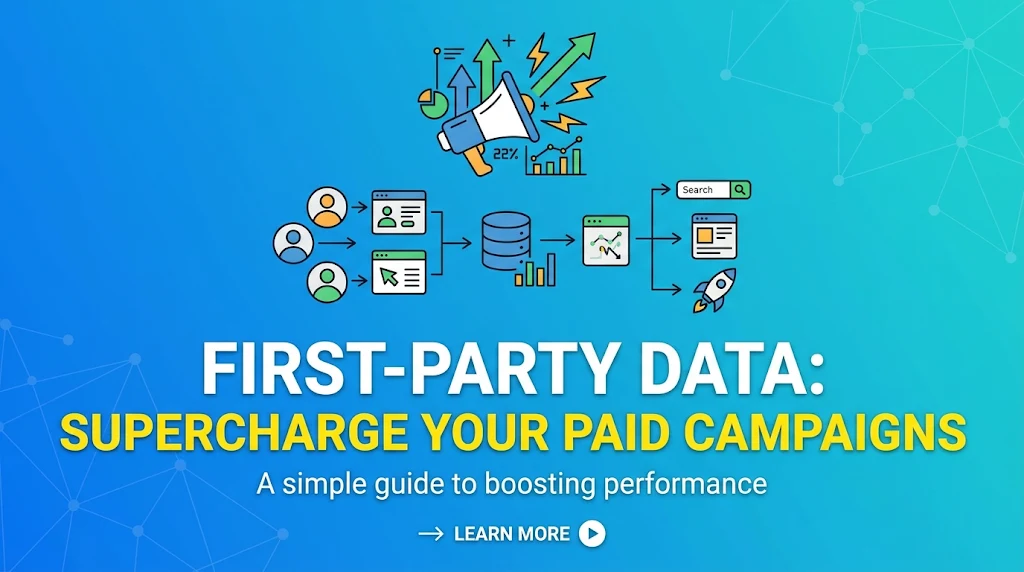
The digital advertising ecosystem has hit a structural tipping point. Between the phased deprecation of third-party cookies, Apple’s App Tracking Transparency (ATT) framework, tightening privacy regulations like GDPR and CCPA, and skyrocketing Customer Acquisition Costs (CAC), traditional audience targeting is losing its edge.
For years, media buyers relied heavily on third-party data broker segments and broad platform retargeting pixels. Today, those third-party signals are degraded, inaccurate, and expensive. Media buyers who continue relying solely on platform-native algorithmic expansion without supplying deterministic data signals are watching their Return on Ad Spend (ROAS) erode month over month.
The solution isn’t to spend more money fighting algorithmic inefficiency. The solution is First-Party Data Activation.
When properly gathered, structured, and piped into ad platforms like Google Ads, Meta Ads Manager, LinkedIn Campaign Manager, and Programmatic Demand-Side Platforms (DSPs), your proprietary customer data becomes the ultimate competitive moat. It enables hyper-accurate lookalike modeling, predictive value-based bidding, advanced funnel exclusion, and hyper-personalized creative messaging.
This comprehensive playbook walks you through the technical, strategic, and tactical steps to transform raw first-party customer signals into high-ROI paid campaigns.
What Is First-Party Data (and Why Is It Your Highest-ROI Asset)?
Before scaling your data pipeline, it is critical to clarify how first-party data fits into the broader data ecosystem.
+-------------------------------------------------------------------------------+
|                               THE DATA SPECTRUM                               |
+-------------------+-----------------------------------------------------------+
| Zero-Party Data   | Explicitly shared by user (Preferences, Survey Answers)   |
+-------------------+-----------------------------------------------------------+
| First-Party Data  | Collected directly via touchpoints (CRM, Web, App Events) |
+-------------------+-----------------------------------------------------------+
| Second-Party Data | Another company's 1st-party data shared via partnership    |
+-------------------+-----------------------------------------------------------+
| Third-Party Data  | Aggregated data bought from third-party data brokers      |
+-------------------+-----------------------------------------------------------+
Defining First-Party vs. Zero-Party Data
-
Zero-Party Data: Information a customer intentionally and proactively shares with you. This includes survey responses, style preferences, quiz results, purchase intent indicators, and newsletter preferences.
-
First-Party Data: Data collected directly from your audience through their interactions across your digital touchpoints. This includes CRM records (email addresses, phone numbers, postal addresses), website behavioral data (pages viewed, time on site, cart additions), mobile app activity, transaction history, and customer service logs.
Key Takeaway: Third-party data tells you what someone might like based on external tracking. First-Party Data tells you exactly who your verified buyers are, how much they spend, and how they behave across your assets.
The Economic Advantage of First-Party Signals in Media Buying
Modern ad networks run on machine learning models (e.g., Google’s Smart Bidding and Meta’s Advantage+). These models require high-quality conversion signals to understand who your ideal customer is.
When you feed ad platforms pixel data alone, you send incomplete, low-fidelity signals—often degraded by ad blockers and browser restrictions. When you feed platforms unified, server-side first-party data:
-
Match Rates Increase: Server-to-server data ingestion bypasses browser-level blocking, ensuring 20% to 40% higher signal capture.
-
Value-Based Algorithms Optimization: You train bidding engines to optimize for Customer Lifetime Value (LTV) rather than cheap, low-intent conversions.
-
CAC Decreases: Precise exclusion lists prevent wasting ad spend on existing customers or churned accounts during acquisition campaigns.
Building the Technical Foundation: Data Collection and Integration
Activating first-party data requires moving beyond the basic browser pixel. Relying solely on client-side JavaScript tracking leaves substantial conversion data on the table due to Safari ITP (Intelligent Tracking Prevention), brave browser shields, and ad-blocking extensions.
[User Action on Web/App]
       │
       ├──► Client-Side (Browser Pixel) ───────► (Blocked by ITP / AdBlock) ──► Loss of Signal
       │
       └──► Server-Side (CAPI / Server GTM) ────► Ad Platform Endpoint ─────► High Match Rate
1. Implement Server-Side Tracking & Conversions API (CAPI)
Client-side tracking happens in the user’s browser. Server-side tracking sends event data directly from your cloud server (or a Server-Side Google Tag Manager container) straight to the ad network’s API endpoints.
To maximize signal fidelity, implement:
-
Meta Conversions API (CAPI): Connects your web server directly to Meta Ads Manager.
-
Google Enhanced Conversions: Sends hashed customer parameters (email, name, address) to Google alongside standard conversion tags.
-
LinkedIn Conversions API: Ensures reliable offline and online attribution for B2B pipelines.
Pro Tip: Event Deduplication
When deploying both client-side pixels and server-side APIs simultaneously, you must pass unique event_id parameters with every payload. This enables ad networks to deduplicate events so your conversion counts remain accurate.
2. Standardize Customer Identifiers for Higher Match Rates
When uploading offline CRM files or streaming data via APIs, ad networks attempt to match your records against their user accounts. Higher match rates yield larger custom audiences and more accurate lookalikes.
To achieve an 80%+ match rate, clean and normalize your data across these parameters:
-
Email Addresses: Trim spaces, convert all text to lowercase, and format as UTF-8 before SHA-256 hashing.
-
Phone Numbers: Convert to full E.164 international format (e.g.,
+14155552671). -
Physical Addresses: Include city, state/province, postal code, and two-letter ISO country codes.
-
Advanced Match Keys: Include first name, last name, date of birth, and gender when available.
3. Deploy Customer Data Platforms (CDPs) or Reverse ETL Tools
Manually exporting CSV files from your CRM and uploading them to ad accounts creates operational latency. Audience lists quickly become stale, leading to wasted ad spend.
Implement an automated data pipeline using tools like:
-
Customer Data Platforms (CDPs): Segment, Tealium, or RudderStack to aggregate real-time behavioral data across web, mobile, and backend systems.
-
Reverse ETL Engines: Census or Hightouch to sync SQL queries from your data warehouse (Snowflake, BigQuery, Databricks) directly into Meta, Google, LinkedIn, and TikTok ad managers every hour.
5 High-ROI Tactics to Supercharge Your Paid Campaigns
Once your data pipelines are active, move from defensive tracking to offensive media buying strategies.
+---------------------------------------------------------------------------------+
|                       5 FIRST-PARTY DATA ACTIVATION STRATEGIES                  |
+---------------------------------------------------+-----------------------------+
| TACTIC                                            | OBJECTIVE                   |
+---------------------------------------------------+-----------------------------+
| 1. LTV-Weighted Value-Based Bidding (VBB)         | Maximize Revenue / ROAS     |
| 2. High-Fidelity Custom Lookalikes                | Lower Cold Acquisition CAC  |
| 3. Dynamic Retention & Cross-Sell Workflows       | Boost Expansion & Repeat LTV|
| 4. Deterministic Exclusion Lists                  | Eliminate Ad Spend Waste    |
| 5. Zero-Party Quiz Data Personalization           | Skyrocket Ad Relevance      |
+---------------------------------------------------+-----------------------------+
Strategy 1: Transition from Target CPA to Value-Based Bidding (VBB)
Most media buyers bid on raw conversion volume using Target CPA (Cost Per Acquisition). The flaw? It treats a customer who spends $20 identically to a VIP customer who spends $2,000.
First-party activation enables Value-Based Bidding (VBB) across Google Search, Performance Max, and Meta Advantage+.
Execution Framework:
-
Extract historic purchase data from your warehouse.
-
Group users into spending tiers or calculate predicted 12-month LTV ($pLTV$).
-
Pass historical or predicted purchase values alongside the conversion event via Server-Side API.
-
Switch campaign bidding strategies from Maximize Conversions to Maximize Conversion Value (with a Target ROAS floor).
[Standard CPA Bidding]   ---> Treats all buyers equally ---> Optimizes for high-volume, low-value buyers.
[Value-Based Bidding]    ---> Inputs 1st-Party LTV Data ---> Directs budget to high-value buyers.
Real-World Example: An e-commerce apparel brand uploaded 2 years of purchase data categorized into top 10% LTV customers versus low-tier buyers. By setting up Google Performance Max with Enhanced Conversions passing predicted LTV values, their ROAS increased by 42% within 60 days because the bidding engine prioritised user profiles matching their highest-value cohort.
Strategy 2: Build Seed Audiences for Precision Lookalike Modeling
Broad targeting works well when ad platform algorithms have billions of data points. However, supplying high-quality “seed lists” derived from first-party segments accelerates algorithmic learning and lowers cold acquisition costs.
High-Converting Seed List Ideas:
-
Top 15% Highest-LTV Customers: Strip out low-margin, one-time buyers.
-
Repeat Buyers (3+ Purchases): Focus exclusively on multi-buyer signals.
-
High-Intent B2B Pipeline: Upload users who reached the “Qualified Opportunity” or “Closed Won” stage in your CRM (HubSpot/Salesforce), rather than raw ebook leads.
-
Recent High-AOV Buyers: Customers who purchased above your average order value within the last 90 days.
Execution Step:
-
Export your segmented seed list (minimum 1,000 unified profiles; 5,000+ preferred).
-
Upload directly to Meta Ads, LinkedIn, or Google Customer Match.
-
Build 1% to 3% Lookalike Audiences (Meta) or Similar Audiences/Optimized Targeting seeds (Google).
-
Run dedicated acquisition campaigns delivering creative customized to the Pain Points of that high-value segment.
Strategy 3: Deploy Automated Funnel Exclusion
The fastest way to improve campaign efficiency is to stop paying to show ads to users who have already taken the desired action, or who are structurally incapable of converting.
Core Exclusions to Implement:
-
Active Subscribers / Existing Customers: Exclude your master active customer list from general lead-generation or brand awareness campaigns.
-
Open CRM Deals: Exclude active sales opportunities from top-of-funnel educational ads, and route them instead to middle-of-funnel validation campaigns (case studies, security credentials).
-
Recent Converters (1–30 Days): Exclude recent buyers from retargeting campaigns pushing the exact product they just purchased.
-
Job Applicants & Unqualified Leads: Exclude visitors who visited
/careersor were marked “Unqualified” by your sales team.
Example Setup in Meta Ads Manager:
Campaign: Top-of-Funnel Prospecting (Advantage+ / Cold Interest)
├── Included Targeting: Broad / Lookalike (Top 10% LTV)
└── EXCLUDED TARGETING:
    ├── Custom Audience: 1st-Party Master Customer List (Synced hourly via Reverse ETL)
    ├── Custom Audience: Web Visitors (Past 180 Days)
    └── Custom Audience: Unqualified CRM Leads
Strategy 4: Drive High-Margin Repeat Purchases with Dynamic Lifecycle Retargeting
First-party data isn’t just for acquisition—it is an engine for driving customer retention, cross-selling, and upselling via paid channels. Email and SMS open rates continue to fluctuate; combining owned channels with paid retargeting ensures high touchpoint visibility.
Tactical Scenarios:
A. The Replenishment Loop (Consumer Goods / CPG)
If your product (e.g., protein powder, skincare, coffee beans) has a 30-day usage cycle:
-
Days 1–25 post-purchase: Exclude user from all product ads.
-
Days 26–35 post-purchase: Trigger dynamic retargeting ads featuring 1-click reorder incentives or subscription offers.
B. The Vertical Cross-Sell (SaaS & B2B)
When a user purchases Tier A software:
-
Segment your CRM data to isolate users actively using Tier A for 60+ days.
-
Run targeted video ads highlighting the features and ROI of upgrading to Tier B or adding seats.
C. Churn Prevention & Win-Back
-
Target inactive customers (no login or purchase in 90 days) with targeted win-back offers before they churn completely.
Strategy 5: Activate Zero-Party Data for Hyper-Personalized Creative Match
When users take an onboarding quiz, complete an assessment, or set account preferences, you collect direct zero-party signals. Wiring this data directly into your ad platforms enables radical ad creative alignment.
[User Completes Quiz] ──► Selects "Dry Skin + Anti-Aging" ──► Synced to Ad Account via CDP ──► Sees Custom Creative for Anti-Aging Hydration Cream
Step-by-Step Implementation:
-
Build an interactive quiz on your site (e.g., “Find Your Custom Skincare Routine” or “Calculate Your Enterprise Cloud Cost”).
-
Capture key user responses (e.g., Skin Type = Dry, Budget Tier = Enterprise, Primary Goal = Lead Generation).
-
Push these user attributes into custom variables within your CRM/CDP.
-
Pass these attributes as custom audience tags to Meta, TikTok, and Google.
-
Deliver ad creative tailored directly to their selection.
Common Pitfalls & Mistakes to Avoid
Even seasoned growth marketers stumble when managing complex first-party data strategies. Avoid these common traps:
1. Uploading Stale, Static CSV Files
-
The Error: Exporting a customer list manually once every six months and leaving it in the ad platform.
-
The Result: You waste budget serving ads to people who bought yesterday, while missing out on new buyers who should be seed profiles for lookalikes.
-
The Fix: Set up real-time or hourly automated data syncs using reverse-ETL tools or native CRM integrations.
2. Violating Privacy Laws and Consent Frameworks
-
The Error: Syncing non-consented user emails or PII (Personally Identifiable Information) to ad platforms in regions governed by strict data privacy legislation (GDPR, CCPA, CPRA, LGPD).
-
The Result: Massive regulatory fines, ad account suspensions, and brand reputation damage.
-
The Fix: Implement a Consent Management Platform (CMP) like OneTrust or Cookiebot. Ensure your data pipelines map explicit consent flags (e.g.,
ad_user_data=grantedandad_personalization=grantedfor Google Consent Mode v2) before routing records to ad platforms.
3. Relying on Unhashed, Poorly Formatted Data
-
The Error: Uploading lists containing formatting errors (e.g., missing country codes, spaces in phone numbers, capitalized emails).
-
The Result: Ad networks fail to match the data, leading to low match rates (20-30%) and small audience sizes.
-
The Fix: Standardize data hygiene at ingestion using clean data transformations (E.164 phone formats, lowercase sanitized string parameters, proper SHA-256 hashing).
4. Over-Segmenting Custom Audiences
-
The Error: Creating dozens of hyper-niche CRM audience lists with under 100 contacts each.
-
The Result: Ad platform bidding engines enter perpetual learning phases due to insufficient data volume.
-
The Fix: Aggregate audience segments until they contain at least 1,000–5,000 active records per ad set to ensure machine learning algorithms can optimize effectively.
Frequently Asked Questions (FAQ)
What is the difference between first-party data and zero-party data in advertising?
First-party data is behavioral and transactional data collected automatically from user interactions with your owned assets (e.g., website pageviews, purchase history, app engagement). Zero-party data is information that customers proactively and explicitly share with you (e.g., quiz answers, preference center selections, survey feedback). Both are proprietary, but zero-party data provides direct insight into user intent.
How does cookieless tracking impact first-party data strategies?
The phase-out of third-party tracking means third-party cookies can no longer reliably track users across external sites. First-party data strategies bypass this limitation by relying on direct, consent-backed user identifiers (emails, phone numbers, first-party cookie IDs) matched via server-to-server connections (such as Conversions API and Enhanced Conversions), maintaining high tracking accuracy despite browser privacy restrictions.
What minimum audience size is required to run first-party data campaigns?
While most major advertising platforms allow custom audience uploads with a minimum of 100 matched users, a list size of 1,000 to 5,000 matched profiles is recommended to exit platform learning phases and run efficient campaigns. For generating reliable Lookalike/Similar Audiences, aim for a high-quality seed list of 2,500 to 10,000 active customer records.
How do I improve my audience match rate on Google and Meta Ads?
To maximize match rates (aiming for 70–80%+):
-
Include multiple identifiers per user (Email 1, Email 2, Phone Number, First Name, Last Name, Zip Code, Country).
-
Normalize all data before hashing (lowercase text, trim whitespace, use E.164 format for phones).
-
Use automated real-time API integrations (like Meta CAPI or Google Customer Match API) rather than periodic manual uploads.
-
Pass first-party cookie IDs (
_fbp,_fbc,gclid) alongside PII data parameters.
Conclusion: Turn Your First-Party Signals Into Market Dominance
The era of effortless, cookie-driven media buying is over. Marketers who rely exclusively on native platform pixels and generic third-party data will continue to experience lower match rates, inefficient ad spend, and deteriorating ROAS.
Winning in today’s performance landscape requires building a robust, privacy-compliant first-party data engine. By standardizing customer identifiers, implementing server-side APIs, automating data syncs, and deploying value-based bidding, you turn your proprietary data into your greatest growth engine.

I’m Md Nasir Uddin, a digital marketing consultant with over 9 years of experience helping businesses grow through strategic and data-driven marketing. As the founder of Macroter, my goal is to provide businesses with innovative solutions that lead to measurable results. Therefore, I’m passionate about staying ahead of industry trends and helping businesses thrive in the digital landscape. Let’s work together to take your marketing efforts to the next level.