
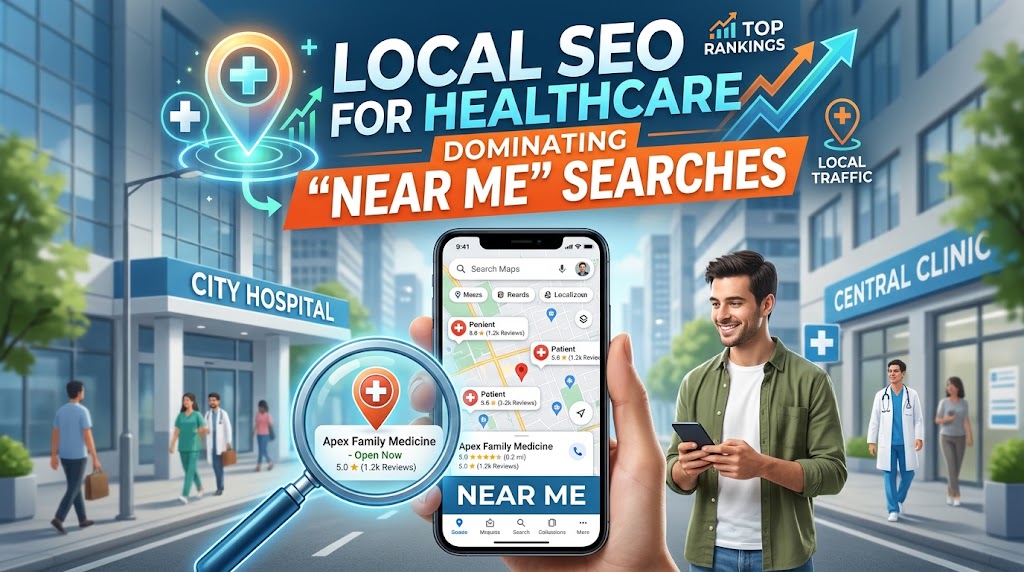
Imagine a patient waking up at 2:00 AM with severe toothache pain, or a mother searching on her smartphone for a “pediatrician near me” after her toddler spikes a fever. In these critical, high-intent moments, patients aren’t scrolling through pages of traditional search results or leafing through directory listings. They are looking at the top three local map results on their screens—the coveted Google Local 3-Pack.
For modern medical practices, urgent care centers, dental clinics, and specialized healthcare providers, local search is no longer just a digital marketing channel. It is the primary front door to your practice. Over 77% of patients use search engines to find healthcare providers, and searches containing location-based modifiers like “near me,” “open now,” or “closest clinic” have grown exponentially year after year.
If your healthcare organization does not dominate local search results, you are losing high-value patients to competing practices every single day. This comprehensive guide details the exact frameworks, technical optimizations, and patient-acquisition strategies needed to own local search results and secure sustainable practice growth.
The Strategic Importance of Local Healthcare SEO
Healthcare intent differs fundamentally from general e-commerce or informational search behavior. When a user searches for consumer products, their journey often spans days or weeks of passive research. Healthcare searches, however, are driven by immediacy, proximity, and trust.
       [ Patient Experiences Need or Symptom ]
                         │
                         ▼
       [ High-Intent Search: "Urgent Care Near Me" ]
                         │
                         ▼
       [ Local 3-Pack & Google Maps Displayed ]
                         │
        ┌────────────────┴────────────────┐
        ▼                                 ▼
[ Practice A: Top 3 Rank ]      [ Practice B: Page 2 ]
  - High Star Rating              - Outdated Info
  - Online Booking                - Poor Review Profile
  - Accurate NAP Info             - Hard to Contact
        │                                 │
        ▼                                 ▼
[ Patient Booked Immediately ]     [ Direct Conversion Lost ]
The Search Intent Behind Healthcare Queries
The primary search intent behind local healthcare queries is commercial and transactional. Users searching for “dermatologist near me” or “best physical therapy clinic in [City]” are ready to convert. They want to make a phone call, check insurance coverage, or schedule an appointment immediately.
Google treats these requests with high local sensitivity, prioritizing proximity, relevance, and prominence over traditional sitewide authority.
Key Takeaway: Local SEO for healthcare isn’t about driving vanity web traffic; it is about converting high-intent local searchers into scheduled patients at the exact moment they need care.
1. Master the Google Business Profile (GBP) Foundation
Your Google Business Profile (GBP)—formerly Google My Business—is the single most influential ranking asset for local map results. Optimizing your GBP goes far beyond entering basic business information; it requires precise data structuring tailored to medical entities.
Primary and Secondary Category Selection
Google uses business categories as a core filter for determining relevance. Selecting the incorrect primary category will cripple your ability to rank for high-value search terms.
-
Primary Category: Choose the most specific category that defines your core medical service (e.g., Orthopedic Surgeon instead of Medical Clinic, or Pediatric Dentist instead of Dentist).
-
Secondary Categories: Add every relevant secondary medical service offered (e.g., Sports Medicine Clinic, Pain Management Physician, Joint Replacement Surgeon).
Pro Tip: Look at the primary categories used by the top three ranking practices in your city for your target keyword. Align your primary category with the dominant category pattern while leveraging secondary categories to capture niche intent.
Standardizing NAP (Name, Address, Phone Number) Data
Inconsistent NAP data confuses search engines and reduces algorithmic trust. Ensure that your practice name, physical address, and phone number are perfectly uniform across all web properties.
-
Practice Name: Avoid keyword stuffing in your official business name (e.g., listing “City Dental – Best Dentist Near Me”) as this violates Google guidelines and risks suspension. Stick to your legal or branded operational name.
-
Phone Numbers: Use a primary local telephone number with a local area code rather than a toll-free 800 number. Local area codes reinforce geographic proximity.
Multi-Practitioner and Multi-Location Setups
Healthcare marketing often faces the complexity of managing multi-doctor practices or multi-location systems. Google allows profiles for both physical locations and individual practitioners, but they must be structured correctly to prevent self-cannibalization.
                  [ Healthcare System / Practice ]
                                  │
         ┌────────────────────────┴────────────────────────┐
         ▼                                                 ▼
[ Location Profile 1 ]                            [ Location Profile 2 ]
  - Dedicated NAP                                   - Dedicated NAP
  - Location Landing Page                           - Location Landing Page
  - Unique Photos & Reviews                         - Unique Photos & Reviews
         │
         ├─── [ Practitioner Profile A ]
         └─── [ Practitioner Profile B ]
-
Physical Locations: Every physical clinic must have a distinct GBP profile linked to a dedicated location page on your main website.
-
Individual Practitioners: Individual doctors can have dedicated GBP profiles if they are patient-facing. Ensure the practitioner profile links to their specific bio page on your website, while the location profile links to the location page.
2. On-Page SEO and Technical Structure for Medical Sites
While your Google Business Profile drives local map pack rankings, your website’s on-page architecture serves as the contextual engine that validates your practice’s relevance and authority to search crawlers.
Geo-Targeted Location Pages
If your practice operates in multiple cities or neighborhoods, create dedicated, unique landing pages for every location. Avoid creating duplicate pages with swapped city names; each page must offer unique value.
Structural Elements of a High-Converting Location Page:
-
URL Structure:
[domain.com/locations/city-clinic-name/](https://domain.com/locations/city-clinic-name/) -
Localized H1 Tag: Include service and city (e.g., “Comprehensive Cardiac Care in Downtown Austin, TX”)
-
Embedded Interactive Map: Embed the practice’s official Google Maps listing directly on the page.
-
NAP Information: Display localized address and direct phone numbers matching the GBP profile.
-
Operating Hours and Parking Info: Details regarding entrance access, public transit, and parking facilities.
-
Provider Bios: Direct links to the doctors practicing at that specific location.
Advanced Medical Schema Markup
Structured data (Schema.org) acts as a direct line of communication with search engine bots, helping them parse complex medical entities, qualifications, and operational details.
Implement the MedicalBusiness or specific sub-types like Physician, Dentist, or MedicalClinic using JSON-LD formatting.
{
  "@context": "https://schema.org",
  "@type": "MedicalClinic",
  "name": "Apex Orthopedics & Sports Medicine",
  "image": "https://www.apexorthoexample.com/images/clinic-front.jpg",
  "@id": "https://www.apexorthoexample.com/#clinic",
  "url": "https://www.apexorthoexample.com/locations/austin/",
  "telephone": "+1-512-555-0199",
  "priceRange": "$$",
  "address": {
    "@type": "PostalAddress",
    "streetAddress": "1200 Medical Parkway, Suite 300",
    "addressLocality": "Austin",
    "addressRegion": "TX",
    "postalCode": "78701",
    "addressCountry": "US"
  },
  "geo": {
    "@type": "GeoCoordinates",
    "latitude": 30.2747,
    "longitude": -97.7404
  },
  "openingHoursSpecification": {
    "@type": "OpeningHoursSpecification",
    "dayOfWeek": [
      "Monday",
      "Tuesday",
      "Wednesday",
      "Thursday",
      "Friday"
    ],
    "opens": "08:00",
    "closes": "17:00"
  },
  "medicalSpecialty": "Orthopedic"
}
3. Review Acquisition, Reputation Management, and Compliance
Online reviews are a significant ranking factor for local search engines and the single most critical trust signal for potential patients. A higher star rating and steady volume of fresh reviews directly influence click-through rates from local pack results.
            [ Patient Completes Appointment ]
                            │
                            ▼
           [ Automated Request via SMS/Email ]
                            │
              ┌─────────────┴─────────────┐
              ▼                           ▼
    [ Patient Leaves Review ]    [ Patient Needs Support ]
              │                           │
              ▼                           ▼
    [ Publish to GBP ]            [ Internal Feedback Loop ]
              │                           │
              └─────────────┬─────────────┘
                            ▼
          [ Standardized HIPAA-Compliant Response ]
Automated Review Collection Frameworks
Relying on patients to proactively search for your profile and leave a review yields low completion rates. Implement automated SMS and email sequences integrated into your Electronic Health Record (EHR) or practice management software.
-
Timing: Send review requests within 2 to 24 hours after an appointment when the experience is still fresh.
-
Simplicity: Provide a direct short link to your GBP review prompt.
-
Message Format: Keep requests concise: “Hi [Patient Name], thank you for visiting [Practice Name] today. Would you mind sharing a quick feedback review of your experience? [Link]”
The HIPAA Compliance Framework for Review Responses
Responding to reviews shows prospective patients that your practice values patient feedback. However, responding to medical reviews presents strict privacy risks under healthcare legislation like HIPAA in the United States.
CRITICAL RULE: Never acknowledge that the reviewer is a patient of your practice, confirm clinical details, or reveal personal health information—even if the patient openly discloses medical details in their review.
Incorrect (HIPAA Violation):
“Hi Sarah, thank you for the review! We are so glad Dr. Smith was able to help treat your knee pain at our Austin clinic.”
Correct (HIPAA Compliant):
“Thank you for your feedback. We strive to deliver high-quality, compassionate care to everyone who walks through our doors. If you would like to discuss your experience further, please contact our office manager directly at [Phone/Email].”
4. Local Citation Ecosystem and Healthcare Directories
Citations—mentions of your practice’s NAP across business directories, medical platforms, and mapping platforms—validate your physical footprint and geographic authority.
Core Medical Directory Checklist
Ensure your practice maintains updated profiles on both general local citations and specialized healthcare portals:
| Tier 1 General Platforms | Tier 2 Medical Directories | Regional & Niche Directories |
| Google Business Profile | Healthgrades | Local Chamber of Commerce |
| Apple Maps | WebMD Physician Directory | State Medical Board Directories |
| Bing Places | Vitals | Regional Hospital Network Listings |
| Yelp for Business | Zocdoc | Local Community Business Directories |
Aggregator Management
Primary data aggregators (such as Data Axle, Neustar Localeze, and Foursquare) feed accurate business details down to hundreds of tier-2 and tier-3 local directories. Claiming and verifying data at the aggregator level ensures systemic consistency across the web.
5. E-E-A-T and Search Quality Rater Guidelines for Healthcare
Healthcare websites fall squarely under Google’s YMYL (Your Money or Your Life) quality guidelines. Search engines hold medical information to extreme standards of accuracy, expertise, and safety. Building strong E-E-A-T (Experience, Expertise, Authoritativeness, and Trustworthiness) is critical for local medical sites.
                   ┌────────────────────────┐
                   │       E-E-A-T          │
                   └───────────┬────────────┘
                               │
       ┌───────────────────────┼───────────────────────┐
       ▼                       ▼                       ▼
[ Author Qualifications ]  [ Editorial Oversight ]  [ Local Authority ]
 - Medical Doctor Bios      - Peer-Reviewed Content   - Press Mentions
 - Board Certifications     - Updated Citations       - Community Involvement
 - Academic Credentials     - Clinical Disclaimers    - Local Sponsoring
Medical Review and Author Credentials
-
Verified Authorship: Ensure all clinical articles, conditions guides, and treatment pages feature an author bio box outlining credentials, board certifications, and clinical experience.
-
Medical Reviewers: Have content medically reviewed by a qualified doctor or physician assistant. Include explicit badges: “Medically Reviewed by Dr. [Name], MD, Board Certified Cardiologist.”
Local Link Building Strategies for Medical Practices
Building contextual local backlinks signals to search engines that your clinic is an established institution within your geographic region.
-
Sponsor Local Health Events: Support local 5K charity runs, youth sports leagues, or wellness fairs in exchange for links on event organization sites.
-
Community Health Education: Host free public seminars or health screening events and secure press links from local news sites and community portals.
-
Syndicate Expert Commentary: Pitch your lead physicians to local journalists and TV channels as expert commentators on seasonal health topics (e.g., allergy season prep or sports injury prevention).
Common Local Healthcare SEO Mistakes to Avoid
Avoid these frequent pitfalls that can degrade your practice’s search rankings and visibility:
-
Creating Duplicate GBP Profiles: Setting up duplicate listings for individual services or different suites in the same building dilutes ranking signals and confuses Google’s deduplication algorithms.
-
Ignoring Negative Reviews: Unaddressed negative reviews damage click-through rates. Address complaints professionally with standardized, HIPAA-compliant responses within 24–48 hours.
-
Failing to Manage Holiday and Special Hours: Incorrect operating hours on holidays leads to frustrated patients leaving negative reviews due to unexpected office closures.
-
Keyword-Stuffing Core Website Content: Forcing awkward geo-targeted keywords into medical copy (e.g., “If you need a great dentist Austin TX near me…”) harms readability and trust. Write naturally for humans while structuring metadata for search engines.
Frequently Asked Questions (FAQ)
How long does it take to see results from healthcare local SEO?
Initial improvements from Google Business Profile optimization and NAP cleanup often appear within 30 to 90 days. Achieving dominant rankings for competitive medical keywords (e.g., “dermatologist near me”) in major metropolitan areas typically requires 6 to 12 months of consistent local SEO execution, review acquisition, and content strategy.
Should individual doctors have their own Google Business Profiles?
Yes, individual doctors can have dedicated GBP practitioner profiles if they see patients directly. However, these profiles should complement—not compete with—the primary practice profile. Ensure practitioner profiles link to their dedicated provider bio page on the main practice website, while the primary location profile links to the main location page.
How do we handle negative online reviews without violating HIPAA?
Always respond neutrally and professionally without acknowledging that the reviewer was a patient. Thank them for their feedback, state your practice’s commitment to quality patient care, and invite them to reach out directly via an offline channel (such as a private phone number or administrative email) to resolve any concerns.
What is the most important factor for ranking in the Google Local 3-Pack?
Google’s local ranking algorithm relies on three core factors: Proximity (how close the practice is to the searcher), Relevance (how well the profile and website match the search query), and Prominence (review count/rating, local backlinks, and overall online authority).

I’m Md Nasir Uddin, a digital marketing consultant with over 9 years of experience helping businesses grow through strategic and data-driven marketing. As the founder of Macroter, my goal is to provide businesses with innovative solutions that lead to measurable results. Therefore, I’m passionate about staying ahead of industry trends and helping businesses thrive in the digital landscape. Let’s work together to take your marketing efforts to the next level.