
If you have looked at a performance marketing dashboard recently, you already know the uncomfortable truth: paid acquisition is getting brutally expensive. Customer acquisition costs (CAC) across Meta, Google Ads, and LinkedIn have climbed steadily, squeezing margins for even the sharpest media buyers.
When paid media efficiency plateaus, smart growth teams turn to organic search to lower their blended CAC and build durable demand capture. Yet, most companies treat SEO copywriting like an assembly line—churning out soulless, keyword-stuffed blog posts written for 2015 algorithms, or flooding their domains with unedited, generic AI text.
The result? High bounce rates, stagnant rankings, and zero pipeline contribution.
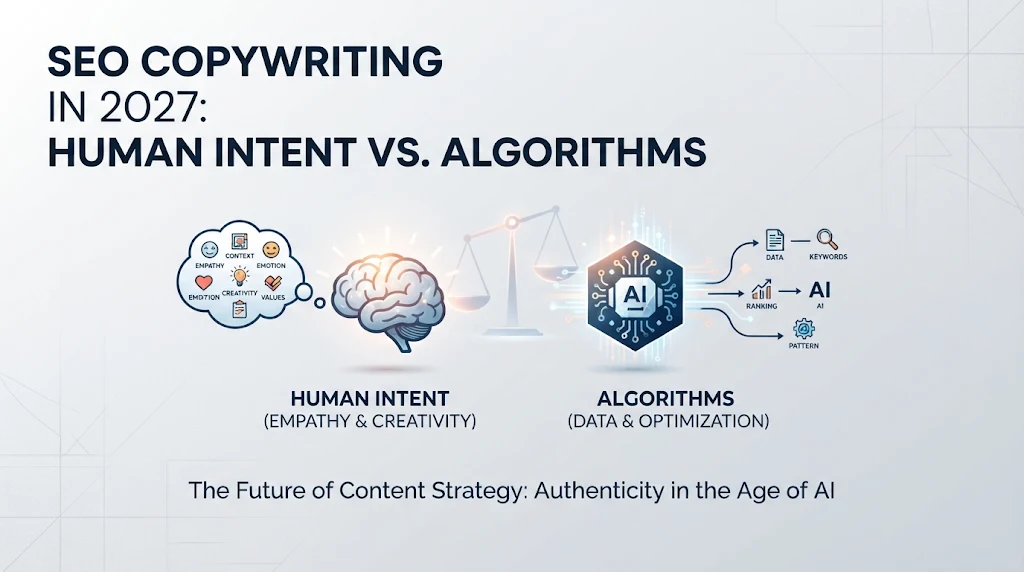
In 2027, Google’s ranking systems—powered by machine learning models like RankBrain, BERT, MUM, and the Helpful Content system—no longer reward mechanical keyword repetition. Instead, the algorithm has evolved to mirror human satisfaction. To win top SERP (Search Engine Results Page) real estate today, your copy must simultaneously satisfy two distinct audiences: an impatient, skeptical human reader and a sophisticated, semantic-understanding search engine.
In this comprehensive guide, we will break down the exact frameworks, psychological triggers, and structural tactics needed to master SEO copywriting in 2027—turning organic clicks into high-intent conversions.
1. The 2027 Search Landscape: Why Old SEO Copywriting Fails
For over a decade, SEO copywriting operated on a predictable, albeit robotic, formula: pick a primary keyword, jam it into the H1, repeat it at a 2% keyword density, add a few exact-match subheadings, and build backlinks.
That playbook is officially dead.
With the integration of Google’s Helpful Content updates into its core ranking algorithm and the rise of AI-generated search summaries (Search Generative Experience / AI Overviews), commodity content is invisible. If your article simply regurgitates the top three results on page one without adding original insight, lived experience, or sharper clarity, search engines have zero incentive to rank it.
How Modern Algorithms Evaluate Copy
Modern search engines use Natural Language Processing (NLP) and vector embeddings to understand context, entity relationships, and user satisfaction rather than just matching strings of text. Google evaluates your copy through three primary lenses:
-
Information Gain: Does this page offer new data, a unique framework, or a fresh perspective that isn’t already present in existing top-ranking documents?
-
User Engagement Signals (Navboost): Do users click your result, stay to read, scroll deeply, and interact—or do they immediately hit the back button (“pogo-sticking”) to click a competitor’s link?
-
E-E-A-T (Experience, Expertise, Authoritativeness, Trustworthiness): Does the copy demonstrate first-hand, real-world experience with the subject matter, rather than theoretical summarization?
Key Takeaway: In 2027, you do not optimize for the algorithm by gaming technical loopholes. You optimize for the algorithm by engineering superior human engagement—and then structuring that content so machines can parse it effortlessly.
The High-ROI Overlap Between PPC and SEO Copywriting
Media buyers and PPC specialists actually hold a massive unfair advantage in modern SEO copywriting. In paid search, you pay for every single click; if your landing page copy doesn’t match the ad’s promise and convert the visitor within seconds, you lose money immediately.
Applying that same direct-response discipline to organic content transforms SEO from a vanity traffic channel into a predictable revenue engine. Every organic landing page should be treated like a high-converting ad destination: clear value proposition above the fold, zero fluff, friction-free readability, and a logical path to conversion.
2. Decoding Search Intent: The Foundation of High-Converting Copy
Before typing a single word, you must diagnose Search Intent—the underlying goal driving a user to type a query into the search bar. Misreading intent is the fastest way to guarantee page-two obscurity, regardless of your domain authority.
Search intent generally falls into four core buckets:
-
Informational Intent: The user wants to learn, understand, or solve a problem (e.g., “how to reduce Meta ad fatigue”).
-
Navigational Intent: The user is looking for a specific brand, tool, or login page (e.g., “Google Ads Manager login”).
-
Commercial Investigation Intent: The user is researching solutions, comparing options, and evaluating vendors before buying (e.g., “best attribution software for ecommerce”).
-
Transactional Intent: The user is ready to buy, sign up, or book a demo right now (e.g., “enterprise SEO agency pricing”).
The 3-Step SERP Forensics Method
Never guess what Google thinks the intent is for a keyword—look at the live evidence. Before outlining your piece, run SERP Forensics on your target query:
-
Analyze Content Format: Are the top five results listicles, step-by-step tutorials, product category pages, interactive calculators, or comparison matrices? If 4 out of 5 top results are comparison tables and you write a 3,000-word philosophical essay, you will not rank.
-
Identify Content Angle: Look at the headlines. Are they angled toward beginners (“101 Guide”), speed (“In 15 Minutes”), cost (“Free Tools”), or advanced practitioners (“Enterprise Frameworks”)?
-
Spot the Content Gap: Open the top three ranking articles and ask: What did they leave out? Where is their advice vague? What questions would a smart reader still have after finishing these pages? That gap is your wedge to win the click and the ranking.
Example in Practice: Suppose you are targeting the keyword “B2B SaaS onboarding checklist.”
Amateur approach: Write 800 words explaining why user onboarding is important for churn reduction, followed by five generic bullet points.
Intent-driven approach: Recognize that the searcher wants an immediate, actionable tool. Open with a 2-sentence definition, immediately provide a categorized, copy-pasteable onboarding checklist broken down by Day 1, Day 7, and Day 30, and include specific benchmark metrics (e.g., “Target a Time-to-Value under 4 minutes”).
3. Writing for Humans First: Persuasion, Clarity, and Engagement
Once you understand what the reader wants, your primary job is to keep them reading. Search engines closely track behavioral signals—dwell time, scroll depth, and return-to-SERP rates. If your introduction bores the reader, your SEO metadata won’t save you.
Mastering the “Hook” with the PAS + Value Framework
Most SEO articles fail in the first 100 words because they start with Throat-Clearing Introductions (e.g., “In today’s fast-paced digital world, content marketing is more important than ever…”). Readers bounce instantly when they see generic filler.
Instead, structure your introductions using PAS + V (Problem, Agitate, Solution, Value):
-
Problem: Call out the exact pain point or goal that brought them to the search bar.
-
Agitate: Briefly highlight the cost of getting it wrong (wasted budget, lost rankings, stalled growth).
-
Solution: Introduce your core thesis or methodology.
-
Value: Tell them explicitly what they will walk away with by reading the piece.
Formatting for Modern Scanning Behavior
People do not read web pages word-for-word from top to bottom; they scan in an F-shaped or layer-cake pattern, hunting for visual anchors that confirm they are in the right place.
To maximize readability and dwell time, enforce strict visual hygiene:
-
Keep paragraphs short: Limit paragraphs to 2–4 sentences maximum. Walls of text trigger instant cognitive fatigue on mobile devices.
-
Use bolding strategically: Bold key takeaways and core concepts—not random keywords—so a skimmer can grasp the entire argument just by reading the bold text.
-
Deploy bulleted and numbered lists: Whenever you present three or more items, steps, or attributes, break them out of prose into a scannable list.
-
Use pattern interrupts: Break up long stretches of text every 250–300 words with blockquotes, data tables, concrete examples, or custom diagrams.
Injecting First-Hand Experience (The “E” in E-E-A-T)
In an era flooded with AI-generated summaries, specificity is the ultimate differentiator. AI writes in averages and generalities; human experts write with scars, numbers, and concrete examples.
Compare these two sentences:
-
Generic AI-style: “Improving your landing page speed can significantly boost your conversion rates and lower bounce rates.”
-
Experience-driven human copy: “When we compressed hero images and deferred third-party tracking scripts on a client’s checkout page, mobile load time dropped from 4.2 seconds to 1.6 seconds—lifting checkout completion by 18% within 14 days.”
Notice how the second version builds immediate trust? Use phrases like “In our testing,” “Here is what happens when,” and “Avoid making the mistake of…” backed by real metrics, tool names, and step-by-step workflows.
Pro Tip: Use the “So What?” Test on every paragraph you write. After drafting a section, ask yourself: “If a practitioner reads this, do they know exactly what to do next, or did I just state an obvious truism?” Cut every sentence that doesn’t pass the test.
4. Optimizing for Algorithms: Semantic SEO & Structural Architecture
Writing compelling copy gets humans to stay; Semantic SEO and clean information architecture help search engines understand, index, and rank your page for hundreds of related queries—not just one primary keyword.
Moving Beyond Exact-Match Keywords to Topic Clusters
Google no longer ranks pages based on exact keyword repetition. Instead, it maps entities (people, places, concepts, tools, metrics) and evaluates how thoroughly you cover a topic’s semantic neighborhood.
For example, if you are writing an authoritative guide on “High-ROI PPC Campaigns,” Google’s NLP models naturally expect to see related entities and concepts woven organically into the copy, such as:
-
Return on Ad Spend (ROAS) and Customer Acquisition Cost (CAC)
-
Negative keyword sculpting and match types
-
Quality Score, Ad Rank, and Expected CTR
-
Landing page message match and conversion rate optimization (CRO)
-
Multi-touch attribution and incrementality testing
When you cover these subtopics naturally in depth, you establish topical authority, allowing a single well-crafted article to rank for dozens of long-tail variations simultaneously.
Engineering Headings for Humans and Crawlers
Your heading hierarchy (H1, H2, H3) serves as both a visual table of contents for readers and a structural roadmap for search crawlers.
-
H1 Tag (One per page): Must clearly communicate the core value of the page while incorporating your primary topic naturally. Front-load the most important words when possible.
-
H2 Tags (Main Sections): Frame H2s as clear, benefit-driven statements or specific questions that users actually search for. Avoid clever, vague headings like “A New Paradigm”—use descriptive ones like “How to Audit Your Existing Content for Search Intent.”
-
H3 Tags (Subsections): Use H3s to break complex H2 sections into digestible steps, frameworks, or categories.
Winning Featured Snippets and “People Also Ask” Boxes
Position Zero (Featured Snippets) and “People Also Ask” (PAA) boxes capture massive click share—even when your page ranks in position #3 or #4 organically. You can engineer your copy to win these placements:
-
Target Question-Based Queries: Identify specific “What is,” “How to,” and “Why does” questions in Google’s PAA box for your topic.
-
Use the “Inverted Pyramid” Answer Style: Place the exact question in an H2 or H3 tag. Immediately below it, write a 40-to-60-word direct, objective definition or answer using clear subject-verb-object syntax.
-
Follow with Depth: Once you’ve provided the concise snippet-ready answer, expand into nuance, examples, and step-by-step instructions in the subsequent paragraphs.
Strategic Internal Linking with Descriptive Anchor Text
Internal links are one of the highest-leverage, most underutilized SEO tools available to copywriters. They distribute page authority (PageRank) across your site, help crawlers discover deep pages, and guide readers down your conversion funnel.
-
Avoid generic anchors: Never use “click here,” “read more,” or “this article.”
-
Use descriptive, contextual anchors: Link using natural phrases that describe the destination page’s core topic (e.g., “our step-by-step guide to technical SEO audits”).
-
Link with commercial intent: Bridge high-traffic informational blog posts directly to relevant commercial landing pages, case studies, or product comparison pages where contextually appropriate.
5. The 2027 SEO Copywriting Workflow: Step-by-Step Execution
Great SEO copywriting isn’t accidental—it is the output of a repeatable editorial system. Follow this five-stage workflow to take any topic from raw keyword idea to high-ranking asset.
Step 1: Audience & Intent Research (20% of Total Time)
Before opening a blank document, gather your raw inputs:
-
Define the single primary keyword and 4–6 secondary long-tail variations.
-
Run SERP Forensics on the top 5 organic results to lock in format, angle, and content gaps.
-
Pull real customer language from sales call transcripts, Reddit threads, G2 reviews, or internal support tickets to capture the exact phrasing your audience uses to describe their problems.
Step 2: The Structural Outline & Angle Lock (20% of Total Time)
Build a detailed skeleton before writing prose:
-
Draft 3–5 variations of your H1 and Meta Title to maximize click-through rate (CTR) without resorting to misleading clickbait.
-
Map out every H2 and H3, noting the specific questions each section will answer.
-
Assign concrete proof points (data points, mini case studies, examples, or templates) to each major section so no part of the article relies on vague theory.
Step 3: The “Zero-Fluff” First Draft (35% of Total Time)
Write the first draft focusing entirely on clarity, depth, and momentum—not micro-optimizing keywords:
-
Hook the reader immediately using the PAS + V introduction framework.
-
Write conversationally, as if explaining the concept across a table to a smart colleague.
-
Use AI tools strictly as research assistants or brainstorming sparring partners—never paste raw LLM output into your draft, as it dilutes voice and triggers repetitiveness.
Step 4: Semantic & On-Page Optimization (15% of Total Time)
Once the human narrative is rock-solid, put on your technical SEO hat:
-
Verify that your primary keyword appears naturally in the H1, the first 100 words, at least one H2, and the URL slug.
-
Check that you’ve naturally included key semantic entities and secondary terms without forcing awkward phrasing.
-
Format key definitions to capture Featured Snippets.
-
Add 3–5 strategic internal links to related pillar content and relevant conversion pages, plus 2–3 outbound links to authoritative primary data sources.
Step 5: Editorial Polish & Conversion Alignment (10% of Total Time)
Read the entire piece aloud (or use text-to-speech) to catch clunky transitions, passive voice, and repetitive phrasing:
-
Trim 10–15% of the word count by cutting redundant qualifiers (“very,” “really,” “in order to,” “it is important to note that”).
-
Ensure every visual element, table, and image includes descriptive alt text that reinforces page context.
-
Align your Call to Action (CTA) with the reader’s awareness stage—don’t pitch a $50,000 enterprise contract on a top-of-funnel beginner guide; offer a relevant template, calculator, or newsletter opt-in instead.
6. Common SEO Copywriting Pitfalls to Avoid
Even experienced marketers fall into traps that quietly sabotage organic performance. Watch out for these five common mistakes:
-
Keyword Cannibalization: Writing three separate articles targeting nearly identical search intent (e.g., “best CRM for startups,” “top startup CRMs,” and “CRM software for small startups”). This forces your own pages to compete against each other, splitting backlinks and engagement signals. Consolidate overlapping topics into one definitive powerhouse guide.
-
Burying the Lede: Making readers scroll past 600 words of backstory before answering their core question. Give the answer upfront, then spend the rest of the article unpacking the how and why.
-
Unedited AI Content Factories: Publishing dozens of unedited ChatGPT articles per week. Search engines rapidly detect formulaic syntactic patterns, lack of original information gain, and low user engagement—often resulting in site-wide algorithmic demotions.
-
Clickbait Titles with High Bounce Rates: Writing an exaggerated title that earns clicks on the SERP, only for the body copy to underdeliver. Google measures the discrepancy between click-through rate and user satisfaction; if users bounce back to the SERP immediately, your rankings will plummet.
-
Ignoring Post-Publish Decay: Treating SEO copywriting as “publish and forget.” Search intent shifts, competitors publish fresher data, and statistics age. Audit your top-performing pages every 6 months to refresh outdated stats, tighten introductions, and expand sections based on real Google Search Console query data.
7. Frequently Asked Questions (FAQ)
What is the ideal word count for SEO copywriting in 2027?
There is no universal “ideal” word count—the right length is whatever it takes to satisfy search intent completely without adding fluff. A simple query like “how to calculate ROAS” may only need 600 words, while a comprehensive pillar guide on enterprise demand generation may require 2,500+ words. Match the depth of the top-ranking SERP results, then aim to be clearer and more actionable.
How many times should I use my target keyword in an article?
Stop tracking exact keyword density percentages. Instead, place your primary keyword naturally in four high-impact locations: the H1 title, the URL slug, the first 100 words of the introduction, and one or two H2 subheadings. Beyond that, focus on covering related subtopics, synonyms, and semantic entities naturally.
Does Google penalize AI-assisted SEO copywriting?
Google does not penalize content simply because AI was used in the workflow; it penalizes low-quality, unoriginal, mass-produced content designed to manipulate search rankings rather than help users. Using AI for outlining, research synthesis, or editing is completely fine, provided a human expert injects original insights, fact-checks every claim, and owns the final voice.
How do I balance SEO requirements with brand voice?
Always prioritize brand voice and clarity over rigid keyword insertion. If an exact-match keyword sounds grammatically broken (e.g., “best plumber Chicago cheap”), rewrite it into natural English (“affordable plumbing services in Chicago”). Modern NLP algorithms easily connect grammatical variations to the underlying search query without sacrificing your brand’s credibility.
Conclusion: Build Assets, Not Just Articles
SEO copywriting in 2027 is no longer a game of tricking a crawler with clever word placement. It is the discipline of understanding human psychology at scale—diagnosing exactly what your audience needs at a specific moment in their buying journey, delivering an authoritative, friction-free answer, and structuring that knowledge so search engines can reward it with compounding visibility.
When you combine the direct-response rigor of high-ROI paid media with deep semantic SEO architecture, every piece of content you publish becomes a durable digital asset that lowers acquisition costs and builds brand authority month after month.
Ready to put this framework to work? Audit your top five highest-traffic organic pages in Google Search Console today. Look for pages ranking in positions 4 through 12, apply the PAS + V introduction rewrite and SERP Forensics gap analysis covered above, and watch how quickly human-first optimization moves the needle on both rankings and revenue.

I’m Md Nasir Uddin, a digital marketing consultant with over 9 years of experience helping businesses grow through strategic and data-driven marketing. As the founder of Macroter, my goal is to provide businesses with innovative solutions that lead to measurable results. Therefore, I’m passionate about staying ahead of industry trends and helping businesses thrive in the digital landscape. Let’s work together to take your marketing efforts to the next level.