
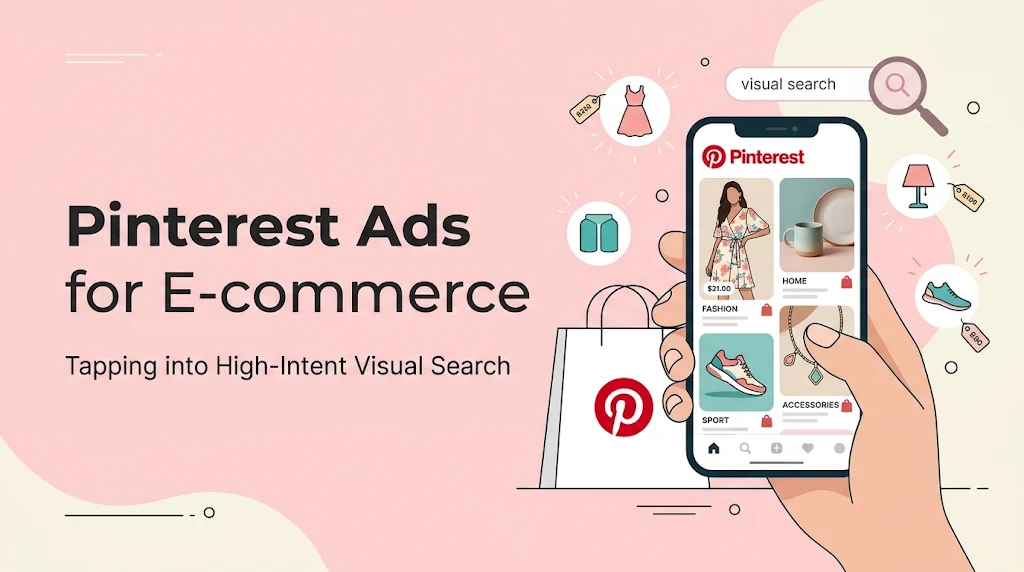
Every day, millions of online shoppers log onto digital platforms to browse products, seek inspiration, and plan their future purchases. However, unlike standard social platforms where users passively scroll past algorithmic feeds or traditional search engines where users actively type exact branded terms, Pinterest occupies a unique intersection of consumer behavior: visual search driven by commercial intent.
For e-commerce brands, Pinterest is not merely a social network; it functions as a visual discovery engine. Users arrive at Pinterest in an exploratory mindset—planning home renovations, curating seasonal wardrobes, designing nurseries, or discovering upcoming lifestyle trends. They are actively searching for products to buy, often before they have even settled on a specific brand.
If your media buying mix relies entirely on rising Meta CPMs or highly competitive Google Search keywords, you are missing one of the highest-margin acquisition channels available today. This guide breaks down how to build, optimize, and scale high-ROI Pinterest ad campaigns tailored specifically for e-commerce brands.
1. Why Pinterest Visual Search Changes E-Commerce PPC
To maximize performance on Pinterest, media buyers must first understand how user psychology on Pinterest differs fundamentally from channels like Instagram, TikTok, or Google Search.
┌─────────────────────────────────────────────────────────────────────────┐
│                        THE E-COMMERCE AD TRINITY                        │
├────────────────────────────────┬────────────────────────────────────────┤
│ Meta (Facebook/Instagram)      │ Interruption Discovery                 │
│ Google Search                  │ Direct Keyword Intent                  │
│ Pinterest                      │ Visual Planning & Pre-Intent Discovery │
└────────────────────────────────┴────────────────────────────────────────┘
The “Planner Mindset”: Early-Funnel Commercial Intent
On Meta platforms, ads interrupt a user’s feed while they are consuming social content from friends and creators. On Google Search, users type exact product queries (e.g., “buy leather cross-body bag black”) once they already know what they want.
Pinterest operates in the high-intent space between these two behaviors:
-
Unbranded Search Dominance: Over 97% of top queries on Pinterest are unbranded. Users search for broad terms like “minimalist living room aesthetic” or “fall wardrobe outfit ideas.”
-
Longer Buying Cycles: Pinners plan purchases weeks or months in advance. Ad engagement translates to high-intent saves, boards, and persistent referral traffic.
-
Visual Contextual Matching: Pinterest’s computer vision algorithms analyze pixel structure, color palettes, and object placement within image pins to recommend complementary products.
Key Takeaway: Pinterest users do not scroll past ads to find content—they view pins as the content. When your visual ad directly answers a user’s aesthetic intent, it feels like a curated recommendation rather than an ad.
2. Technical Setup & Tracking: Building the Conversion Foundation
Before launching visual ad campaigns, establishing precise pixel mapping and catalog integration is critical for accurate attribution and machine-learning optimization.
  ┌───────────────────────┐
  │   Pinterest Tag       │ ---> Tracks On-Site Events (Page Visit, Cart, Checkout)
  └───────────┬───────────┘
              │
  ┌───────────▼───────────┐
  │ Conversions API (CAPI)│ ---> Server-to-Server Event Backup (Bypasses iOS/Ad-Blockers)
  └───────────┬───────────┘
              │
  ┌───────────▼───────────┐
  │ Dynamic Product Feed  │ ---> Enables Catalog Ads & Dynamic Retargeting
  └───────────────────────┘
Step 1: Install the Pinterest Tag & Conversions API (CAPI)
The Pinterest Tag is a snippet of JavaScript installed across your site to track conversion events. To protect your data pipeline against browser privacy updates, ad blockers, and cookie loss, pair the client-side tag with the Pinterest Conversions API (CAPI).
Key events to map:
-
PageVisit: View product pages. -
AddToCart: Add item to shopping basket. -
Checkout: Purchase completion (must pass parameters:value,currency,order_id, andline_items). -
Search: Site-level search query logging.
Step 2: Sync a Dynamic Product Catalog
Connect your store’s primary XML/CSV product feed (Shopify, WooCommerce, Salesforce Commerce Cloud, or custom) directly to the Pinterest Business Manager.
-
Ensure your feed maps core parameters cleanly:
id,title,description,link,image_link,price,availability, andgoogle_product_category. -
Keep item availability updated continuously to prevent ad spend waste on out-of-stock items.
3. High-ROI Campaign Architecture for E-Commerce
A scalable Pinterest Ads structure segregates campaigns by intent tier, audience type, and optimization goal.
                   ┌──────────────────────────────────────┐
                   │    TOP OF FUNNEL (TOF): PROSPECTING  │
                   │   Interests + Keyword Targeting      │
                   └──────────────────┬───────────────────┘
                                      │
                                      ▼
                   ┌──────────────────────────────────────┐
                   │   MIDDLE OF FUNNEL (MOF): ENGAGEMENT │
                   │  Pin Engagers + Actalike Audiences   │
                   └──────────────────┬───────────────────┘
                                      │
                                      ▼
                   ┌──────────────────────────────────────┐
                   │  BOTTOM OF FUNNEL (BOF): CONVERSION  │
                   │ Catalog Retargeting + Site Visitors  │
                   └──────────────────────────────────────┘
Layer 1: Top-of-Funnel (TOF) Prospecting
TOF campaigns drive net-new traffic by tapping into high-volume visual searches and consumer interest groups.
Targeting Options
-
Keyword Targeting: Combine broad terms with exact match modifiers (e.g.,
modern ceramic vase,[boho dining table]). -
Interest Targeting: Target broader contextual verticals (e.g., Home Decor > Mid-Century Modern).
-
Pinterest Actalikes: Build 1%–5% lookalike audiences based on high-value customer seed lists (e.g., top 20% LTV customers or recent buyers).
Pro Tip: Unlike Meta ads, where keyword targeting is limited, Pinterest Keywords operate much like search engine marketing (SEM). Mix 20–30 relevant phrase- and exact-match keywords per ad group to capture intent without over-constraining the delivery algorithm.
Layer 2: Middle-of-Funnel (MOF) Engagement
MOF campaigns recapture users who have interacted with your brand on Pinterest but have not yet converted on your store.
Audience Building
-
Users who saved, clicked, or expanded any pin from your claimed domain over the past 30 to 90 days.
-
Users who watched at least 50% of your video pins.
Layer 3: Bottom-of-Funnel (BOF) Dynamic Retargeting
BOF campaigns drive direct conversion volume by matching dynamic product ads to warm site visitors.
Strategy
-
Dynamic Catalog Retargeting: Automatically serve product carousel pins featuring items users viewed or added to cart within the past 7 to 30 days.
-
Customer List Exclusions: Suppress existing customers from prospecting campaigns to maximize media efficiency.
4. Visual Creative Strategy: Crafting Pins That Convert
Creative assets account for over 50% of campaign performance on Pinterest. Standard social ads designed for Facebook or Instagram stories often perform poorly on Pinterest because they lack the contextual formatting Pinterest users expect.
┌──────────────────────────────────────────────────────────────────────────┐
│                           THE ANATOMY OF A HIGH-ROI PIN                  │
├──────────────────────────────────────────────────────────────────────────┤
│ Aspect Ratio: 2:3 Vertical (1000 x 1500 px)                             │
│ Focal Point: High-contrast product in real-world lifestyle setting      │
│ Text Overlay: Clear, benefit-driven title (Bold typography)              │
│ Branding: Subtle logo placement at top or bottom center                  │
│ CTA: Soft contextual invitation ("Shop the Collection", "Explore Ideas")│
└──────────────────────────────────────────────────────────────────────────┘
High-Performing Ad Formats
-
Standard Vertical Pins (2:3 Aspect Ratio): Use a 1000x1500px format. Square or horizontal images take up less screen real estate and lower click-through rates.
-
Carousel Pins: Feature 2–5 cards showing a product collection, multi-step tutorials, or angles of a flagship item.
-
Idea Ads (Video & Multi-Page): Immersive, mobile-first video formats that showcase product utility, tutorials, or behind-the-scenes brand stories.
-
Collections Ads: A hero visual or video frame displayed above a grid of 4 secondary product catalog items.
Creative Best Practices
-
Show Products in Context: Lifestyle images featuring products in native environments perform significantly better than isolated white-background product shots.
-
Integrate Text Overlays: Include clear, elegant typography on the top half of the image. State the specific value proposition or collection name.
-
Place Logos Intentionally: Keep brand logos visible but tasteful. Avoid placing logos in the bottom-right corner, where platform icon overlays appear.
-
Optimize for Visual Search (Pinterest Lens): Ensure key product features are clean and well-lit. Pinterest’s machine-learning algorithm scans visual element patterns in your pin to match them with visually similar searches across the network.
5. Bidding, Budgeting, and Scaling Frameworks
To maintain profitability while scaling, media buyers must align campaign bidding strategies with campaign maturity and funnel position.
┌─────────────────────────────────────────────────────────────────────────┐
│                      CAMPAIGN SCALING FRAMEWORK                         │
├─────────────────┬───────────────────┬───────────────────────────────────┤
│ Phase           │ Campaign Goal     │ Bidding Model                     │
├─────────────────┼───────────────────┼───────────────────────────────────┤
│ 1. Cold Start   │ Page Visit / Traffic│ Automatic / Max Clicks            │
│ 2. Data Build   │ Add to Cart       │ Custom Bid per Conversion         │
│ 3. Optimization │ Checkout / Purchase│ Automatic Bidding (cCPA / oCPM)   │
│ 4. Scale        │ ROAS Target       │ Target ROAS Bidding               │
└─────────────────┴───────────────────┴───────────────────────────────────┘
Selecting the Right Bid Strategy
-
Automatic Bidding: Allows Pinterest’s algorithm to optimize bids to extract maximum conversion volume within your allocated budget. Best for scaling conversion-focused campaigns once pixel data is established.
-
Custom Bidding: Manually caps the maximum cost-per-action (CPA) or cost-per-click (CPC). Ideal for strict margin requirements during initial testing phases.
-
Target ROAS (Return on Ad Spend): Automatically adjusts bids to hit a specified target ROAS. Requires at least 50 to 100 tracked pixel conversions per week to run effectively.
Scaling Protocols: Vertical & Horizontal Growth
Vertical Scaling
Increase daily campaign budgets by 15% to 20% every 3 to 4 days on top-performing ad groups. Avoid doubling budgets overnight, which can trigger a reset in algorithm learning phases.
Horizontal Scaling
-
Expand target keyword clusters into adjacent search themes.
-
Test secondary Interest categories (e.g., expanding from Outdoor Gear into Trail Camping and Travel Accessories).
-
Introduce fresh visual variations (different colorways, lifestyle contexts, or graphic overlays) to mitigate creative fatigue.
6. Common Pitfalls to Avoid in Pinterest Advertising
Even experienced performance marketers can run into efficiency drops when applying tactics from other channels directly to Pinterest.
❌ Incorrect: Re-purposing 1:1 Instagram Square Images
✅ Correct: Redesigning native 2:3 vertical visuals built for search discovery

❌ Incorrect: Expecting immediate 1-day view-through conversions
✅ Correct: Evaluating performance across a 30-day click / 30-day save window

❌ Incorrect: Using hyper-narrow audience targeting (< 50,000 users)
✅ Correct: Broadening keyword & interest clusters (1M+ reach per ad group)
Pitfall 1: Expecting Ultra-Fast Conversion Windows
Pinterest users spend time curating items into boards before buying. Expecting 100% of conversions on a 1-day attribution window underestimates the channel’s performance. Evaluate campaigns using a 7-day click / 1-day view or 30-day click / 30-day save view to measure real impact accurately.
Pitfall 2: Re-using Repurposed Social Assets Without Modification
Repurposing 1:1 square assets or fast-cut TikTok clips directly to Pinterest often leads to lower engagement. Re-crop and re-format creative into clean, high-resolution 2:3 vertical designs designed for visually scannable feeds.
Pitfall 3: Hyper-Segmenting Audiences Too Early
Restricting an ad group to a single exact keyword with a tiny target audience prevents Pinterest’s bid system from finding inventory efficiently. Aim for ad group audience sizes of 1,000,000+ users during prospecting phases to give the delivery engine enough room to optimize.
7. Frequently Asked Questions (FAQ)
What daily budget is required to test Pinterest Ads for an e-commerce store?
We recommend starting with a minimum testing budget of $50 to $100 per day per campaign. This allows the platform to generate enough impression and click volume to exit initial learning phases within 7 to 14 days.
How do Pinterest Ads compare to Meta Ads in cost per click (CPC) and ROAS?
Pinterest CPMs and CPCs are often 20% to 40% lower than Meta Ads due to lower competitive density in specific product categories. While top-of-funnel conversion timeframes can be longer, long-term return on ad spend (ROAS) is highly competitive due to lasting traffic from user saves and persistent repins.
What e-commerce product niches perform best on Pinterest?
Pinterest performs exceptionally well for visual and lifestyle categories, including Home Decor & Furniture, Apparel & Fashion, Beauty & Skincare, Jewelry, Food & Beverage, Kids & Nursery, and Craft/DIY Products.
Should I prioritize Keyword or Interest targeting for prospecting campaigns?
For direct-response e-commerce goals, start by testing a hybrid ad group that combines both high-intent keywords and relevant broad interest categories. Once baseline data accumulates, split top-performing keywords into dedicated search-intent campaigns for precise bid control.

I’m Md Nasir Uddin, a digital marketing consultant with over 9 years of experience helping businesses grow through strategic and data-driven marketing. As the founder of Macroter, my goal is to provide businesses with innovative solutions that lead to measurable results. Therefore, I’m passionate about staying ahead of industry trends and helping businesses thrive in the digital landscape. Let’s work together to take your marketing efforts to the next level.