
If you have managed Google Ads accounts for any length of time, you have likely hit the scaling wall.
You build a campaign that drives incredible initial Return on Ad Spend (ROAS). The Cost Per Acquisition (CPA) is low, stakeholders are thrilled, and the budget gets approved for a massive increase. However, the moment you attempt to double or triple your daily spend, performance degrades. Quality Scores drop, CPA doubles, and the automated bidding algorithm loses its anchor.
Why does this happen? In nine out of ten cases, the failure isn’t caused by weak ad copy or poor landing pages. It is rooted in your account structure.
Your Google Ads account architecture is the foundation upon which your data collection, automation, and audience targeting rest. An outdated structure forces you into constant manual micro-management while starving Google’s machine-learning algorithms of vital signal volume. Conversely, a modern, highly scalable structure allows AI automation to optimize bids while keeping search intent tightly matched to ad creative.
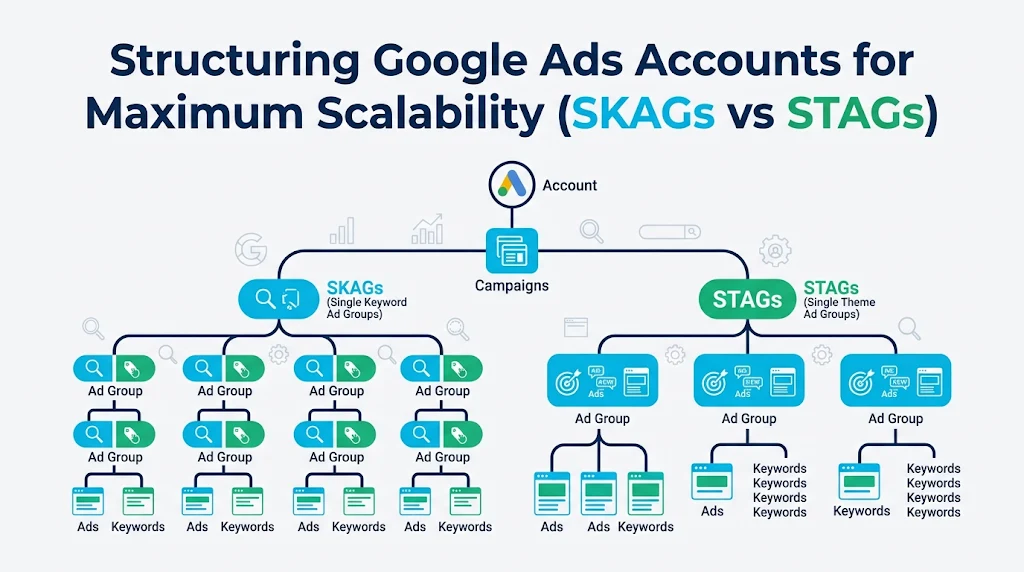
In this guide, we will evaluate the two most influential account structuring frameworks in PPC history: Single Keyword Ad Groups (SKAGs) and Single Theme Ad Groups (STAGs). You will discover why the industry shifted, how Google’s algorithm updates transformed account management, and how to implement a high-ROI structure engineered for maximum scalability.
The Evolution of Google Ads Account Architecture
To understand how to structure your campaigns today, you must first understand how Google’s search mechanics have transformed over the last decade. Account design has always been a response to how Google processes keyword matching and match types.
The Historic Era: Exact Match Superiority and Granular Control
Historically, Google Ads ran on strict Boolean logic. If you targeted the exact match keyword [running shoes], your ad triggered only when a user typed precisely “running shoes.” If the user searched “shoes for running,” your exact match keyword would not trigger unless included separately.
Because control over search queries directly determined relevancy, advertisers built hyper-segmented accounts. The goal was simple: achieve 100% message match between the user’s search query, the ad copy, and the landing page headline.
The Shift: AI, Intent Signals, and Close Variants
Between 2018 and 2024, Google introduced fundamental updates to match types and automated bidding:
-
Expansion of Close Variants: Exact match was expanded to include misspellings, plurals, synonyms, reordered words, and intent-matched variations.
-
Broad Match + Smart Bidding: Broad Match evolved from an unpredictable budget burner into an intent-based targeting engine powered by real-time context (user search history, location, device, and audience signals).
-
Smart Bidding Dominance: Algorithms (Target CPA, Target ROAS, Maximize Conversions) began outperforming manual bidding by evaluating millions of cross-contextual data signals at the exact millisecond of every auction.
These changes reshaped the trade-off between control and automation. Excessive manual control restricts data flow, preventing machine learning from optimizing performance effectively.
+-----------------------------------------------------------------------+
|                       EVOLUTION OF AD CONTROL                        |
|                                                                       |
|  HISTORIC (Pre-2018)                      MODERN (2026+)              |
|  Manual Control & Relevancy               Machine Learning & Scale    |
|  +-----------------------+                +------------------------+  |
|  | Exact Match Logic     |                | Intent Signal Analysis |  |
|  | Granular Ad Groups    |   =======>     | Smart Bidding Engine   |  |
|  | High Data Fragmentation|                | Consolidated Data Pools|  |
|  +-----------------------+                +------------------------+  |
+-----------------------------------------------------------------------+
Single Keyword Ad Groups (SKAGs): The Legacy Model
What is a SKAG?
A Single Keyword Ad Group (SKAG) is an ad group containing exactly one keyword, typically added in three match types (Exact, Phrase, and Broad Match Modifier/Broad).
Campaign: Search - Core Products
 ├── Ad Group: [Blue Running Shoes]
 │    ├── Keyword: [blue running shoes] (Exact)
 │    ├── Keyword: "blue running shoes" (Phrase)
 │    └── Ad Copy: Tailored specifically to "Blue Running Shoes"
 ├── Ad Group: [Red Running Shoes]
 │    ├── Keyword: [red running shoes] (Exact)
 │    └── Ad Copy: Tailored specifically to "Red Running Shoes"
The underlying objective of SKAGs was to lock down a 1:1 ratio between Search Query, Keyword, Ad Copy, and Landing Page.
Advantages of SKAGs
-
Maximum Initial Relevancy: Matching the exact phrase in your headline yields exceptional click-through rates (CTR).
-
Granular Control: You can quickly pause underperforming individual search terms without impacting adjacent keywords.
-
Predictable Quality Scores: High historical CTR directly boosts Quality Scores, reducing your base Cost Per Click (CPC).
Disadvantages and Scaling Bottlenecks
While SKAGs were once the standard for PPC success, changes to Google Ads have exposed serious operational flaws:
-
Severe Data Fragmentation: Splitting traffic across hundreds of ad groups starves Smart Bidding algorithms. An account with 500 conversions split across 200 ad groups yields ~2.5 conversions per ad group per month. Smart Bidding requires 30–50 conversions per ad group monthly to optimize effectively.
-
Close Variant Overlap: Google’s close variants route identical search queries to different SKAGs, causing internal competition and messy reporting.
-
High Operational Overhead: Managing thousands of negative keywords, ad copy variations, and bid adjustments creates massive administrative bloat.
Key Takeaway: SKAGs rely on manual micro-management. They limit modern automated bidding by fragmenting conversion data across isolated ad groups.
Single Theme Ad Groups (STAGs): The Modern Architecture
What is a STAG?
A Single Theme Ad Group (STAG) groups 3 to 7 tightly related keywords that share the same commercial intent and landing page destination into a single ad group.
Instead of isolating keywords based on syntax, STAGs group them by user intent.
Campaign: Search - Athletic Footwear
 ├── Ad Group (STAG): Mens Road Running Shoes
 │    ├── Keyword: [mens running shoes]
 │    ├── Keyword: "mens road running shoes"
 │    ├── Keyword: [best running shoes for men]
 │    ├── Keyword: "marathon shoes men"
 │    └── RSA Ad Assets: Focused on Performance, Cushioning & Durability
Advantages of STAGs
-
Conversion Signal Aggregation: Pooling impressions into themed ad groups supplies Smart Bidding engines with high conversion volumes, shortening algorithmic learning periods.
-
Compatibility with Responsive Search Ads (RSAs): RSAs utilize up to 15 headlines and 4 descriptions. A STAG gives Google’s asset-testing algorithms enough context to match individual headlines to user intent dynamically.
-
Streamlined Account Management: Reducing ad group count by 70–80% simplifies budget allocation, asset group optimization, and creative testing.
Disadvantages of STAGs
-
Lower Initial CTR Potential: If keywords within a theme vary too widely, ad copy relevancy can drop, lowering initial CTR compared to a precise SKAG.
-
Risk of Intent Drift: Poorly planned STAGs risk grouping intent incorrectly (e.g., combining
buy running shoeswithhow to repair running shoes), driving wasted spend.
Pro Tip: When constructing a STAG, ensure every keyword in the ad group logically leads to the exact same headline on your landing page. If a keyword requires a different landing page proposition, it belongs in a separate ad group.
Head-to-Head Comparison: SKAGs vs. STAGs
| Performance Metric | Single Keyword Ad Groups (SKAGs) | Single Theme Ad Groups (STAGs) |
| Primary Driver | Manual Syntax Matching | Algorithmic Intent Matching |
| Bidding Compatibility | Manual CPC / Enhanced CPC | Smart Bidding (Target CPA / Target ROAS) |
| Data Aggregation | Highly Fragmented (Poor AI signal) | Consolidated (Strong AI signal) |
| RSA Efficiency | Low (Limits creative asset combinations) | High (Optimizes asset combinations) |
| Account Maintenance | Complex (Requires extensive negative lists) | Streamlined (Focuses on strategic direction) |
| Scalability Potential | Caps out early due to data limits | Scales cleanly with budget increases |
Step-by-Step Guide: Transitioning from SKAGs to STAGs
If your account is constrained by an outdated SKAG structure, follow this step-by-step framework to consolidate without disturbing account history or dropping conversion volume.
+-----------------------------------------------------------------------------------+
|                           STAG TRANSITION FRAMEWORK                               |
|                                                                                   |
|  [STEP 1]              [STEP 2]              [STEP 3]              [STEP 4]       |
| Audit Search Terms  ===> Group by Intent ===> Build Consolidated ===> Deploy Smart |
| & Group Volume       Clusters               STAG Architecture     Bidding Safely  |
+-----------------------------------------------------------------------------------+
Step 1: Audit Search Term Reports and Conversion Distribution
Export 90 days of search term data. Identify high-performing keywords that drive 80% of your conversions. Isolate long-tail variations that generate low impression volume (under 10 clicks per month).
Step 2: Map Keywords into Intent-Based Clusters
Group your high-performing search terms by intent instead of exact syntax.
Example Mapping:
-
Legacy SKAGs: Ad Group 1:
[crm for small business], Ad Group 2:[small business crm software], Ad Group 3:[affordable crm for small business] -
Unified STAG: Ad Group Name: CRM – Small Business Solutions
-
Keyword 1:
[crm for small business](Exact) -
Keyword 2:
"small business crm software"(Phrase) -
Keyword 3:
crm software small business(Broad + Smart Bidding)
-
Step 3: Configure Responsive Search Ads (RSAs) for Intent Coverage
To maintain the high message match of SKAGs within a STAG, structure your RSA assets strategically:
-
Headlines 1–3: Direct Keyword Matches (e.g., “Top Small Business CRM”).
-
Headlines 4–7: Value Propositions & Benefits (e.g., “Setup in Under 10 Minutes”).
-
Headlines 8–10: Social Proof & Trust Signals (e.g., “Over 50,000+ Active Users”).
-
Headlines 11–15: Calls to Action (e.g., “Start Your 14-Day Free Trial”).
This layout gives Google’s machine-learning algorithm the assets needed to tailor dynamic ad copy to every incoming query within the theme.
Step 4: Launch via Google Ads Experiments
Avoid modifying high-performing campaigns directly. Use Google Ads Experiments to run a 50/50 split test comparing your existing SKAG campaign against the new consolidated STAG campaign over a 30-day period.
Advanced Scalability: Combining STAGs, Broad Match, and Smart Bidding
Once your account is structured into clean STAGs, you can implement the modern enterprise scaling strategy: The Automated Flywheel.
                       +------------------------+
                       |   Unified STAG Structure|
                       +-----------+------------+
                                   |
                                   v
                       +------------------------+
                       | Intent-Based Broad     |
                       | Match Expansion        |
                       +-----------+------------+
                                   |
                                   v
                       +------------------------+
                       | Real-Time Smart Bidding|
                       | (tCPA / tROAS)         |
                       +-----------+------------+
                                   |
                                   v
                       +------------------------+
                       | First-Party Data &     |
                       | Offline Conversion API |
                       +------------------------+
1. Broad Match Integration
In a consolidated STAG, Broad Match acts as a discovery engine for high-intent search queries. Because the ad group collects significant conversion data, Smart Bidding evaluates contextual signals to prevent broad match spend waste.
2. First-Party Data Feeds and Offline Conversion Tracking (OCT)
Smart Bidding relies on quality input data. If you feed Google Ads generic web conversion events (like page views or simple lead forms), the algorithm optimizes for quantity over quality.
Connect your CRM directly to Google Ads via the Offline Conversion API. Import downstream conversion events (such as Qualified Lead, Opportunity Created, or Closed Deal). This conditions the STAG structure to target search terms that generate net revenue, rather than cheap lead volume.
Common Account Structuring Errors
1. The “Mega Ad Group” Fallacy
The Error: Combining loosely related keywords into a single ad group to speed up consolidation (e.g., placing accounting software and payroll services together).The Fix: Maintain strict intent boundaries. If two keywords require different landing page content or distinct value propositions, keep them in separate STAGs.
2. Neglecting Negative Keyword Lists
The Error: Assuming Smart Bidding eliminates the need for negative keywords.The Fix: Use shared negative keyword lists at the account level to block irrelevant search queries, brand cannibalization, and cross-ad-group keyword competition.
3. Premature Scale with Underfunded Budgets
The Error: Creating 20 STAGs with a budget that can only support 2 conversions per day across the entire account.The Fix: Calculate your target CPA. Ensure each ad group receives enough daily budget to secure at least 1–2 conversions per day. If funds are limited, consolidate your strategy into 2 or 3 high-converting core STAGs.
Frequently Asked Questions (FAQ)
Are SKAGs completely obsolete?
For 95% of accounts, yes. SKAGs conflict with Google’s close variants and Smart Bidding models. The only exception is hyper-competitive niche accounts with extremely high CPCs (e.g., commercial litigation), where absolute control over exact match terms and exact ad copy pin-pointing remains necessary.
How many keywords should be in a Single Theme Ad Group (STAG)?
A STAG typically performs best with 3 to 7 keywords. The focus should be on semantic intent rather than count. Every keyword in the group must share the same core intent and send traffic to the exact same landing page.
Will consolidating from SKAGs to STAGs ruin my Quality Score?
Not if your ad assets are configured correctly. Modern Quality Score relies heavily on historical ad relevance and expected CTR. Providing rich Responsive Search Ad assets within a consolidated STAG allows Google to serve high-relevance ad variations, which protects and often improves your Quality Scores over time.

I’m Md Nasir Uddin, a digital marketing consultant with over 9 years of experience helping businesses grow through strategic and data-driven marketing. As the founder of Macroter, my goal is to provide businesses with innovative solutions that lead to measurable results. Therefore, I’m passionate about staying ahead of industry trends and helping businesses thrive in the digital landscape. Let’s work together to take your marketing efforts to the next level.