
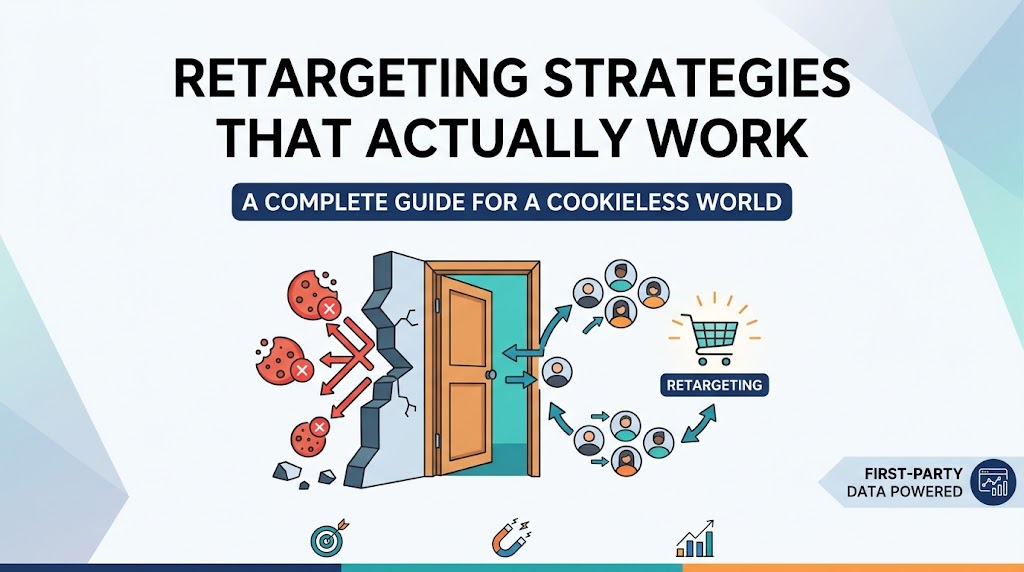
The digital advertising ecosystem has hit a seismic inflection point. For over two decades, digital marketers relied heavily on third-party cookies as the invisible engine powering tracking, attribution, and precise ad retargeting. You could drop a tracking pixel on a user’s browser, follow them across the web, and re-engage them with pinpoint accuracy days or weeks later.
That era is officially over.
With Apple’s App Tracking Transparency (ATT), Safari and Firefox blocking third-party tracking by default, Google’s Privacy Sandbox initiatives, and toughening global privacy legislation (GDPR, CCPA, CPRA), traditional retargeting networks are fracturing. Signal loss has led to shrinking custom audience sizes, skyrocketing Cost Per Acquisition (CPA), and plummeting Return on Ad Spend (ROAS).
However, the death of the third-party cookie does not mean the death of retargeting. It simply demands a shift from passive surveillance marketing to intent-driven, first-party data architecture.
In this comprehensive guide, we unpack the high-ROI cookieless retargeting strategies that media buyers and PPC strategists are using today to capture demand, rebuild lost audience signals, and scale conversions predictably.
The Cookieless Reality: What Changed and Why Old Retargeting Failed
To build a resilient retargeting strategy, you must first understand why legacy methods broke down.
Historically, retargeting operated via third-party client-side tracking:
[ User Visit ] ──> [ Browser Pixel Drops 3rd-Party Cookie ] ──> [ Ad Network Tracks User Across Web ] ──> [ Ad Served ]
When web browsers blocked third-party storage, the connection between the user’s off-site behavior and your ad network collapsed. Ad platforms lost visibility into who visited your product pages, abandoned their carts, or read your content.
The Impact of Signal Loss on PPC Campaigns
-
Dramatically Smaller Retargeting Pools: Retargeting lists built purely on pixel tracking dropped by 40% to 70% in audience volume.
-
Frequency Cap Breakdown: Without cross-site identity resolution, users are either bombarded with the same ad repeatedly or missed entirely.
-
Attribution Blind Spots: Multi-touch attribution models lost key touchpoints, making top-of-funnel (TOFU) media spending look inefficient on paper.
Key Takeaway: Surviving the cookieless transition requires shifting your media buying focus from third-party web tracking to first-party identity resolution and in-platform engagement signals.
1. First-Party Data Capture & Server-Side Tracking Architecture
The cornerstone of modern PPC retargeting is first-party data. Instead of relying on a third-party ad network to identify your visitor, your business must capture user signals directly, own that data, and pass it back to ad platforms securely.
[ User Action on Site ] ──> [ Your Server / CNAME ] ──> [ Server-Side API (CAPI / Conversions API) ] ──> [ Ad Platforms ]
Server-Side Tagging & Conversions APIs
Client-side pixels operate in the user’s browser, making them vulnerable to ad blockers, Intelligent Tracking Prevention (ITP), and network timeouts. Server-side tracking (via Google Tag Manager Server-Side, Meta Conversions API, or LinkedIn Conversions API) routes data from your server directly to the ad platform’s server.
Benefits of Server-Side API Integration:
-
Bypasses Browser Restrictions: Bypasses client-side script blockers and browser-level third-party cookie bans.
-
Data Governance & Privacy: Allows you to clean, hash, and strip sensitive User Personal Data (PII) before transmitting it.
-
Extended Cookie Lifetimes: First-party cookies set via server-side CNAME records survive standard browser expiration limits far longer than client-side cookies.
First-Party Data Match Optimization
When pushing customer data (emails, phone numbers, addresses) to Meta, Google, or LinkedIn custom lists, platform match rates determine campaign scale. Advanced matching uploads hashed PII (SHA-256 algorithm) to connect site visitors directly to their user profiles on social networks.
| First-Party Data Type | Average Match Rate | Primary Retargeting Platform |
| Work Email Address | 65% – 85% | LinkedIn Ads, Google Search/Customer Match |
| Personal Email + Phone Number | 70% – 90% | Meta Ads, TikTok Ads, YouTube Ads |
| Physical Address + Name | 40% – 60% | Programmatic Display, Direct Mail Integration |
| Hashed IP + User-Agent String | 30% – 50% | Household/Account-Based Marketing (ABM) |
Pro Tip: Always capture both mobile phone numbers and email addresses at checkout or lead-capture forms. Dual-parameter matching increases your ad network match rate by up to 35% compared to single-parameter email matching alone.
2. In-Platform Native Engagement Retargeting
If off-site web tracking is degraded, the solution is simple: keep the initial engagement on-platform. Ad platforms retain 100% data fidelity for user actions that happen within their own apps or ecosystems.
[ Native Video / Lead Form / Instant Experience ] ──> [ 100% In-Platform Data Capture ] ──> [ Retargeting Pool Created ]
By leveraging native ad formats, you construct rich retargeting pools that don’t rely on website cookies at all.
Strategies for High-ROI Native Engagement Retargeting
A. Video View Duration Sequencing
Instead of driving cold traffic straight to your website, run high-value short-form or long-form video ads natively on Meta, YouTube, or LinkedIn.
-
Segment 1: Retarget users who watched at least 50% or 75% of your top-of-funnel video. These users have demonstrated explicit intent.
-
Segment 2: Deliver a middle-of-funnel (MOFU) offer (e.g., case study, product demonstration, comparison framework) specifically to that high-view-duration cohort.
B. Lead Generation Forms & Instant Experiences
Platform-native lead forms (Meta Instant Forms, LinkedIn Lead Gen Forms) auto-fill user profile details, dramatically increasing conversion rates while retaining complete tracking accuracy.
-
Retargeting Sub-audience 1: Users who opened the native lead form but did not submit (High-intent abandoners).
-
Retargeting Sub-audience 2: Users who submitted the form (Exclude from TOFU/MOFU, push to BOFU bottom-of-funnel upsell campaigns).
Example Scenario: SaaS B2B Campaign
The Strategy: A B2B enterprise software brand stopped relying on site-visitor pixels. Instead, they ran a 90-second native video ad on LinkedIn highlighting a major industry problem.
The Execution: They created an audience segment of users who watched >75% of the video and retargeted them with a LinkedIn Lead Gen Form offering an ungated industry benchmark report.
The Result: Lead quality increased by 42%, while CPA dropped by 31% compared to traditional landing page pixel-retargeting campaigns.
3. Contextual Retargeting & Publisher Direct Partnerships
Contextual advertising has evolved from simple keyword matching into sophisticated AI-driven thematic targeting. In a cookieless environment, context acts as a proxy for intent.
[ User Reads Article on "Cloud Security Compliance" ] ──> [ Immediate Contextual Ad Inserted ] ──> [ High Relevance Conversion ]
Advanced Contextual Strategies
1. Page-Level Semantic Analysis
Modern contextual engines analyze full-page semantics, sentiment, content structure, and user engagement metrics in real time—not just surface keywords. Placing ads on content hyper-relevant to your offer captures users precisely when their mindset is aligned with your solution.
2. Private Marketplace (PMP) & Publisher Direct Deals
Bypass traditional programmatic middle-men by executing Direct Deals or Private Marketplace auctions with specific niche publishers.
-
Publisher First-Party Data: Leading media publishers collect robust logged-in user data. Through PMP deals, advertisers leverage the publisher’s first-party ID graph to target niche audiences safely within their media properties.
-
Curated Marketplaces: Group publishers by industry vertical (e.g., FinTech, Healthcare, E-commerce Logistics) to build contextual scale.
4. Universal ID Frameworks & Clean Room Collaboration
The ad tech industry responded to signal loss by building open-source and proprietary Universal Identity Frameworks. These frameworks unify fragmented consumer identity across channels without relying on third-party tracking.
[ Brand First-Party Data ] ──\
                             ├──> [ Data Clean Room / Universal ID Graph ] ──> [ Precise Audience Match ]
[ Publisher First-Party Data ] ──/
Key Identity Resolution Standards
Unified ID 2.0 (UID2)
Pioneered by The Trade Desk and open-sourced to the ecosystem, UID2 turns encrypted, hashed email addresses into privacy-conscious identifiers for programmatic bidding across Connected TV (CTV), web, and mobile apps.
LiveRamp RampID
Connects online and offline data points into a deterministic identity graph, allowing brands to execute cross-channel retargeting within privacy compliance guardrails.
Leveraging Data Clean Rooms (DCRs)
Data Clean Rooms (such as Snowflake, InfoSum, Amazon Marketing Cloud, or Google Ads Data Hub) allow two parties (e.g., a brand advertiser and a media publisher or retailer) to overlap their first-party datasets securely.
-
How It Works: Neither party exposes raw customer PII to the other. The clean room matches the encrypted datasets, allowing the advertiser to build lookalike or retargeting cohorts based on verified multi-touch overlaps.
-
Retail Media Networks (RMNs): Brands leverage Data Clean Rooms to match their ad exposure with retailer point-of-sale data (e.g., Walmart Connect, Instacart Ads), enabling closed-loop retargeting and attribution.
5. Intent-Based Zero-Party Data Funnels
While first-party data is data collected from user interactions on your property (pageviews, purchases), zero-party data is data a customer intentionally and proactively shares with you.
[ Interactive Quiz / Assessment ] ──> [ User Shares Pain Points & Budget ] ──> [ Dynamic Personalization & Custom Retargeting ]
Zero-party data provides the highest signal-to-noise ratio in modern digital marketing. When users explicitly tell you their preferences, pain points, budget, and timeline, you don’t need to guess their purchase intent using third-party tracking cookies.
Mechanics of a High-Converting Zero-Party Data Engine
-
Interactive Micro-Experiences: Deploy quizzes, product recommendation engines, interactive calculators, or diagnostic assessments on your primary landing pages.
-
Data Categorization: Tag users dynamically based on their responses (e.g.,
Budget: Enterprise,Primary Pain Point: Data Security,Timeline: Immediate). -
Custom Audience Sync: Automatically sync these zero-party audience tags directly to your ad platforms via API integration (Zapier, Make, or custom webhooks).
-
Hyper-Personalized Dynamic Retargeting: Serve specific ad creatives addressing the exact selection the user made in the quiz.
+-----------------------------------------------------------------------------------+
|                            ZERO-PARTY DATA RETARGETING ARCHITECTURE              |
+-----------------------------------------------------------------------------------+
|  Step 1: Visitor takes "Cloud Security Assessment Quiz"                            |
|  Step 2: Visitor selects option "AWS Compliance Failure Concerns"                  |
|  Step 3: User CRM Tag: [Segment_AWS_Compliance]                                    |
|  Step 4: API Sync to Meta/Google Custom Customer Match Audiences                  |
|  Step 5: User sees Ad Creative: "How to Fix AWS Compliance Issues in 30 Days"      |
+-----------------------------------------------------------------------------------+
6. Full-Funnel Cookieless Retargeting Framework
To implement these strategies effectively, media buyers need a systematic execution framework. Below is an end-to-end blueprint for structuring your retargeting funnel without relying on third-party cookies.
           [ Top-of-Funnel (TOFU) ]
     Native Video Ads & Contextual Search
                   │
                   ▼
         [ Middle-of-Funnel (MOFU) ]
  Zero-Party Quizzes & Server-Side Tracked Visits
                   │
                   ▼
        [ Bottom-of-Funnel (BOFU) ]
First-Party Match Lists & High-Intent Conversion Ads
The 3-Tiered Cookieless Funnel Architecture
Tier 1: Top of Funnel (TOFU) – Intent Signal Capture
-
Channels: Google Search, YouTube Ads, Meta Native Video, Contextual Programmatic.
-
Objective: Drive initial broad engagement and capture native platform signals.
-
Tactics:
-
Target broad, high-intent keywords on Search.
-
Launch native videos designed to filter out non-prospects.
-
Gate high-value resources using native Lead Gen Forms.
-
Tier 2: Middle of Funnel (MOFU) – Zero/First-Party Data Enrichment
-
Channels: Meta Custom Audiences (Video Watcher cohorts), LinkedIn Matched Audiences, Email/SMS Nurture.
-
Objective: Convert anonymous platform engagement into explicit first-party contacts.
-
Tactics:
-
Retarget >50% video viewers with interactive quizzes or diagnostic tools.
-
Serve ads leading to server-side tracked landing pages optimized for micro-conversions (e.g., webinar registration, template download).
-
Tier 3: Bottom of Funnel (BOFU) – High-Conversion Personalization
-
Channels: Google Customer Match, Meta First-Party Custom Audiences, Retargeting via Universal IDs (UID2), Direct Mail Sync.
-
Objective: Close pipeline revenue and drive immediate ROI.
-
Tactics:
-
Segment first-party lead databases by user actions, deal stage, or zero-party data tags.
-
Push server-side offline conversion events back to Google and Meta to train bidding algorithms on high-value customers.
-
Deploy direct testimonial ads, ROI calculators, and limited-time offer messaging.
-
Common Pitfalls & Mistakes to Avoid
Even seasoned performance marketers make costly errors when shifting away from third-party tracking. Avoid these common mistakes:
1. Expecting 1:1 Match Rates on Uploaded First-Party Lists
-
The Error: Uploading a 10,000-contact email list and expecting a retargeting audience of 10,000 users.
-
The Fix: Realize that match rates average 50%–70% across major platforms. Build larger top-of-funnel capture mechanisms to offset identity match decay.
2. Failing to Hash PII Data Properly Before API Transmission
-
The Error: Sending unformatted or unhashed user data via custom API scripts, resulting in dropped payloads or privacy compliance breaches.
-
The Fix: Ensure all customer parameters (email, phone, name) are normalized (lowercased, stripped of whitespaces) and encrypted using SHA-256 algorithm standards before sending to platform endpoints.
3. Over-Relying on Client-Side GTM Scripts
-
The Error: Continuing to rely entirely on web-browser tracking scripts while wondering why audience sizes are shrinking month over month.
-
The Fix: Transition to a hybrid or pure server-side tracking infrastructure using Google Tag Manager Server-Side paired with platform Conversions APIs.
4. Ignoring Frequency Capping Across Platforms
-
The Error: Setting retargeting ads to blast users across social channels without account-level frequency controls, leading to ad fatigue and brand erosion.
-
The Fix: Implement cross-channel frequency management caps and refresh ad creative assets every 14–21 days.
Frequently Asked Questions (FAQ)
What is cookieless retargeting?
Cookieless retargeting refers to advertising tactics used to re-engage past site visitors or interested prospects without using third-party tracking cookies. Instead, it relies on first-party data (CRM uploads, server-side tracking), native platform engagement signals (video views, lead forms), universal ID networks, and contextual relevance.
Is retargeting dead without third-party cookies?
No, retargeting is not dead, but traditional client-side pixel retargeting is severely degraded. Marketers who adapt by using server-side Conversions APIs, first-party customer match lists, and in-platform engagement audiences continue to generate high return on ad spend (ROAS).
What is the difference between first-party data and zero-party data?
First-party data is information collected automatically about user behavior on your own channels (e.g., page views, transaction history, click rates). Zero-party data is information a customer intentionally and explicitly shares with you (e.g., survey responses, preference center selections, product recommendation quiz answers).
How do Server-Side Conversions APIs improve retargeting?
Conversions APIs transmit conversion data directly from your website’s server to the ad platform’s server, bypassing browser-level ad blockers, privacy extensions, and Intelligent Tracking Protection (ITP). This restores lost tracking signals, increases audience match accuracy, and improves ad attribution.
Conclusion & Next Steps
The deprecation of third-party cookies is not an obstacle—it is a competitive moat for brands willing to modernize their growth stack. Marketers who continue clinging to legacy client-side pixel strategies will face rising acquisition costs and diminishing audience reach. Conversely, those who build robust first-party identity ecosystems will capture market share at a significantly lower cost.

I’m Md Nasir Uddin, a digital marketing consultant with over 9 years of experience helping businesses grow through strategic and data-driven marketing. As the founder of Macroter, my goal is to provide businesses with innovative solutions that lead to measurable results. Therefore, I’m passionate about staying ahead of industry trends and helping businesses thrive in the digital landscape. Let’s work together to take your marketing efforts to the next level.